


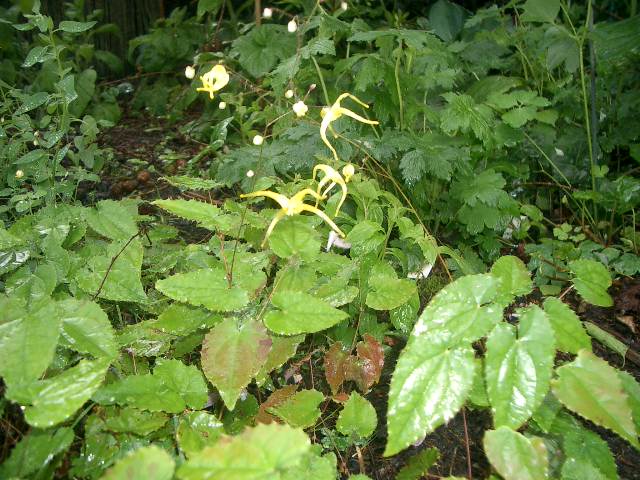
For the last ten years or so I have been increasingly in love with this genus of beautiful flowering plants. They are so adaptable, some more than others, to what are best described as “difficult” conditions some members of the genus have actually seemed to thrive for me rather than just tolerate dry shade which is one of the most difficult areas to cater for. There are both evergreen and deciduous species many with colourful leaves particularly when just emerging in the early spring and sometimes again in the autumn. Many variations are now available sporting different flower combinations giving a wide range of “mini-orchids” to choose from.

Deciduous cultivar Queen Esta prefers a moisture retentive soil although I have grown it within a few feet of the base of a birch tree as shown in the picture without any trouble however during very dry spells the area received some watering.

Much as I like the flowers of Epimedium x rubrum I have never grown a robust specimen and I normally don’t have a problem with epimediums, in fact the new plant I have now is not doing well compared with its companions. This plant is evergreen in that the leaves last the winter and although preferring moist soils should withstand drier conditions.


Epimedium x warleyense from the legendary Miss Willmott’s garden was the result of a cross between two western species, the cultivar ‘Orangekonigin’ is a fairly recent introduction. Seems to thrive in either moist or dryish soils. Unfortunately the new foliage pictured had been visited by Mr. Slug!
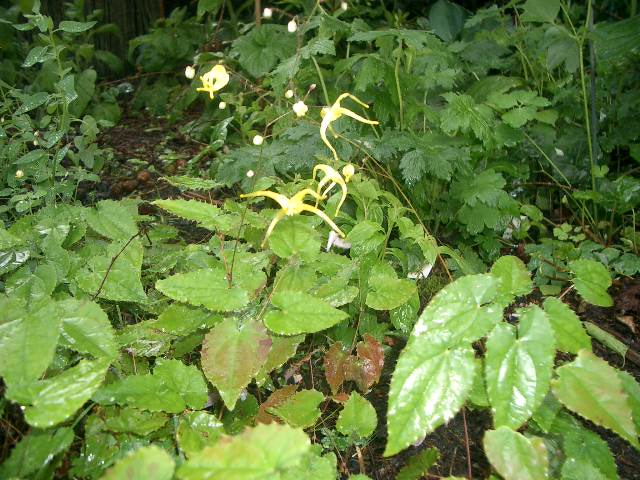
I am not sure if this actually is E.davidii but the combination of the yellow spider-like flowers and the glossy toothed leaves makes for a really useful plant. I had this in my mind as E.rossii but it could have been a case of word association as I knew someone called David Ross, who knows? E.davidii is from China and therefore prefers moist conditions although, again, the plant pictured, which thrived, was growing in fairly dry shade.

E. grandiflorum ‘Lilafee’ is a cultivar from the same stable as ‘Orangekonigin’. The lilac coloured flowers are suspended over glossy leaves with toothed edges, seems to grow best in moist conditions.
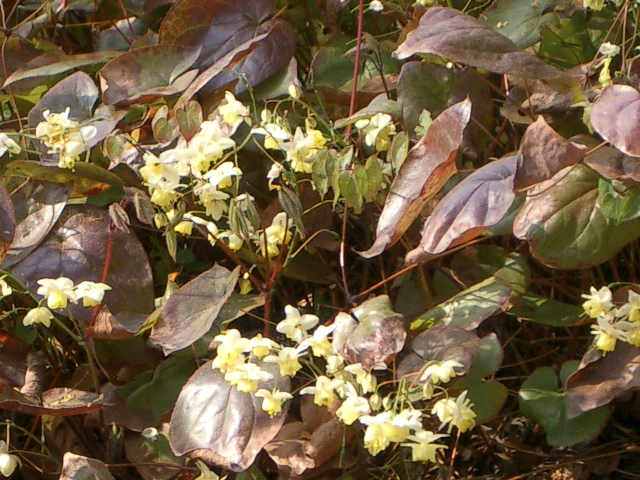
Delicate flower spikes over copper foliage which tends to green up during the summer only to revert to copper again as winter approaches. Although evergreen the foliage does tend to look rather tatty by the spring.

Neat little plant growing to about 8″, delicate pure white flowers hang off wiry stems which are reddish in colour. prefers a moist spot to thrive. The new leaves can give some good colour.
It is a matter of preference when or if one decides to remove the old foliage, personally I prefer to leave it on until the spring and then remove it just as the new foliage and flower stems are appearing being careful not to cause any damage to the new growth. This allows a good view of the flowers and the colours of the new leaves, leaving the foliage intact can detract from the display in some types which carry their flowers closer to the base of the plant.
 A Plantsman's World