The weather is holding steady, temperatures as high as 30°C, although 20-25°C is more the norm. The few showers we have experienced have barely dampened the ground. Typically for this time of the year colour is sparse, so the lilies are welcome. Although they do not hold their blooms well in the heat. One thing I have noticed is the lack of butterflies. We were inundated with them earlier, particularly with the Peacocks. Although the eupatorium, now Eutrochium purpureum, is in flower, a tremendous bee and butterfly magnate, there are hardly any to be seen. This is the exact opposite of what happened last year so I am putting it down to the warm spring. For anyone who is interested I have taken the liberty to include a few links to some of my previous posts devoted to lilies that I have grown, with many more pictures.
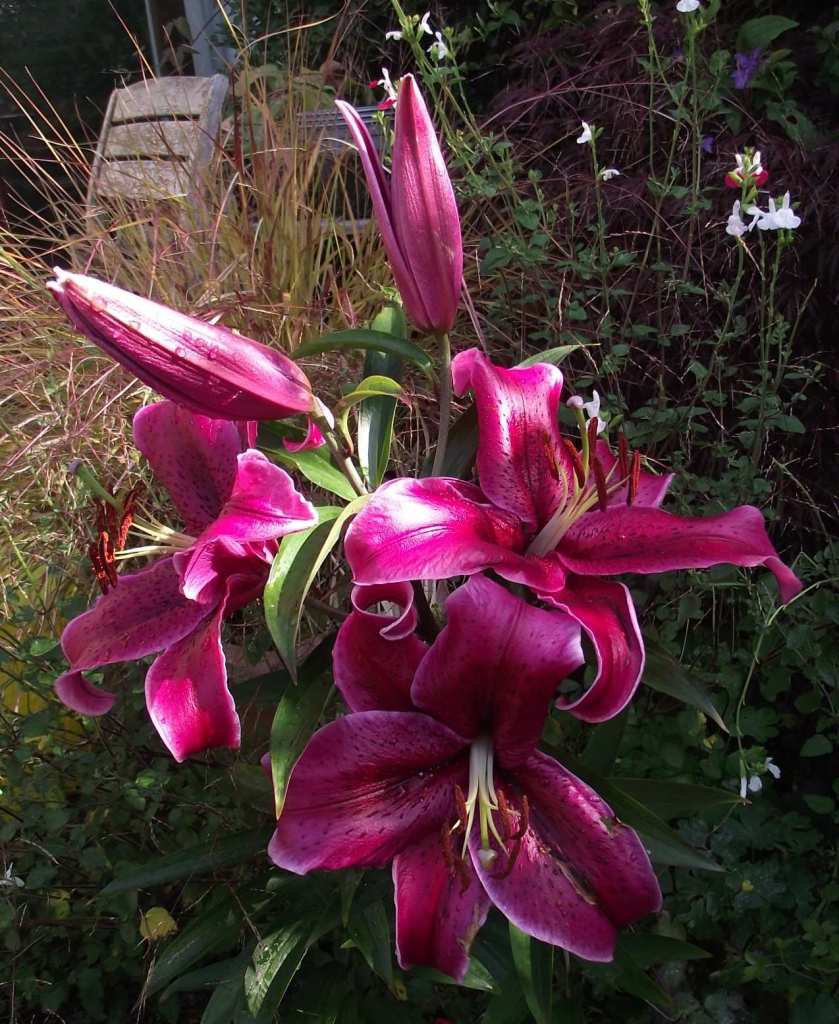
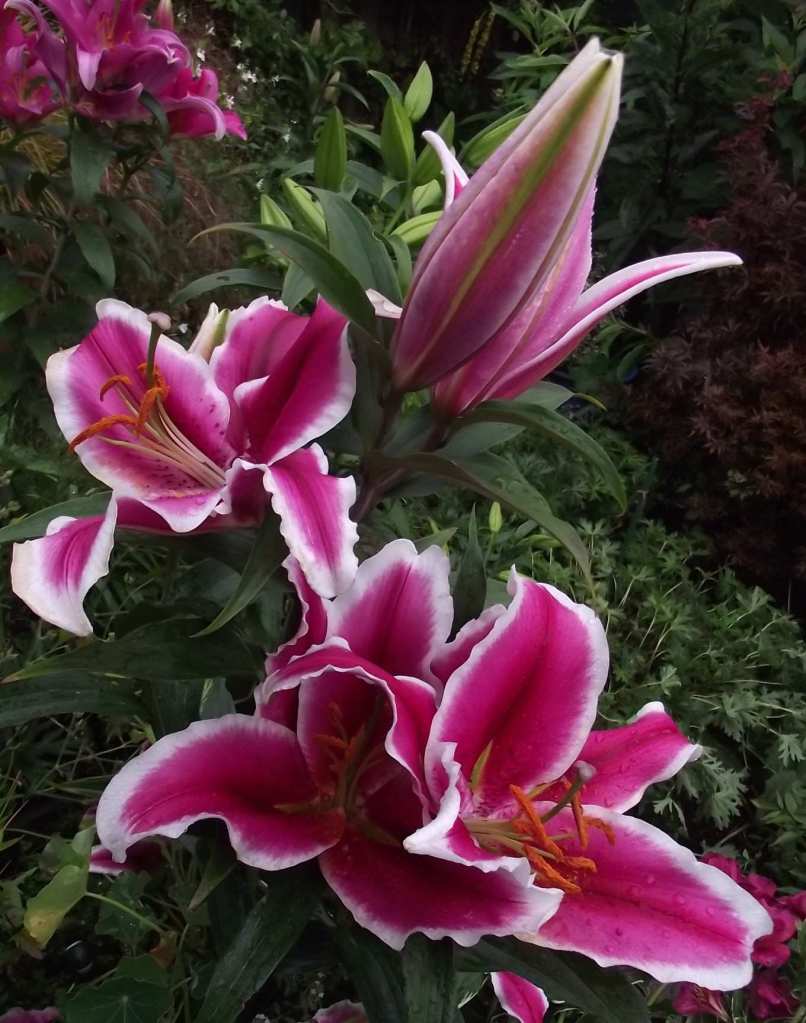
The ever popular Lilium ‘Stargazer’. This is one of the first lilies that I ever grew and remains a favourite even now. I took this picture a couple of days ago but it is already looking worse for ware in the heat. Another Oriental, Lilium ‘Hachi’, which I featured a couple of weeks ago, is very similar with its upturned blooms but the flowers are notably much larger than those of ‘Stargazer’. Here is a link to Lilies Part 1 – Updated for more lily pictures.
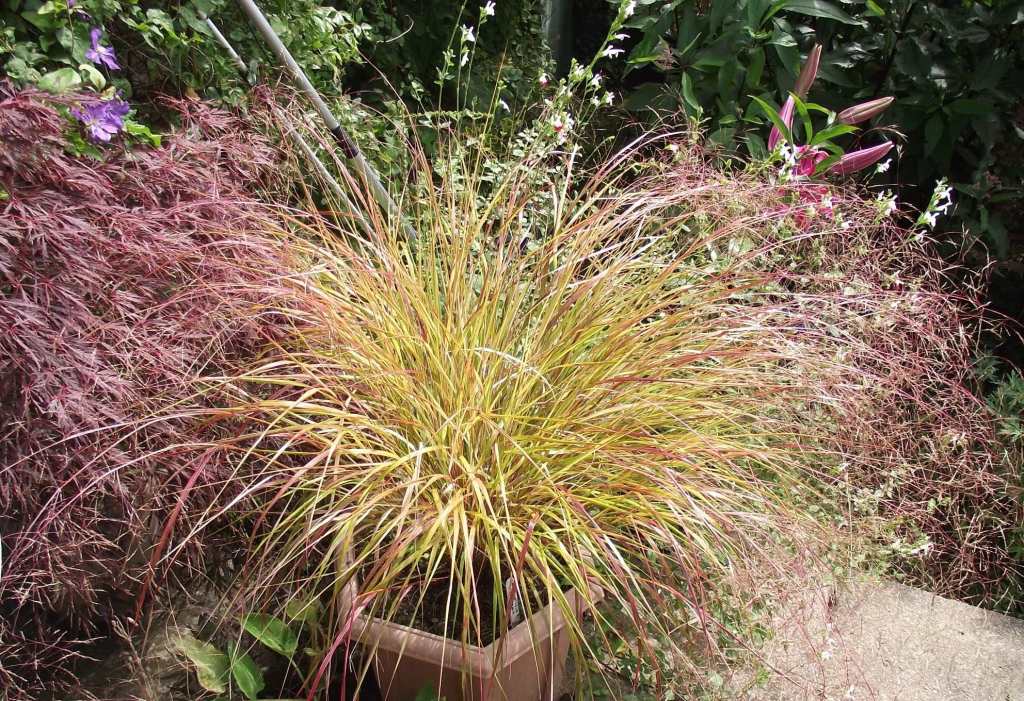
I have shown Anemanthele lessoniana, pheasant tail grass, before but is now at its best. The leaves are taking on some red splashes which are complemented by the airy inflorescences floating in the breeze. I’ll be quoting poetry next!
I have never grown Lilium ‘Red Flash’ before and I am rather enamoured with the strong colour. Unfortunately the bottom bloom is past its best. For even more pictures of lilies that I have grown Lilies Part2 -Updated
A good old standby for late summer/autumn colour Rudbekia fulgida ‘Goldsturm’. I don’t think you can beat these simple “cone-flowers” to add a splash of colour, at this time of the year. I did have some echinaceas but they have decided not to come out to play this year. The splash of blue in the lower right-hand corner is Geranium ‘Johnson’s Blue’ which, in my small garden, is becoming far too invasive. I intend to remove it altogether shortly. Even though I reduced it by half last winter. It is taking up far too much space for one plant, and I have plenty of stuff stuck in pots which can take its place.
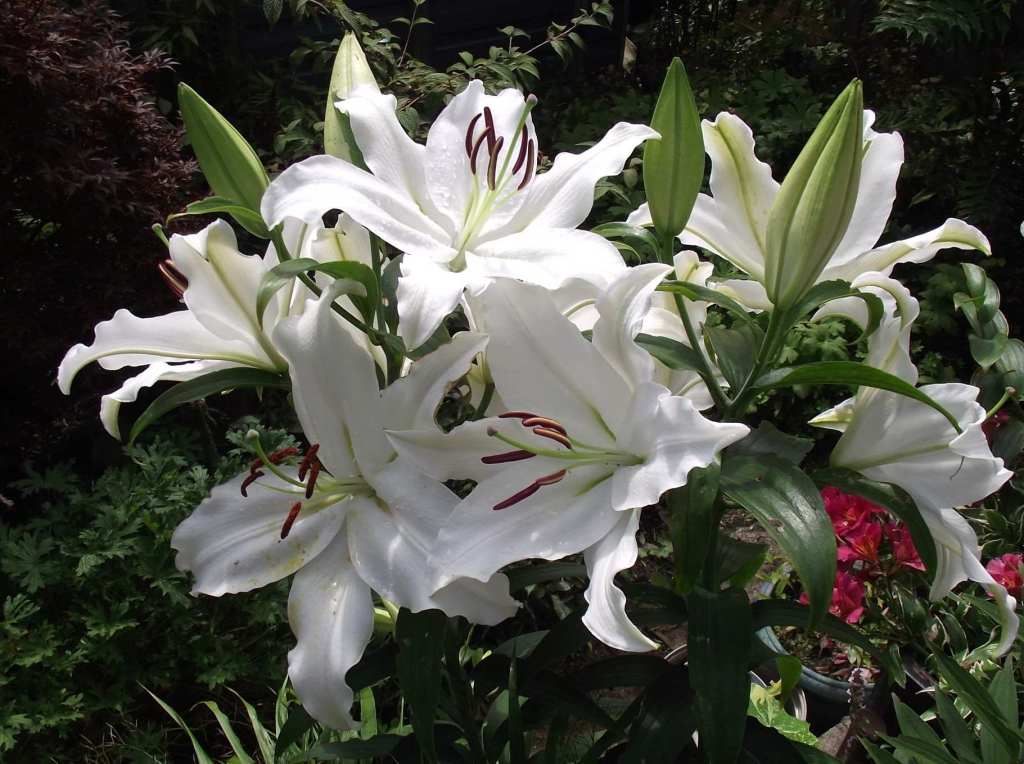
Another strongly scented Oriental. Lilium ‘Casa Blanca’ is another old favourite of mine. I have to admit that I had forgotten it was there until I checked the label before it came into bloom. It is a true pure white and all the better for it. I am in a bit of a quandary at the moment. I have no room to plant the lilies out, so do I keep the pots overwinter and chance that they will come good again next year, which they should do. Or do I buy in some more to guarantee a good show next year. I will probably do both! Here is some more about lilies including Cardiocrinum giganteum. Lilies Part 3-Updated
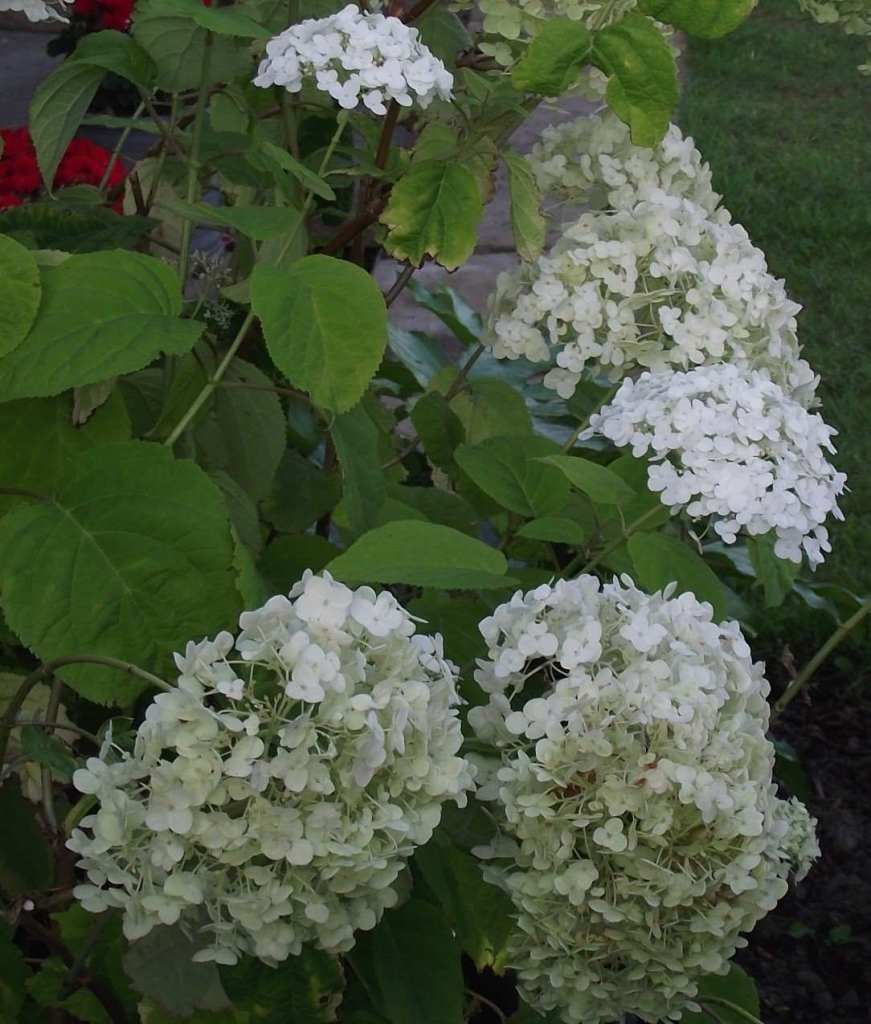
I bought this hydrangea from Thompson and Morgan at least eight years ago when they were selling it as Hydrangea ‘Incrediball’. I think it is now better known as, and is certainly synonymous with, Hydrangea arborescens ‘Strong Annabelle’. My plant is still in a container, and although the blooms aren’t the size that they should be, it still puts on a fairly good display every year. I intended to cut it back hard last winter but forgot. I need to remedy that this year, and put it on a high potash diet to see if I can improve it. Re-potting would be ideal but it is in a very large container so I will continue to nurture it where it is for as long as I can.
This meme is hosted by Jim Stevens who is to be found with all the details and links to plenty of other blogs to enjoy at Garden Ruminations.
When I first started this blog, having removed any that had gone before, it was mainly as a brain exercise, plus, not a little, nostalgia. I came across the Six on Saturday meme run by Jim Stephens at Garden Ruminations and, through that, organically increased my presence on the web. This has prompted me to re-publish some of my old material some of which is updated. These posts are purely about the plants that I have grown and photographed, mainly in my previous garden, unless otherwise stated.
Whether it be in the herbaceous border or more natural settings such as the woodland garden or informal rockery, hardy perennials are the backbone of the majority of gardens. They provide colour from early spring through to late autumn, and even into winter when the dead stems can add form and colour. Unless you intend to grow from seed find a good independent nurserymen. Although a dying breed, they are the people who have a passion for plants and are usually all too willing to give advice gained from their experience. Garden centres are another option but they tend to be impersonal and usually quite a bit more expensive. Online buying can be a bit of a lottery, pay attention to the pot size so you know what to expect. I actually planted out my new front garden with plugs bought online and had a good display the following year. It is important to remember that the above applies to the “standard” range of hardy perennials, when it comes to something more out of the ordinary specialist nurseries are the best option.
My preferred method is growing from seed, although I normally use society seed because I know it’s fresh, for the less invested gardener it is better to use one of the smaller seedsmen such as Plant World Seeds. The method I have always followed with hardy plants is to sow under cold glass, or in my case a poly-tunnel, usually in February to allow the seeds to germinate as they would do naturally. It would be just as good to sow outside except you haven’t the same control. Sowing from seed works well with anything which comes true from seed but in the case of most cultivars (hybrids) you need to buy in plugs or plants, many of which have been raised by micropropagation.
Achillea
From a traditional border plant achilleas (Yarrows) have been developed into a must have plant for the gardener. As with several genera, it has been recognised by the industry as a very desirable plant. Many cultivars, in a wide range of colours, have been produced. It will grow in most soils, is hardy, and attracts insects to its flat flower heads. I can say from experience that it is not fond of damp and shade, preferring an open sunny aspect, and is often used in prairie planting. Fashionable.
Aconitum
Aconitum napellus
Monkshood or wolfsbane is an easy hardy herbaceous perennial of medium height with delphinium-like flowers that prefers a rich moist soil to do well. Personally I think it does best in dappled shade rather than full sun. Easily propagated from seed. It is highly toxic to everything other than birds.
Two totally different plants, Actaea rubra the red baneberry is an American native found in open woodland and therefore thrives in damp shady conditions. It actually forms rhizomes so should really have been included in an earlier post. The berries are toxic.
Actaea simplex (Atropurpurea Group) is an Asiatic baneberry which prefers moist soil and shade, although I have found it to be quite adaptable, thriving for me in an herbaceous border. The dark feathery leaves make a perfect foil for the delicate white scented flower spikes which insects find attractive. Also known as Cimicifuga simplex.
Known as the anise hyssop or giant hyssop, agastaches make a nice plant for a sunny spot. Aniseed scented leaves, and with flowers that attract insects, it is a useful addition to any garden. Generally grown from seed, sometimes as a annual as it will flower in its first year, it will not thrive in a wet soil. Some of the woodier species are not entirely frost hardy.
Althaea
Althaea officinalis
Althea officinalis or the Marsh Mallow Herb is a vigorous herbaceous perennial, which, to be honest, I tend to think of as more of a shrub. Definitely one for a sunny spot it does well in almost any soil, and at one time was very popular but, doesn’t seem to be so much now. The plant has been used in herbal medicine for years, and has several remedial properties attributed to it.
Androsace
Androsace carnea x pyrenaica
Alpines were really my first love, and I built a rock garden and peat bed in the garden of my first house. I was lucky enough to have a small specialist nursery nearby, who bought in from another specialist on a regular basis. This gave me an ever-changing supply of plants on my doorstep. The androsace genus is a member of the primula family and contains almost as many species. They are mainly high alpines originating in the Himalayas. The majority form small cushions studded with disproportionately large flowers, which make stunning specimens for the alpine house and tufa wall. They are not easy to grow but the end result is a reward in itself. I grew a couple of the ‘easy’ species but unfortunately when I was growing alpines it never crossed my mind to take pictures, I really wish I had now. The plant pictured above, who’s name is bigger than it is, was grown from seed and managed a solitary flower in its second year.
Anemones, commonly known as wind flowers, are related to the buttercup. The genus contains something like 120 species some of which are fibrous rooted, others grow from rhizomes or tubers. They are found almost worldwide and range in habitat from mountain scree to woodland. Because of their diverse habitats their cultivation varies equally. It ranges from the alpine house bench to the positively invasive such as Anemone tomentosa. For further information go to my earlier post.
This beautiful plant is a cultivar of the single species in the genus Anemonella. A native of North America, where it found in woodland, and is known as the rue-anemone. This tuberous-rooted beauty would usually obtained from a specialist nursery but the specie plant can be grown from seed. Best grown in moist soil in dappled shade as you would expect from a plant found in woodland.
This beautiful Japanese plant requires a moist lime-free soil in light shade to thrive. Best propagated from fresh seed. Obtainable from specialist nurseries and society seed lists.
Wide spread in Northern Europe, particularly Scandinavia, angelica has tall hollow fluted stems and large flat flower-heads reminiscent of cow parsley. Its edible stems and roots have many culinary uses (candied angelica), flavouring spirits and more. Easy to grow, it is a biennial and sets copious amounts of seed. It self seeds everywhere, which can produce some interesting results. The self-seeded plant above has the dark foliage and the lesser stature of Angelic ‘Ebony’ but has crossed with the specie plant and has contrasting white flowers rather than the dusky pink of ‘Ebony’. It makes a good ‘spot plant’ in the border because of its height.
Aquilegia
Aquilegia alpinaAquilegia chrysanthaAquilegia jonesiiAquilegia fragransAquilegia Pink BonnetsAquilegia x hybrida Songbird F1 BluebirdAquilegia yabeanaAquilegia formosaAquilegia ‘William Guinness’Aquilegia ‘Balllerina’ type.
A traditional cottage garden plant having some 60-70 species occurring in diverse habitats in the Northern Hemisphere. The traditional easy to grow garden varieties known as Columbine or Granny’s Bonnets maintain the spurred flower shape but vary greatly in colour and height. Most aquilegias seen in gardens today are the result of much interbreeding and self-seeding through generations. The earliest introduction of a strain that I remember were the McKana Hybrids which are still available today. I later saw the introduction of such as the Songbird Series of F1 Hybrids which although smaller in stature carry large flowers. They grow best in a damp gritty loam although it isn’t uncommon for them to seed into seemingly inhospitable spots but still live happily. There are a number of species from the mountains which need to be grown in the rockery or alpine house. One species illustrated above worthy of special mention is Aquilegia fragrans, not only does it make a superb specimen but, as its name suggests, is scented.
Astilbe (Spirea)
Ideal plants for a damp spot, astilbes, or as they are sometimes known, spireas, are another plant that seems to have been around in gardens forever. Once established they are easy to divide and share. The common name spirea is confusing because Spiraea is a genus of small shrubs. Astilbes come in all sorts of colours and heights and there are many named varieties. Basically they are a good solid garden plant.
Astrantia
Astrantia major ‘Claret’Astrantia major
Astrantias are another border stalwart, many varieties have been introduced in a variety of purple and pink shades developed from the specie plant. Astrantia major ‘Claret’ is the deepest red I know. They prefer a medium loam and do not tolerate wet soils readily
The weather has been very unsettled but rainfall has been sparse. Daytime temperatures remain at 17-20°C. Yet again the worst of the weather has bypassed us in High Peak. I think the valley I live in has its own macroclimate. It can be very annoying to keep getting messages on my phone informing me rain is expected to stop whilst the garden remains bone dry. This Saturday, unusually, there are some pictures of my back garden, warts and all. The garden is very small, the wall you can see is the gable end of the bungalow to the rear of me. This was an old railway yard and considering the initial planting was done with a pick and trenching tool it isn’t turning out too badly. My previous garden was large so this one has proved to be quite a challenge. I did however, have a vision of what I wanted, which was basically cram it full of plants. I am slowly getting there. Currently there is hardly room to move!
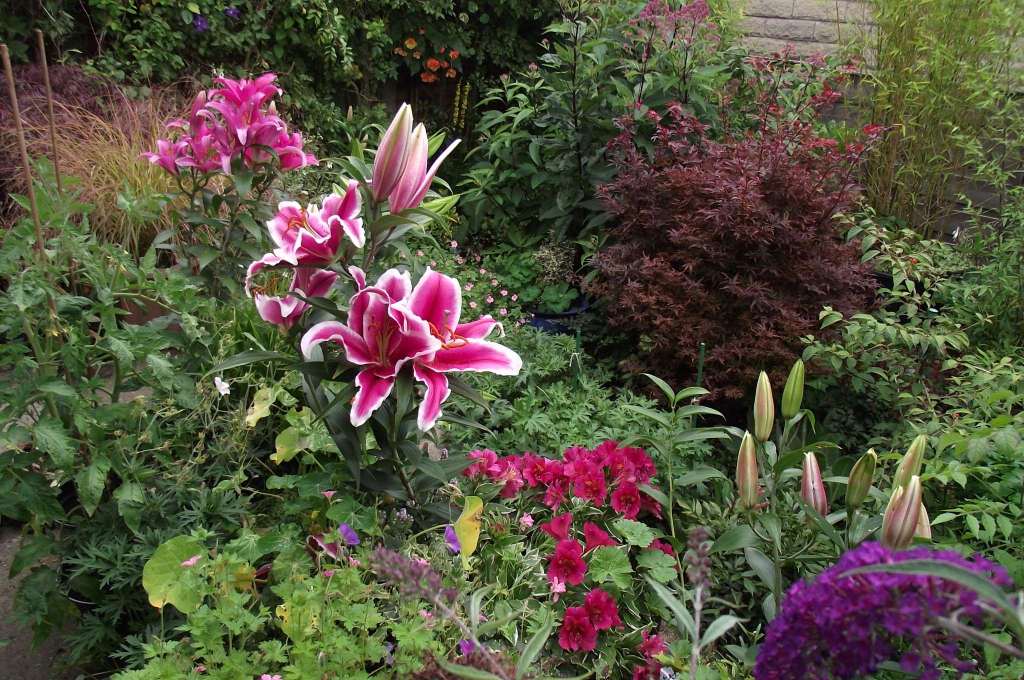
The plants in the foreground, other than the buddleia, are in containers sitting on a six foot wide flagged patio which drops down a couple of feet to the garden below. The oriental lilies are starting to make their display now that the hardy geraniums are mostly leaf. Geranium x oxonianum ‘Wargrave Pink’ is still flowering in the “garden” area along with a few yellow verbascums and some Begonia Illumination Apricot Shades in a basket, hanging under the foliage of Rosa ‘Rambling Rector‘, a rampant honeysuckle, and a purple clematis. The Joe Pye Weed, which I think is now Eutrochium purpureum, is just coming into flower at the top of the picture. This will then become the main attraction for the bees and butterflies as the buddleias finish.
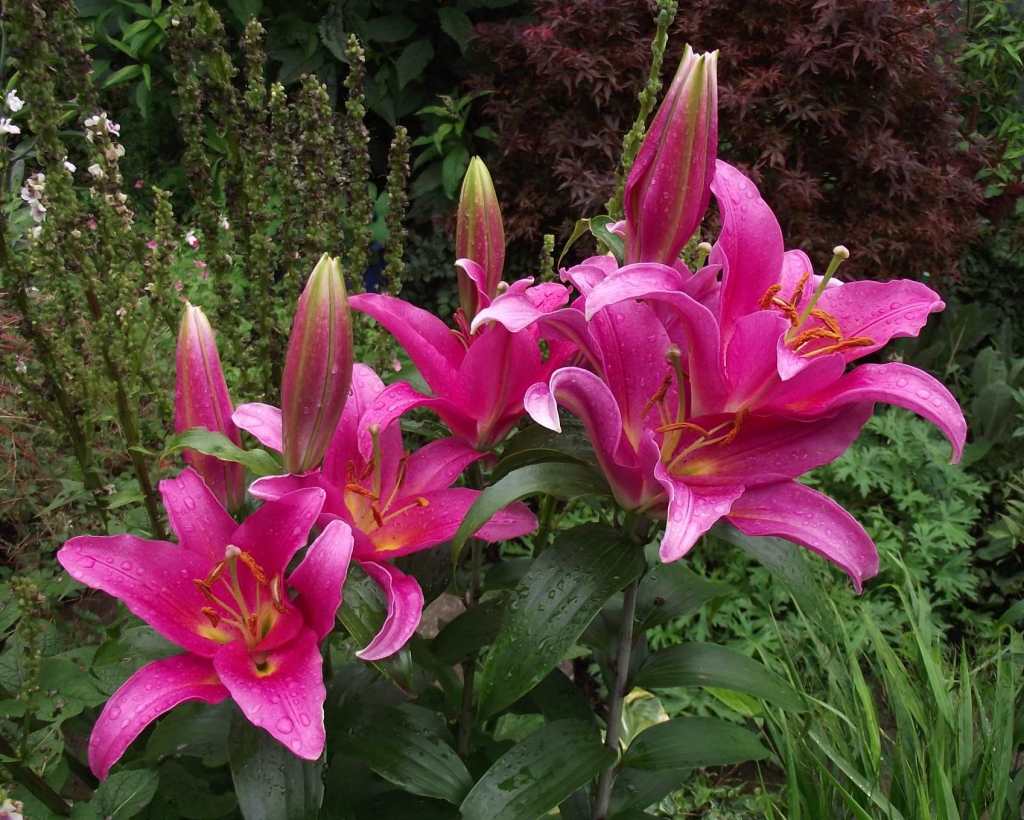
Oriental lily ‘Curly Sue’ is just outside my back door. The scent on a warm day is quite something. I am unhappy to report that I have found my first beetle today!
This is the patio area, I use the term loosely! The sage in the foreground is growing from between the flags which along with the self-seeded plants of Geranium pyrenaicum make every trip an adventure. The staging to the right is a new acquisition, purely to increase the space that I have to grow plants, and has proved a nightmare to keep watered. The older staging is where I initially raised all my plants, but it is now so shaded, that only the top tier is of use. There are even a couple of tomato plants in there somewhere which were foisted on me. If I get one tomato off these it will be a miracle. Phyllostachys nigra is poking its head in top left.
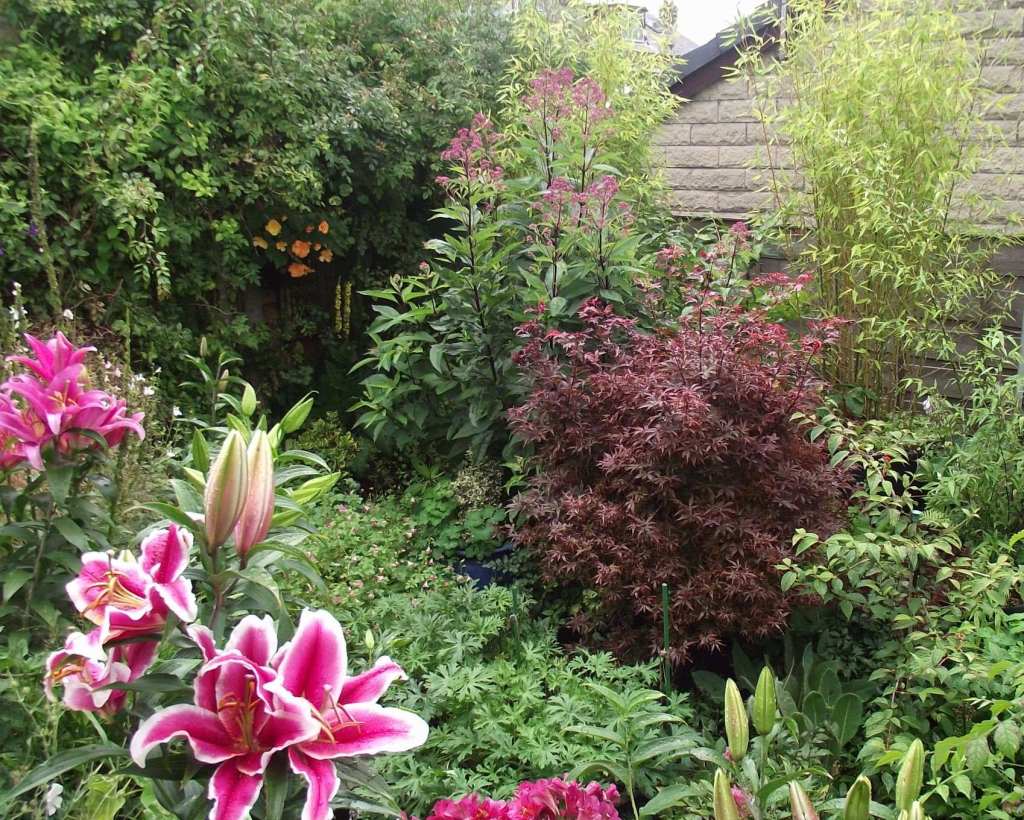
This picture gives a better idea of just how tight room is. The Phyllostachys aureas help to break up the wall behind them, and there is a Viburnum making its way up there in the middle. The Joe Pye weed also makes an efficient screen for the summer, as well as attracting plenty of butterflies and bees. There is a Fatsia japonica in there somewhere also. I think I am going to have a problem keeping the acer in check in the future as it is now beginning to put on quite a bit of growth.
Another Oriental, Lilium ‘Hachi’.
At the other end of the “patio” we have Control Central for the garden, the potting bench! Almost everything is done here. I no longer have the luxury of a covered area, although I have done some potting up on the kitchen draining board. Incidentally, I have to thread my way onto the chair. There are meconopsis plants on the floor on one side and a campanula growing out of the flags on the other!
Reading this post I’m sure that you have surmised that I very much miss my old garden. Unfortunately it was unavoidable that I downsized. At the end of the day, I am lucky not to be fussy about garden design and I am only interested in the plants. I initially filled the space with plants that I knew would survive the far from good conditions. As the ground is improved, I am beginning to replace them with plants I really like to grow such as my meconopsis. I do seem however, to have become keen on hardy geraniums on the way. I might manage a post for the front garden soon, although it’s past its best. It is even smaller!
This meme is hosted by Jim Stevens who is to be found with all the details and links to plenty of other blogs to enjoy at Garden Ruminations.
Book reviewer and garden enthusiast. Updates from my Hampshire garden. Usually talking about books and plants. People do not forget books or flowers that touch them or excite them—they recommend them.







 A Plantsman's World