Hardy Perennials (Part 3) Re-published

Dicentra

Dicentra spectabilis

Now Lamprocapnos spectabilis, Bleeding Heart has become a popular addition to the cottage garden, its unusual flowers born on arching stems over fern-like foliage make an attractive show in early spring. Although it is one of the first border perennials to show it is worth noting that it is one of the first to die back in early autumn, so tends to look better in an informal setting. Thrives in any good moist soil in sun or partial shade but it does not respond well to being moved. There is a yellow leaved form available.

Dicentra scandens

An unusual member of the Dicentra genus is the climbing D.scandens, a half-hardy climber I grew from seed. Unfortunately the botanists have really done a number on the Dicentra genus which is now split into four different genera. D.scandens is now Dactylicapnos scandens! Why are the new names nearly always more difficult to remember and pronounce than the old ones?

Dierama

Dierama pulcherrimum, Angel’s Fishing Rods are beautiful, evergreen perennials for an informal setting. They have arching flower stems covered in funnel shaped flowers in a range of shades of pink/purple and white over grass-like foliage. They prefer a sunny sheltered spot in moist soil and are another plant that does not like being moved although they actually grow from corms. Personally I have struggled to grow them and have only managed a few flowers at best, probably because my garden was too cold and damp. A member of the Iris family from South Africa there are many species and cultivars in cultivation including the well established Slieve Donard hybrids bred in N.Ireland.

Digitalis

Digitalis or Foxglove is a genus of both biennial and short lived perennial plants. The native Digitalis purpurea is common everywhere and well known, however some of the species and hybrids are less seen. Broadly speaking, being woodlanders, they all prefer a moist soil in dappled shade although D.purpurea seeds itself almost anywhere and I have had an excellent plant growing from a shady rock crevice in the past. Pam’s Choice is a naturally occurring garden hybrid found by a keen amateur gardener.

Draba

Draba cuspidata

Drabas are alpine members of the brassica family and originate from Central Europe and even the UK, they are cushion or mat forming plants, the most common garden specie being Draba aizoides. As with most alpines they like a gritty open soil in a sunny position. The plant pictured above was grown from a “lucky dip” collection of society seed out of curiosity.

Epimediums

Epimedium grandis

Find my post dedicated to Epimediums here.

Epipactis hardy orchid

Epipactis helleborine

I have included this for its novelty value, possibly Epipactis helleborine, I am no expert when it comes to orchids, just seeded itself into my ‘woodland’ garden, flowered and disappeared.

Eryngium

Eryngium giganteum ‘Miss Willmott’s Ghost’

Eryngium giganteum or the Giant Sea Holly is colloquially associated with Miss Willmott of Warley Place, who by all accounts was a formidable lady, because of a story in which she was said to scatter the seed of the eryngium in any garden that she visited that she considered to be dull. Unfortunately the story has been debunked in recent years. Eryngiums are basically thistles and require a sunny spot in well drained but moist light soil to grow well. There are several cultivars available ranging from silvery white to steely dark blue.

Eupatorium

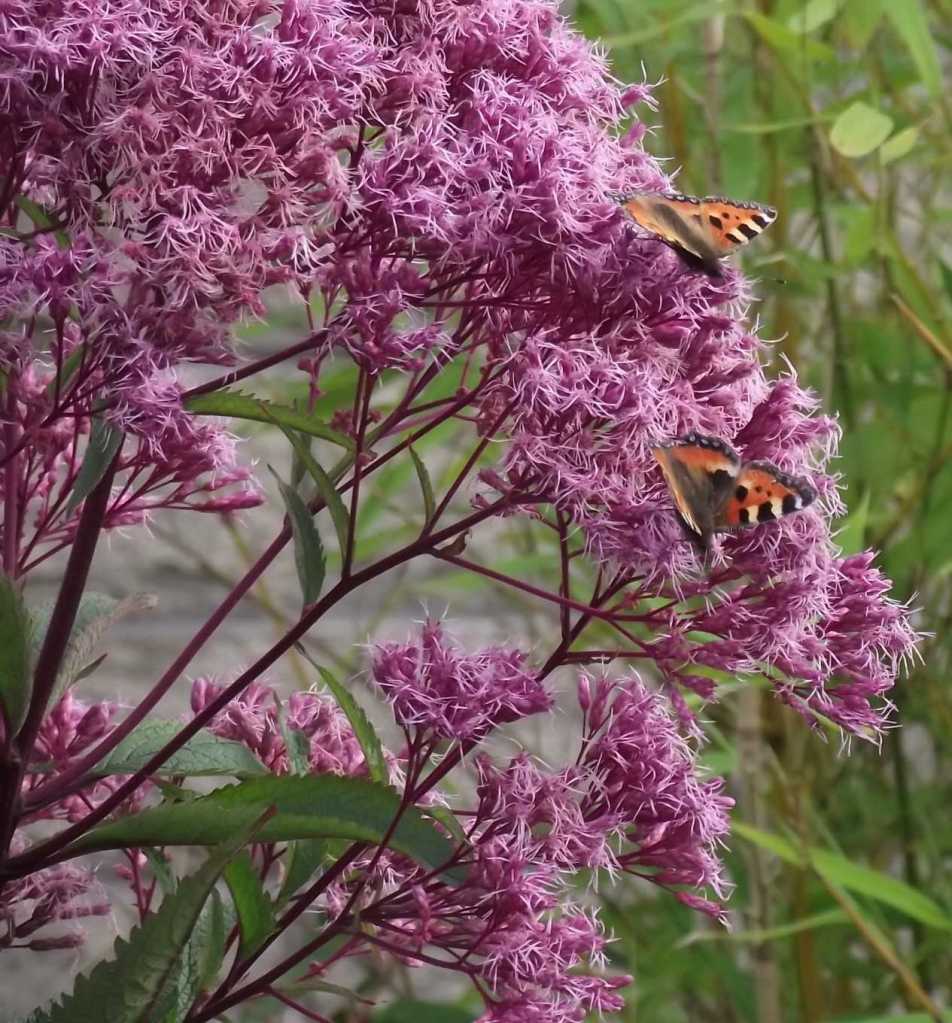
Common name Joe Pye Weed, this is a fantastic plant for adding height and late colour to the border, growing to over 6′ its purple flower heads remain until the first frosts. This is one plant that I have introduced to my new garden, late to surface, its flowers have been covered in butterflies and other insects since the end of June and it is still going strong.

Eupatorium rugosum ‘Chocolate’ is a different plant altogether smaller in stature with dark green/red leaves and contrasting fluffy white flower heads it is rather striking. Now reclassified as Ageratina altissima which just doesn’t have the same ring to it somehow.

Euphorbia

Euphorbia or Spurges are a massive and diverse genus ranging from annual weeds to trees, with shrubs and even succulents in between. The plant above is a typical garden cultivar the many species and cultivars have a range of colours including acid green and even orange. A well known member of the genus is the popular Christmas plant the Poinsettia (Euphorbia pulcherrima). The plant that is getting all my attention at the moment is the annual garden weed Euphorbia peplus, it only appeared a couple of years ago and is proving to be a nightmare! All of them, that we are likely to come in contact with, have a toxic sap which can cause painful blisters on someone who is sensitive.

Six on Saturday 27/9/2025

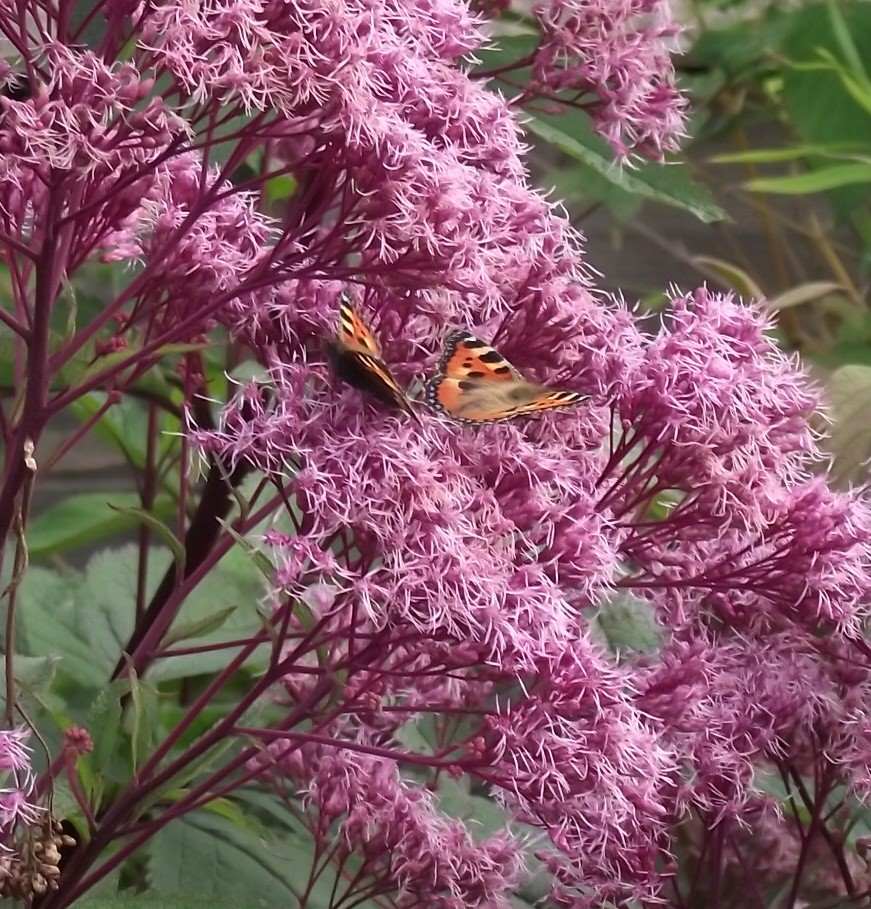
I’ve been missing for a few weeks as, to be frank, I had very little to show without constant repetition. The main show now is the Eutrochium maculatum Atropurpureum Group which, despite my earlier fears, when there were hardly any butterflies to be seen, has done its job. This year the buddleias were covered in Peacock Butterflies and then there was a gap even though Joe Pye was in flower. Now there are plenty of mainly Red Admirals to be seen, when the sun comes out. I am assuming it is to do with the hot dry summer, but I have not seen so many different species of bees as I have this year either. Another new visitor attracted to an old honeysuckle is the Hummingbird Hawk Moth. It is easy to spot as it jinks about, but much harder to photograph!

Eutrochium maculatum Atropurpureum Group or Eupatorium maculatum ‘Atropurpureum’ or Eupatorium maculatum Atropurpureum Group or Eupatorium purpureum ‘Atropurpureum’ or Eupatorium fistulosum ‘Atropurpureum’ or Eupatorium purpureum var. atropurpureum according to the RHS, or just plain old Joe Pye Weed, between two Phyllostachys aureas.

Flutterbies. People ask “why do you have such a large plant in so small a garden?” What you see is why. I even have another one in the even smaller front garden. I’m happy to think my garden has become a butterfly oasis in the wilderness surrounding me.

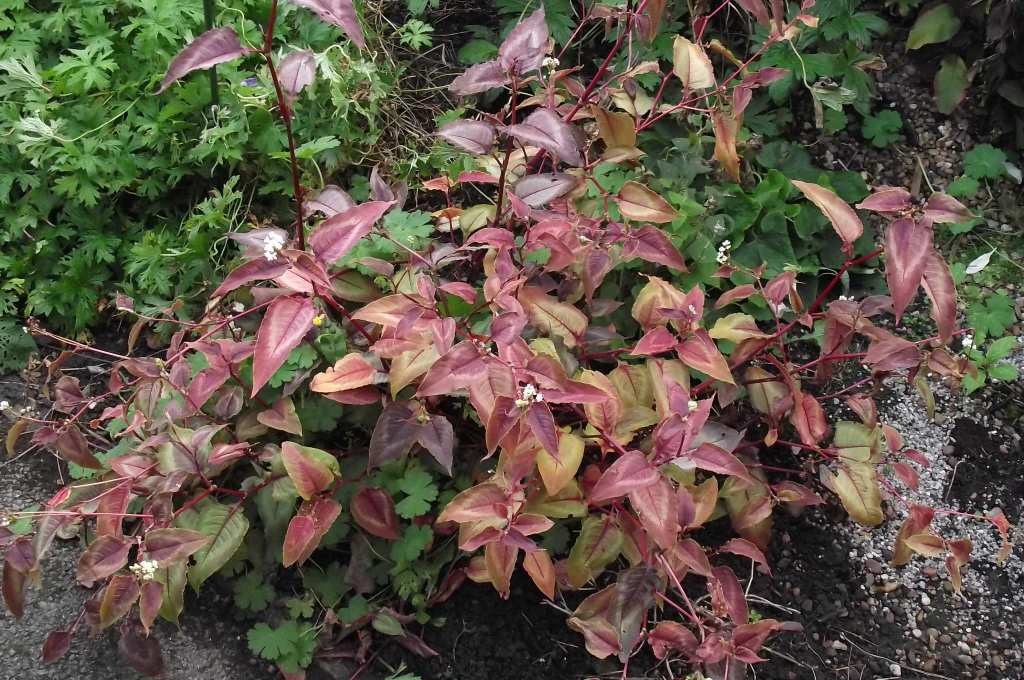
I can never make my mind up about Persicaria microcephala ‘Red Dragon’. I just think the leaf colour could be brighter. I don’t think its sprawling habit is for everyone, but it does have an AGM.

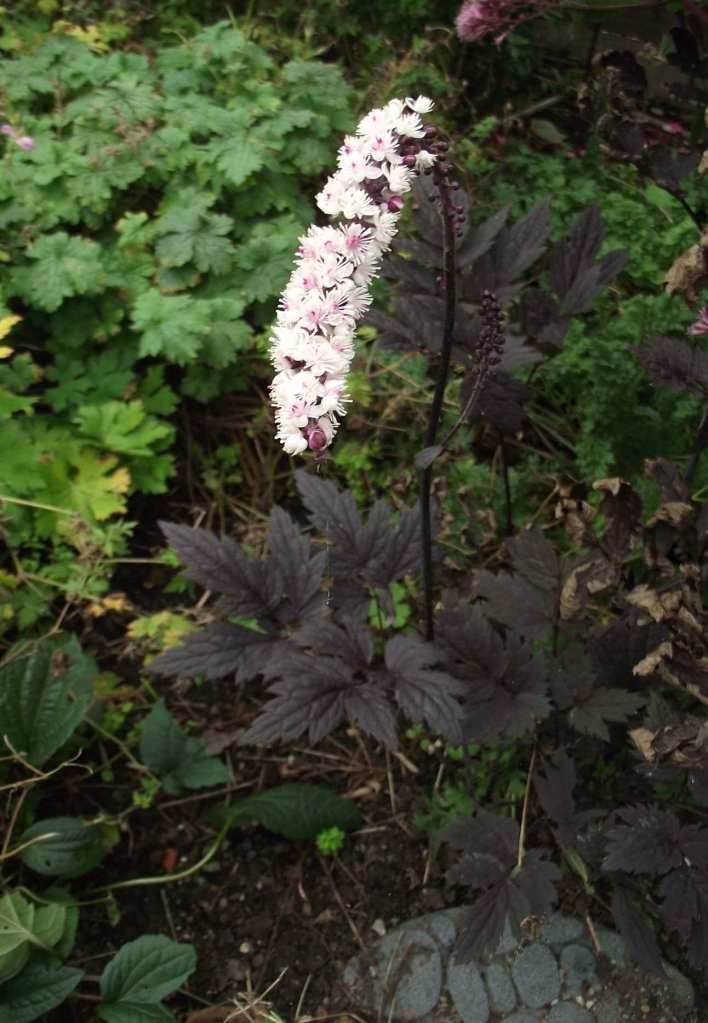
This plant of Actaea simplex ‘Brunette’ suffered very badly from the drought, all the flower spikes, bar this one, drooped never to recover. you can see the brown crinkled leaves to the right of the photo. Also known as Cimicifuga ramosa ‘Brunette’. I look at Actaea rubra and wonder how they can be related.

What’s left of my begonias. The other, more exposed, baskets were finally decimated by the torrential rain and wind that we had last Saturday. This one is in a very dark spot, lacking nutrients, and is definitely running out of steam. I grow these every year from plugs as I get little in the way of sun on this side of the house. Begonia Illumination ‘Apricot Shades’.

Sedum spectabilis ‘Autumn Joy’ or Hylotelephium telephium ‘Autumn Joy’. From Sedum to Hylotelephium please make it stop!

This meme is hosted by Jim Stevens who is to be found with all the details and links to plenty of other blogs to enjoy at Garden Ruminations.

Hardy Perennials (Part 2) – Updated

More plants grown and photographed by myself unless otherwise stated.

Bergenia

Common name Elephant’s Ears, bergenias are easy to grow and will thrive in good, deep, well drained loam in sun or shade, but will also tolerate dry soils. Excessive damp can cause them to rot. Basically an evergreen, bergenias are early flowering and can sometimes be damaged by frosts, keep the plant looking its best by removing dead or damaged leaves.

Borage

I love this herb, Borago officianalis is really an annual but I have included it here because it self seeds and generally reappears in the same spot every year. Definitely a plant for a sunny spot, will not perform in shade or on wet soils. Not only are the flowers a striking shade of blue but they are set off by the fine hairs that cover the stems and sepals. The foliage has a cucumber scent and both flowers and leaves are edible and have medicinal and culinary uses. A white form is also available and sometimes crops up among the seedlings.

Brunnera

Brunnera

A plant for cool shady conditions which will grow in moist soils brunneras have very attractive leaves and blue myosotis-like flowers and look well at the front of a shady border.

Bupleurum

A bit of an oddity Bupleurum is an unusual plant for the herbaceous border. Found in Central Europe and even the UK, it will grow in virtually any well drained soil in full sun or partial shade. The plant shown was grown from seed, the cultivar normally offered for sale is Bupleurum longifolium ‘Bronze Beauty’.

Caltha

The Marsh Marigold or King Cup is a plant for a boggy place and can be grown as a marginal where it will thrive. It overwinters with its buds just below the soil surface from where both flowers and leaves erupt together early in the spring. A member of the Buttercup family, it is an invaluable plant for early colour.

Campanula

Bellflowers are a popular, generally easy to grow, genus ranging from arctic alpine plants as cushions or scrambling over the ground to tall border perennials. Although relatively easy, campanulas are not good with winter wet and some species can be quite invasive such as Campanula poscharskyana from Siberia. Some of the showy border hybrids such as Campanula ‘Sarastro’ can have disproportionately large flowers and will need support. Propagation is from seed for species plants, buying in most cultivars, or division in the garden.

Celandine

Celandine

Ficaria verna subsp. verna or Lesser Celandine is my favourite ‘weed’. Growing from persistent bulbils, this native member of the buttercup family is definitely not everyone’s cup of tea. In a damp woodland setting, such as I had, it makes a wonderful very early spring flowering plant, providing an early source of nectar for the bees, however, in a more formal setting, it is definitely to be discouraged.

Chaerophyllum

Chaerophyllum hirsutum roseum

This Central European plant is similar to Cow Parsley but much more delicate in appearance, easy in a moist but not waterlogged soil. Personally I think this is a really useful border plant, the fernlike foliage is apple scented and the umbels of small flowers are a great attraction for pollinators even in late summer.

Chelone

Chelone obliqua or Turtlehead is a cottage garden plant which thrives in any good well drained garden soil. It has dark green leaves which unfortunately do not contrast too well with the purple flowers. There is however, a white form available. It is a late flowerer so provides some colour into the autumn. This plant was grown from seed, the white form is probably best obtained from a good nursery.

Convallaria

Convallaria majalis

Lily of the Valley used to be seen in most gardens but has gone out of fashion over time. A plant for shady woodland or spreading under shrubs its distinctive flowers give off a very strong scent which can then be followed by berries. There is a pinkish form available. Although popular for its ease of cultivation and scent I think it is possibly too invasive for today’s way of gardening.

Corydalis

Corydalis or Fumitory are generally shade lovers, ideal for a woodland setting, which flower in varying shades of blue to blue/white with the Yellow Fumitory being a welcome exception. They originate in the Northern Hemisphere primarily from China but are also found in America and the mountains of N.Africa. The nondescript Corydalis ophiocarpa is a good example of growing from seed not being quite what you hoped for! A point of interest Pere David who was a catholic missionary to China was a keen botanist and zoologist, although he collected the corydalis pictured above he also discovered Pere David’s deer. The deer became extinct in China where it had once been plentiful but is now being restored in significant numbers from the herd at Woburn.

Crocosmia

Crocosmia ‘Lucifer’

Formerly known as montbretia, Crocosmia should have been included in an earlier post as they are grown from bulb-like corms. Native to South Africa, so best grown in a sheltered spot in a severe climate. The original orange garden plant (Montbretia) was a hybrid (Crocosmia x crocosmiiflora) but there is now a huge range of vibrant colours available through intensive plant breeding. Easy to grow they will thrive in most soil types other than anything too wet. A little shade may help the flowers to last longer.