For the last ten years or so I have been increasingly in love with this genus of beautiful flowering plants. They are so adaptable, some more than others, to what are best described as “difficult” conditions some members of the genus have actually seemed to thrive for me rather than just tolerate dry shade which is one of the most difficult areas to cater for. There are both evergreen and deciduous species many with colourful leaves particularly when just emerging in the early spring and sometimes again in the autumn. Many variations are now available sporting different flower combinations giving a wide range of “mini-orchids” to choose from.
Epimedium grandiflorum ‘Queen Esta’
Deciduous cultivar Queen Esta prefers a moisture retentive soil although I have grown it within a few feet of the base of a birch tree as shown in the picture without any trouble, however, during very dry spells, the area received some watering.
Epimedium x rubrum
Much as I like the flowers of Epimedium x rubrum I have never grown a robust specimen and I normally don’t have a problem with epimediums. In fact the new plant I have now is not doing well compared with its companions. This plant is evergreen and although preferring moist soils should withstand drier conditions.
Epimedium x warleyense ‘Orangekonigin’
Epimedium x warleyense ‘Orangekonigin‘
Epimedium x warleyense from the legendary Miss Willmott’s garden was the result of a cross between two western species, the cultivar ‘Orangekonigin’ is a fairly recent introduction. Seems to thrive in either moist or dryish soils. Unfortunately the new foliage pictured had been visited by Mr. Slug!
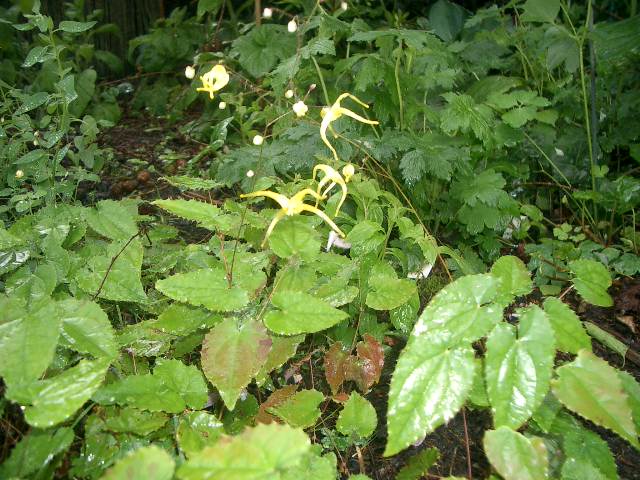
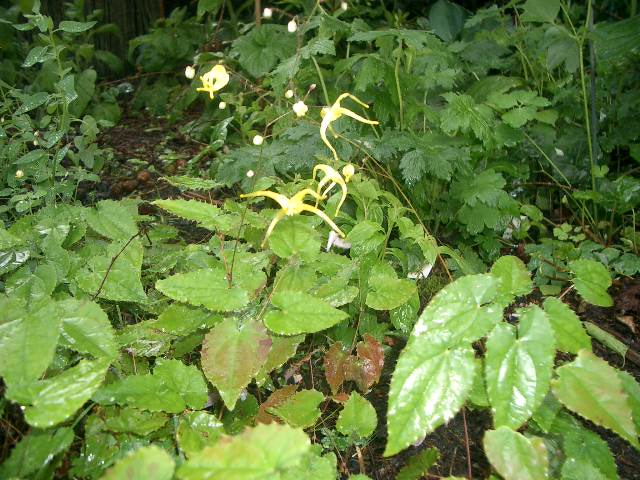
Epimedium davidii?
I am not sure if this actually is E.davidii but the combination of the yellow spider-like flowers and the glossy toothed leaves makes for a really useful plant. I had this in my mind as E.rossii but it could have been a case of word association as I knew someone called David Ross, who knows? E.davidii is from China and therefore prefers moist conditions although, again, the plant pictured, which thrived, was growing in fairly dry shade.
Epimedium grandiflorum ‘Lilafee’
E. grandiflorum ‘Lilafee’ is a cultivar from the same stable as ‘Orangekonigin’. The lilac coloured flowers are suspended over glossy leaves with toothed edges, seems to grow best in moist conditions.
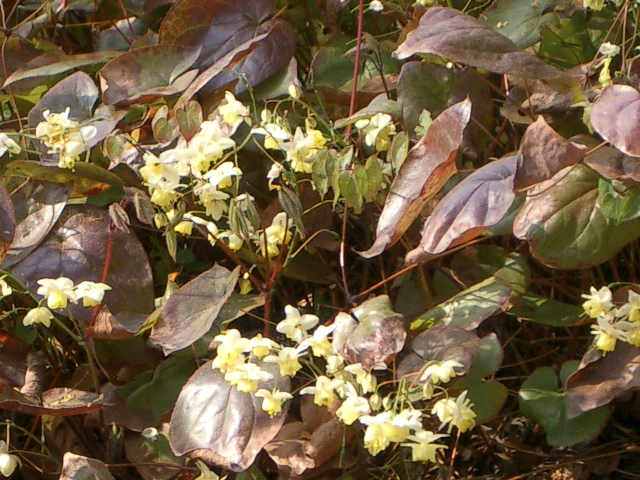
Epimedium x versicolor ‘Sulphureum’
Delicate flower spikes over copper foliage which tends to green up during the summer only to revert to copper again as winter approaches. Although evergreen the foliage does tend to look rather tatty by the spring.
Epimedium x youngianum Niveum AGM
Neat little plant growing to about 8″, delicate pure white flowers hang off wiry stems which are reddish in colour. prefers a moist spot to thrive. The new leaves can give some good colour.
It is a matter of preference when or if one decides to remove the old foliage. Personally I prefer to leave it on until the spring and then remove it just as the new foliage and flower stems are appearing, being careful not to cause any damage to the new growth. This allows a good view of the flowers and the colours of the new leaves. Leaving the foliage intact can detract from the display in those types which carry their flowers closer to the base of the plant.
All plants grown and photographed by myself unless otherwise stated.
First, let me identify just where I stand on matters of climate change and the response to it. The reason I am stating this is because the whole issue of banning peat is now inexorably linked to the so called “climate crisis”. The climate is changing, it always has, but I have the advantage of being lucky enough to be of an age to have had an education that taught me to think for myself, not what to think, which seems to have been the case for the last forty years and even more apparent since the turn of the century. The way I see it is that the whole question has become politicised, and some people are making a lot of money out of a narrative which is now completely divorced from the science.
For anyone reading this outside the UK it must be difficult to comprehend that the sale of peat is related to the actions taken by UK governments in the name of the “climate crisis”. Other than Germany mulling over proposals to limit the extraction of peat, the UK’s response is unique in the western world. For some reason, probably because we are now world leaders in very little, the UK governments have decided they must lead the world in tackling climate change, the fact that we contribute less than 2% of the world’s CO2 emissions doesn’t seem to have occurred to them.
Originally it was planned for the sale to the general public of bagged peat products to be banned from 2024, a typical response from an NGO by Ailis Watt, peat policy officer at The Wildlife Trusts is:
“Today’s announcement is bitterly disappointing. Last year we welcomed the news that the UK Government would ban the sale of bagged peat compost in England by the end of 2024. The Wildlife Trusts hoped that a ban on all peat products would follow shortly after this date.”
UK Government confirms ban on all peat-based gardening products will not be implemented until 2030
Today, Defra (Department for Environment Food and Rural Affairs) has confirmed that while some peat-containing products will be banned from shelves in 2027, others will be exempt from a ban until 2030.
Ailis Watt continues:
“The decision to allow the sale of peat-containing products to continue until 2030 does not reflect the value of peatlands – here and abroad – and is at odds with this Government’s manifesto commitment to ‘deliver the most ambitious environmental programme of any country on earth’.
“It contradicts the notion that gardening is an activity which is beneficial to nature and places a burden of responsibility on the consumer to ensure they are not inadvertently buying environmentally destructive peat-based products.”
The Wildlife Trusts estimate that policy failure to stop peat extraction has caused up to 31 million tonnes of CO2 to be released since 1990.
80% of the UK’s peatlands are now degraded as a direct result of damaging practices such as drainage for agriculture, burning and peat extraction for horticulture. Peatlands are important for biodiversity, home to a host of highly specialised and rare species – from the carnivorous plant, sundew, to Red-listed birds as well as reptiles, amphibians, insects and mammals. It is the lack of protections afforded to habitats like peatlands which has propelled the loss of almost 50% of the UK’s biodiversity.
Peatlands are also crucial carbon stores, locking away over three billion tonnes of carbon in the UK alone. However, when peatlands are damaged, this carbon is released. Today, emissions from peatlands make up 4% of all UK annual greenhouse gas emissions, and the UK is a world leader in emissions from degraded peatlands. To put this into context, every year emissions from degraded peatlands are equivalent to the carbon footprints of over 1.9 million British citizens.*
*Thursday 23 March 2023. The Wildlife Trusts’ website.
I could dissect much of this statement and show it, at best, to be misinformation, but that is not the point I am making. The Wildlife Trusts’ focus should be on wildlife but the card isn’t strong enough, so like many others of their ilk the focus is switched to climate change which is definitely not their core doctrine. I wholeheartedly agree with Kenneth Cox director of Glendoick Gardens when he says:
“The RHS, National Trust RBG, Kew & Edinburgh and other influential organisations, as well as TV presenters such as Monty Don should have a little more courage than simply to jump on this bandwagon. Instead they should appraise themselves of the facts and have the courage to portray both sides of the argument. Rather than condemn peat they should explain the facts and defend the sustainable and sensible of peat. At the moment the only reduction in peat seems to be in sales of bags marked ‘peat’. If the bag says ‘multi-purpose compost’ or ‘ericaceous compost’ it sells as well as ever. Such bags usually contain 40-90% peat.
Many well informed gardeners and writers such as Peter Seabrook and the best selling author Dr Hessayon (author of the ‘Expert’ series) take a pragmatic view. Dr Hessayon writes: ‘don’t use peat as for overall soil improvement- it is not efficient and garden compost and manure will do a much better job. However moss peat has a role to play in planting and seed composts where there are no substitutes of equal merit’ (The Bedside Book of the Garden)” *
*Peat Policy at Glendoick Gardens
The demonization of CO2
There seems to be a train of thought which has developed over the last 20 to 40 years that has been etched into the psyche of western society, aided by our controlled media and education system. It looks something like this: Climate crisis >global warming> greenhouse gases >CO2. The question is: Why is having a greater concentrations of Co2 in the atmosphere a bad thing, as gardeners we all know Co2 is the proverbial staff of all life.
Before climate science became politicized, warm periods were referred to by scientists as “climate optima” because, for almost all species on Earth, warmer is better than colder. The most dramatic advances in civilization took place during the last four warm periods—including our own. The advancement of science, technology and the arts have been directly linked to warmer weather. The warming, which made possible an abundance of food, freed the population from its preoccupation with daily survival to do other things. It led to cultural development, something impossible during the cold periods. These prosperous warm periods were followed by declining temperatures with names like the Greek Dark Ages, the Dark Ages and the Little Ice Age. These were times of great despair as the Earth plunged into global cooling that featured crop failure, famine and mass depopulation. Make no mistake; bad things happen during cold periods, very bad things.
This data is from Greenland ice cores where temperatures are extremely cold.
The conclusion that I draw from the available science is that CO2 levels do not pose any immediate or even long term threat to the planet particularly as:
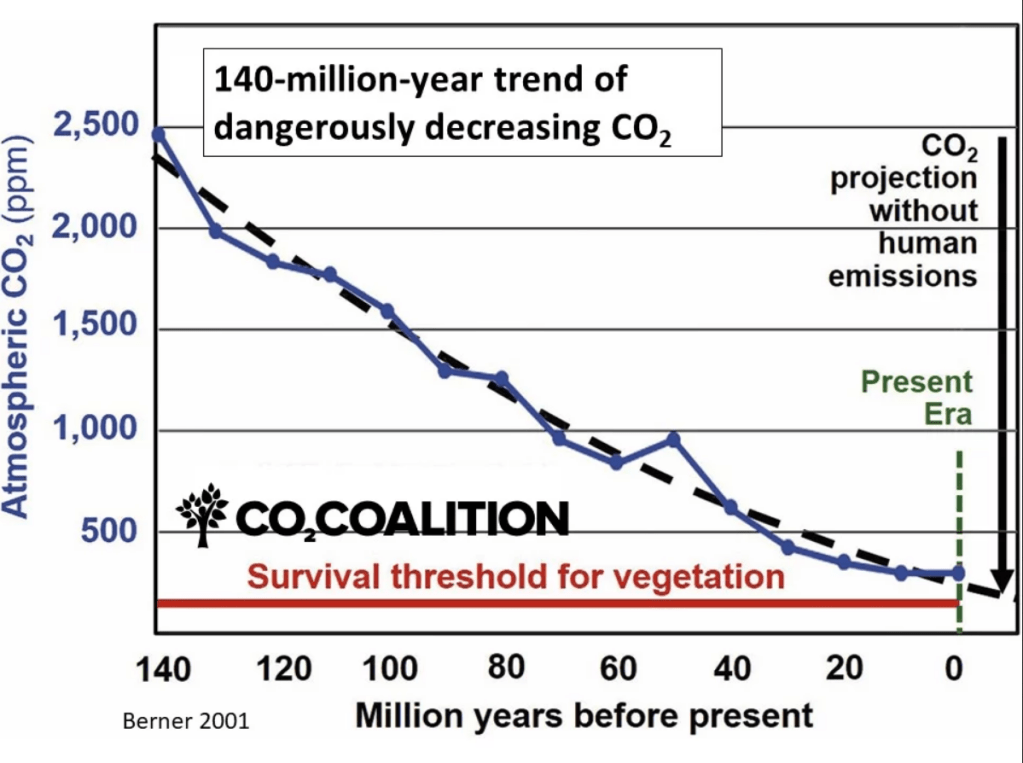
“Climate scientists have determined, and both sides agree, that the warming effect of each molecule of CO2 decreases significantly (logarithmically) as its concentration increases. This is one reason why there was no runaway greenhouse warming when the concentration of CO2 was approaching 20 times that of today. This inconvenient fact, important though it is, is kept very well hidden and is rarely mentioned, for it undermines the theory of future catastrophic climate change. Diminishing returns apply.”*
*CO2 Coalition.
Leaving aside the arguments about the CO2 effect, and coming back to the actual amount of peatlands that are affected by commercial extraction here is a breakdown of the areas of peatlands in the UK and their current status expressed as percentages.
Peatland covers around 3 million hectares in this country:
22% of the total peatland area remains in a near-natural condition, comprising undrained bogs and fens
41% of the UK peat area remains under semi-natural peatland vegetation, but has been affected by human activities including drainage, burn-management, livestock grazing and the cutting of peat for fuel
16% is covered by woodland, the majority of which is drained conifer plantation
15% is occupied by agricultural cropland and grassland, mainly in lowland regions of England such as the Fens, Norfolk Broads, Manchester Mosses and Somerset Levels
Industrial peat extraction for horticultural use occupies 0.15% of UK peatland, mostly on lowland raised bogs.*
*UK Centre for Ecology & Hydrology.
Yes, that’s right, 0.15%, so out of 3,000,000 hectares of peatlands only around 4,500 hectares are used for industrial extraction. All that government effort, not to mention money, going into penalising the horticultural industry and primarily you, the gardener. What about those bogs that are in need of protection? In fact the majority already are protected, that’s how the movement started before it got out of hand. To balance things out, there are now several government schemes to aid the restoration of those bogs which have been degraded, however, to be honest, the sums dedicated to these schemes are not very impressive.
Having read the actual figures again, I can no longer resist commenting on how this information has been misrepresented, for example, in the statement from The Wildlife Trusts. “80% of the UK’s peatlands are now degraded as a direct result of damaging practices such as drainage for agriculture, burning and peat extraction for horticulture.” peat extraction for horticulture right up there with the worst of them yet only 0.15%! Another interesting quote from the same source is the allusion to other countries: “The decision to allow the sale of peat-containing products to continue until 2030 does not reflect the value of peatlands – here and abroad.” yet countries like Sweden have a sound peat harvesting policy and the UN Intergovernmental Panel on Climate Change has changed the classification of peat from a ‘fossil fuel’ to a ‘renewable biomass resource’ in recognition that peat can indeed be harvested and cultivated sustainably. In November 2000 the European Parliament amended Article 21 of the Council Directive on the promotion of electricity from renewable energy sources in the international electricity market, adding peat to the list of renewable energy sources. From the same source, I am not sure what “the UK is a world leader in emissions from degraded peatlands.” even means. In Southeast Asia, in particularly Indonesia, the draining of peat bogs for agricultural use has led to many catching fire and releasing massive amounts of CO2 into the atmosphere, the UK’s peatlands contribution is minimal in comparison. It is also worth noting here that the very high release of CO2 only comes with draining and burning.
In conclusion what has happened to lead to the vilification of peat is similar to that of Co2, a minority opinion, not even good science, has been politicised and the establishment have run with it for whatever reason until it has achieved cult status. I sometimes wonder if this is the result of a society which suffers from an indolent aimlessness until it is given something that it can easily focus on with little or no effort and feel good about itself, or, maybe, it’s just a good business opportunity?
The go to webpage for a balanced approach: Peat Policy at Glendoick Gardens(here)
Bunny Guinness – For Peat’s Sake – Don’t Deprive UK Gardeners.(here)
YouTube video, explaining the multi-trillion dollar climate crisis scam, how it evolved and how it is maintained. The scientists who appear in this film are at the top of their game, including a Nobel Prize winner. They, quite simply, have no longer anything to fear from the establishment so can speak out.
Some of you may well disagree with what I have set out here, and you are welcome to make any constructive comments, however, please read and watch all the material listed before doing so. Thank you.
Latest research paper, news letter from the CO2 Coalition: How in the world did this new temperature reconstruction get past the Climate Industrial Complex’s censor machine?
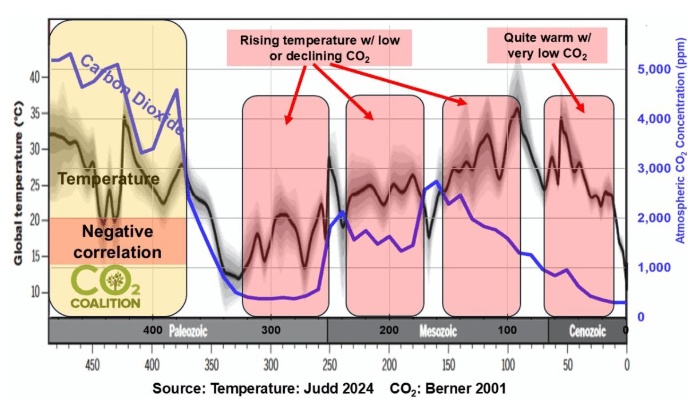
The recent publication by Judd et al looked at nearly half-a-billion years of global surface temperatures and found that, rather living in a time of extraordinarily high temperature, we are in a period of near-historic lows. In fact, the global temperature peaked 100 million years ago at about 96.8oF (36oC) which was 37.8oF (21oC) higher than the temperature for 2023 (59oF and (15oC)! The inconvenient fact for the climate alarmists is that Earth’s temperature has been in a 50-million-year decline.
We then compared this data to long-term CO2 data (see below) and found that CO2 and temperature don’t correlate very well at all.
This is what happened to a rather nice specimen of Cedrus atlantica Glauca, the blue Atlas cedar I had by the front gate. I think the mistake was to try and restrict its growth but there was really no alternative as the tree was already pushing the telephone wires. I used to prune it myself but had left it to a professional arborist who I think just topped it instead of also thinning the growth out at the top causing it to become congested. The general consensus of opinion was that the tree had been pruned too heavily which eventually traumatised it, no evidence of any disease was found.
How a healthy tree should look.Die back!Almost bare!Gone!
First and foremost Glyphosate is not a selective weedkiller, it kills all the plants and grasses you may have in your garden regardless, it may take several applications over several years for particularly persistent weeds but it will get there eventually. Glyphosate works by being absorbed by the leaves and being transmitted to the roots killing the whole plant unlike most herbicides which only kill the top growth allowing the roots to regrow, which is the case with many perennial weeds.
Availability
Although many UK garden centres and supermarkets have removed glyphosate containing products from the shelves it is still freely available online. Unless you are very rich, or have a very small garden, “ready to use” products are definitely not the way to go, far better economically to buy the concentrate. When sold for garden use the product normally contains 300g/l of glyphosate in a soluble concentrate which also includes a wetting agent to help apply the solution to the leaves. These wetting agents have become subjects of controversy themselves as manufacturers do not have to list them in the product’s ingredients.
Application
Without doubt the best tool for application is a knapsack sprayer particularly if you intend to use a “no dig” approach, watering cans are out of the question although some products do give dilution rates for this. It is essential to be in control of the direction and volume of the spray principally to make sure that you only spray the unwanted plants and avoid those that you want to keep. It has been pointed out to me that the most necessary skill when spraying is to actually know the difference between a weed and a keeper, unfortunately many, what I call “mow and blow” garden maintenance people, don’t, best do it yourself. If you have a large garden it’s worth spending a bob or two on a decent sprayer with a metal nozzle, however I manage quite well today in my small garden with a cheap plastic one. If you intend to spray close to plants that you want to avoid, a good idea is to practice with just water first, and of course always point the nozzle away from them, I very often virtually dribble onto the offending weeds to avoid overspray, control is everything.
When and what to spray
As the herbicide is absorbed through the leaves it is essential that no attempt is made to cut back the weeds before spraying however tempting that can be in an overgrown patch, the more leaf surface area there is, the more spray can be absorbed. Old foliage does not take up the chemical as efficiently as new growth, an exception to the rule, in ideal conditions, is to cut back the old growth and then spray the re-growth at a later date to get better absorption. Weeds can be sprayed at any time of the year (it won’t say this on the label) as long as there is growth, however the results will take longer in the cold weather. Patience is a virtue when using glyphosate anyway, I always allow at least a week for it to show signs of acting even in summer.
When it comes to rain, the likelihood is that in ideal conditions for absorption on annual weeds a shower of light rain a couple of hours after spraying may not be too detrimental. If however one is spraying established perennial weeds at least 24 hours without rain is essential. An example of cold weather use is to spray emerging weed seedlings in early spring when the plants in your borders are mainly dormant, this is not necessarily “good practice” as you will get some overspray but it can save a lot of problems later. This particularly applies to the pernicious rock cress which seems to grow all year round.
Speaking of good practice, herbicides containing glyphosate are perfectly safe for the amateur gardener as long as the manufacturer’s instructions are adhered to. Maybe I don’t follow them quite as I should, particularly with regards to PPE, other than washing my hands. I am in my late 70’s and if I think back to the late 60’s and early 70’s when I used to spray God knows what on fruit trees from a cabless tractor without any form of PPE I think I am lucky to have made it this far! The most important thing is to stick to the manufacturers dilution rates. When using that which is available to the amateur gardener the recommended dilution is 24ml/litre. Commercial strength product at 360g/litre glyphosate is usually diluted at 20ml/litre for safe and effective use. There is actually nothing to gain from exceeding the manufacturers recommendations although some gardeners I have known in the past managed to get through remarkable amounts of product in a season!
No Dig
I use glyphosate as a tool in the garden. Although I was already familiar with its use in no-till agriculture in the US, I followed one man who was a great exponent of the use of herbicide to minimise cultivation of the soil in the UK. Roger Brook, a lecturer in Soil Science was a great advocate of controlling weeds by spraying therefore avoiding disturbing the ecosystem which he felt was detrimental to the soil’s health. His version of “no dig” was very different from today’s version which relies principally on mulching. A sign of the times occurred several years ago when a graveyard that he maintained and planted featured in a glossy magazine as a thing of beauty, strangely there was a distinct lack of further interest when it was realised that he had achieved this solely by judicious spraying of a herbicide. Even in my small garden, I still use spraying as my principle form of weed control.
No Dig may not be for you, it is very much a personal choice, but I hope that, in general, my experience is of interest, if in doubt engage the services of a qualified professional.
To me glyphosate, now synonymous with RoundUp is the ultimate herbicide, its introduction in the 1970’s by Monsanto to be used with crops which had been genetically modified to be resistant to it, was a major breakthrough in weed control. Since the 70’s its use has diversified including on crops that have ripened unevenly so they can be harvested and as a major constituent of no-till agricultural practice. Although of prime importance to agriculture, it has been used successfully in the garden for many years until fairly recently when there have been claims that it is a carcinogenic and, as sure as night follows day, the litigation and subsequent bad publicity have followed.
Since 2018 there have been several high profile law suits in the United States against Monsanto, now a subsidiary of Bayer, because of an alleged cancer risk from the use of RoundUp and specifically its main ingredient glyphosate. The cancers in question are non-Hodgkin lymphoma and those related to it, and most allegations seemed to be based on a lack of warning on the product that it posed a cancer risk or even that the company deliberately withheld the fact. Although some studies suggest a link between glyphosate and non-Hodgkin lymphoma it has not been established and still remains open to debate. Even though Bayer offered up around $11billion to settle outstanding claims in 2020, there are still thousands that remain unresolved. Bayer has also removed its glyphosate from the amateur gardening market, but do not see this as admitting culpability as they still claim that it is safe and continue to supply the farming community.
Several countries in Europe have banned glyphosate for household use, including France, Holland and Belgium whilst Germany is moving toward restricting its use in public spaces and eventually a ban. Controversy arises from the fact that many agencies throughout the world back the findings of the EPA (Environmental Protection Agency) that glyphosate is an unlikely carcinogenic the primary dissenter, it would appear, is the International Agency for Research on Cancer which lists it as a probable human carcinogen. It must be noted that IARC is part of the WHO (World Health Organization) who in turn is an arm of of the UN (United Nations) and as such do not have the power to legislate in this case, although I am sure they would very much like to, this is the responsibility of the appropriate agency in each country or even state. Two major factors must be taken into consideration, firstly that the use of glyphosate is so widespread and such an integral part of modern farming methods it is currently impossible to replace it with anything remotely as effective, (see Rothamsted) and secondly, to prove or disprove the case is impossible simply because testing isn’t practical on human subjects and any results from animal testing would be purely conjecture, in effect it is a gigantic grey area. The saga roles on, Bayer trying to push for a Supreme Court judgement in their favour whilst handling yet more claims against them.
Despite there being no legislation in force, in the UK many supermarkets, garden centres and other retail outlets have removed RoundUp from their shelves in a mixture of independent and collective action but whether this is to appease their consciences or to appease the green lobby it is hard to tell, similar action having been taken with bagged peat.
On the other side of the coin in 2023 the EU has extended glyphosate’s licence for a further 10 years as member states reached a stalemate. In Brighton and Hove, always leaders when it comes to green initiatives, the banning of the use of glyphosate in 2019 and the decision to control the problem it has with weed growth on its pavements and roads manually has resulted in parts of the city looking “completely wild”. Glyphosate has been approved by the city council earlier this year for targeted use and with the exception of open spaces and play areas to get things back under control.
For the last ten years or so I have been increasingly in love with this genus of beautiful flowering plants. They are so adaptable, some more than others, to what are best described as “difficult” conditions some members of the genus have actually seemed to thrive for me rather than just tolerate dry shade which is one of the most difficult areas to cater for. There are both evergreen and deciduous species many with colourful leaves, particularly when just emerging in the early spring and sometimes again in the autumn. Many variations are now available sporting different flower combinations giving a wide range of “mini-orchids” to choose from.
Epimedium grandiflorum ‘Queen Esta’
Deciduous cultivar Queen Esta prefers a moisture retentive soil although I have grown it within a few feet of the base of a birch tree as shown in the picture without any trouble however during very dry spells the area received some watering.
Epimedium x rubrum
Much as I like the flowers of Epimedium x rubrum I have never grown a robust specimen and I normally don’t have a problem with epimediums, in fact the new plant I have now is not doing well compared with its companions. This plant is evergreen in that the leaves last the winter and, although preferring moist soils, should withstand drier conditions.
Epimedium x warleyense ‘Orangekonigin’
Epimedium x warleyense ‘Orangekonigin‘
Epimedium x warleyense from the legendary Miss Willmott’s garden was the result of a cross between two western species, the cultivar ‘Orangekonigin’ is a fairly recent introduction. Seems to thrive in either moist or dryish soils. Unfortunately the new foliage pictured had been visited by Mr. Slug!
Epimedium davidii?
I am not sure if this actually is E.davidii but the combination of the yellow spider-like flowers and the glossy toothed leaves makes for a really useful plant. I had this in my mind as E.rossii but it could have been a case of word association as I knew someone called David Ross, who knows? E.davidii is from China and therefore prefers moist conditions although, again, the plant pictured, which thrived, was growing in fairly dry shade.
Epimedium grandiflorum ‘Lilafee’
E. grandiflorum ‘Lilafee’ is a cultivar from the same stable as ‘Orangekonigin’. The lilac coloured flowers are suspended over glossy leaves with toothed edges, seems to grow best in moist conditions.
Epimedium x versicolor ‘Sulphureum’
Delicate flower spikes over copper foliage which tends to green up during the summer only to revert to copper again as winter approaches. Although evergreen the foliage does tend to look rather tatty by the spring.
Epimedium x youngianum Niveum AGM
Neat little plant growing to about 8″, delicate pure white flowers hang off wiry stems which are reddish in colour. prefers a moist spot to thrive. The new leaves can give some good colour.
It is a matter of preference when or if one decides to remove the old foliage, personally I prefer to leave it on until the spring and then remove it just as the new foliage and flower stems are appearing being careful not to cause any damage to the new growth. This allows a good view of the flowers and the colours of the new leaves, leaving the foliage intact can detract from the display in some types which carry their flowers closer to the base of the plant.
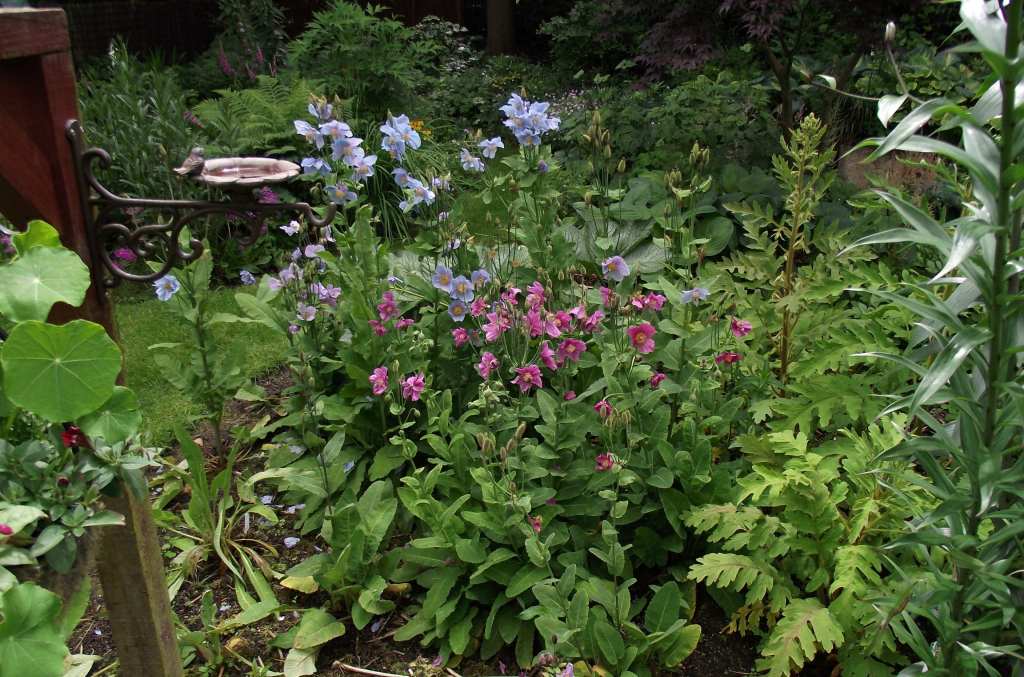
In my descriptions of plants that I have grown I refer to the garden being shaded and generally damp. To put things into context this is a mainly pictorial blog showing the garden at different times of the year from about 2010 onwards.
View of rear garden.
A quick pictorial trip round my old back garden, hope you enjoyed it.
Having had websites or a blog for many years and deciding to start again from scratch my first decision was to remove all previous material as I felt that the temptation to recycle material would be too great and consequently defeat the object of the exercise. I live alone and I am in my 70’s so one would have thought that under the circumstances 2020 would have been a perfect time to start my new project however my enthusiasm literally evaporated, my get up and go went, so I find myself almost a year later finding the resolve to get down to business.
I am now operating in a very limited space so my plan last year was to have a series of trips out to local gardens and events to find new material but, as we all know, this was doomed to failure. The back-up plan was to write a series of blogs on my favourite genera, this also did not come to fruition but nevertheless that is the way I intend to go for the immediate future.
I have already written a post on one of my favourites, epimediums, but my real love lies with the likes of Asiatic primulas and meconopsis which, living in the North of England, I have been able to grow with some success. I hope to be able to show and describe some less familiar plants as one of the things I have retained is my photograph library so I have a reminder of some beautiful plants I have grown in the past which I can share.
Book reviewer and garden enthusiast. Updates from my Hampshire garden. Usually talking about books and plants. People do not forget books or flowers that touch them or excite them—they recommend them.

















 A Plantsman's World