The welcome rainfall has really boosted everything in the garden, although it is always sad to see the early bloomers finished until next year. My garden is always at its best Mid-April To mid-June. I can now breathe a sigh of relief, as the couple of bamboos that I have, are finally greening up again. I always worry that they aren’t going to recover after their winter battering, because they are so late. I have a Phyllostachys nigra which was badly damaged a couple of years ago, and only partially survived. We are promised another “heatwave” next week. I think it is meant to reach as much as 29°C on one day!
An abundance of geraniums this week. I wanted to get them in before some finish flowering.
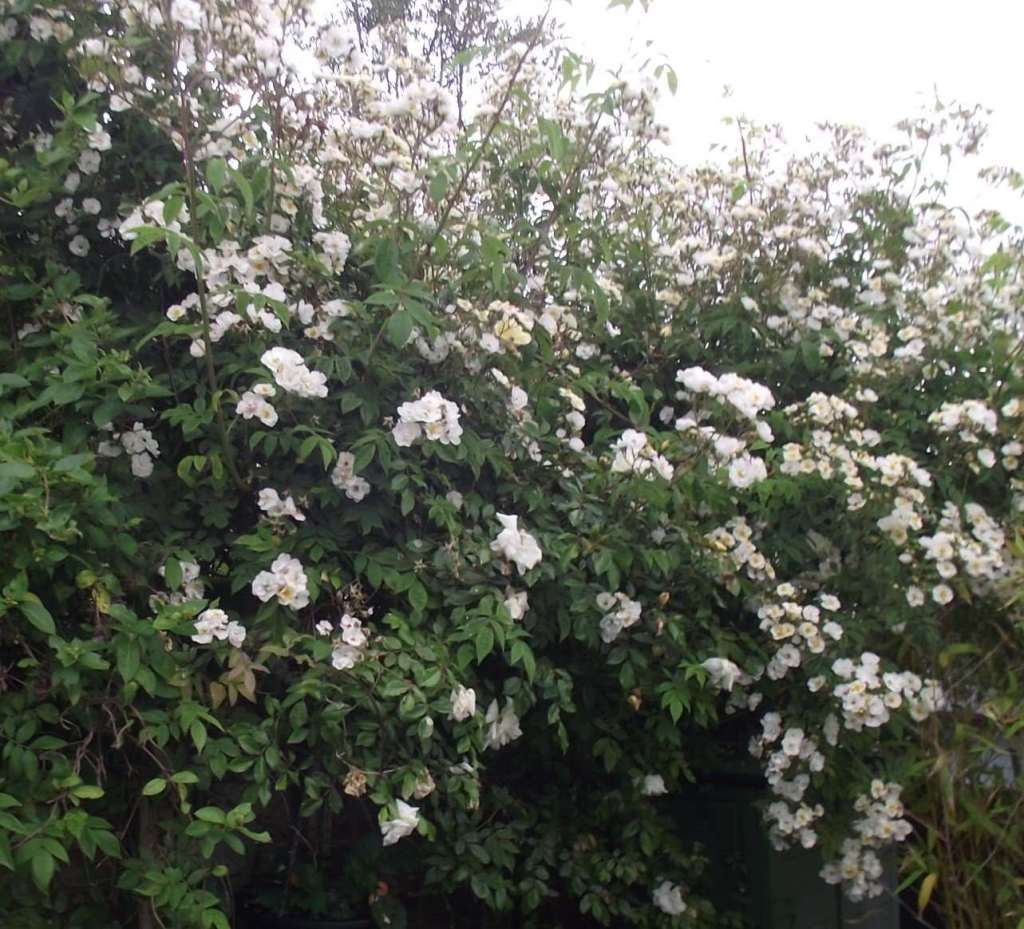
I’m sure Rosa ‘Rambling Rector’ is on steroids. This is only its third year since I planted it, but I never thought this would be the result. Some late pruning, to contain it a little, has certainly helped the flower count. On a warm day it fills my tiny garden with scent, so I won’t complain. A drastic prune is now due!
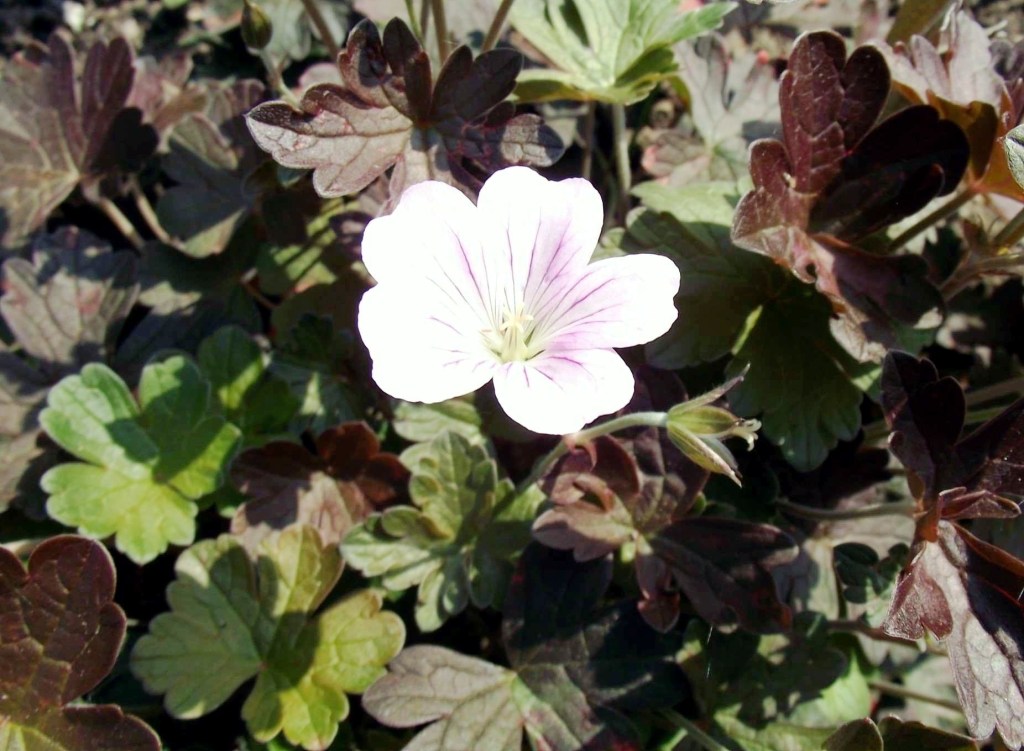
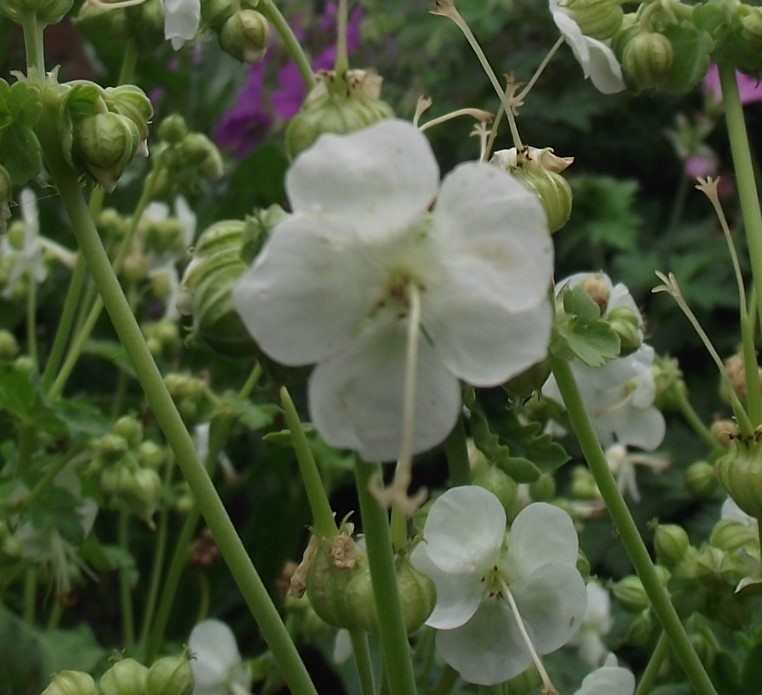
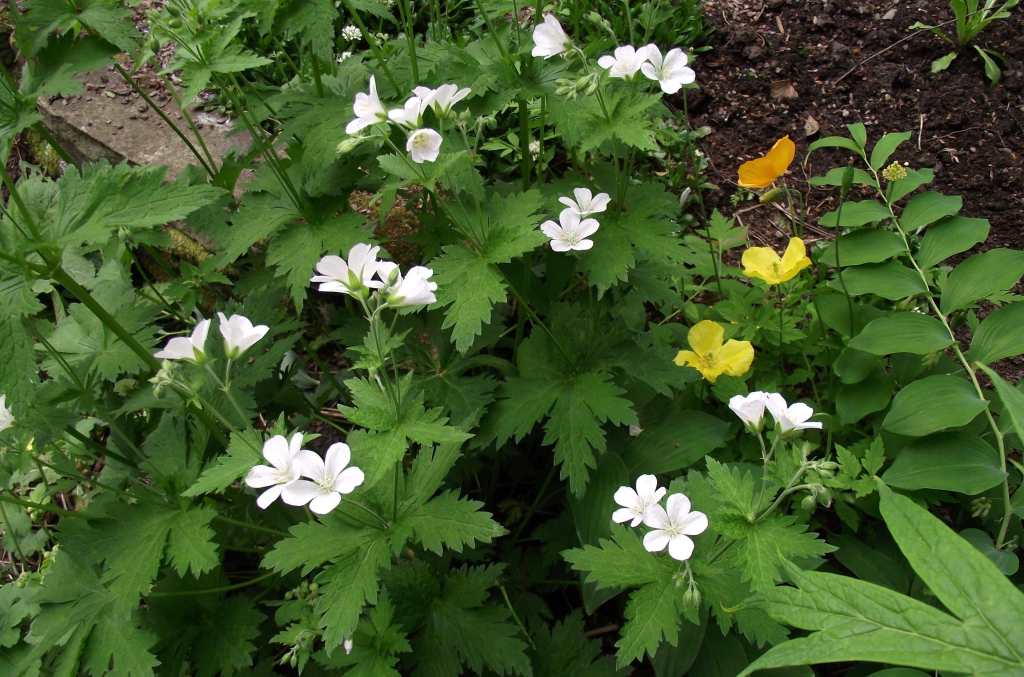
Geranium ‘Galactic’ or to give it the full title Geranium pratense var. pratense f. albiflorum ‘Galactic’, poor thing! It sat in the garden unrecognised, until I found an old label that had been disregarded a few years ago. I am always hesitant when identifying geraniums, as the variations are often very slight. This has led to a growing problem of, plants offered for sale, being wrongly labeled. Best left to the specialists.
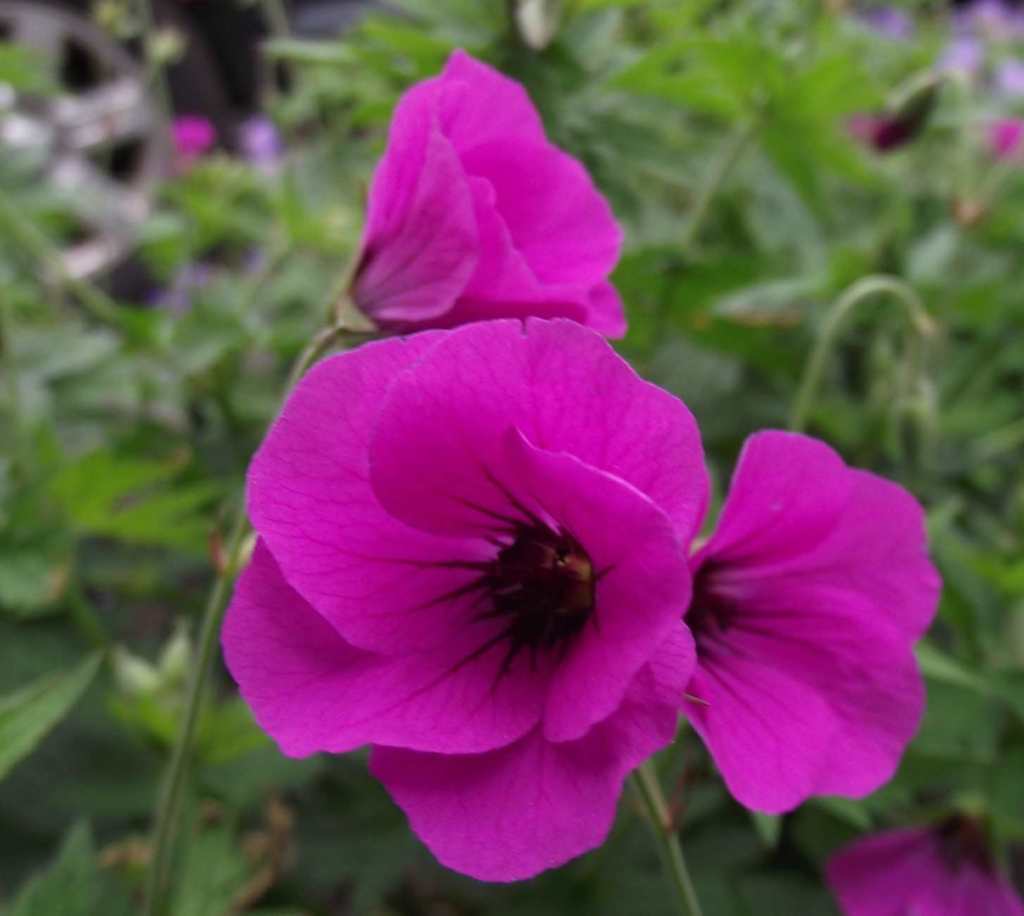
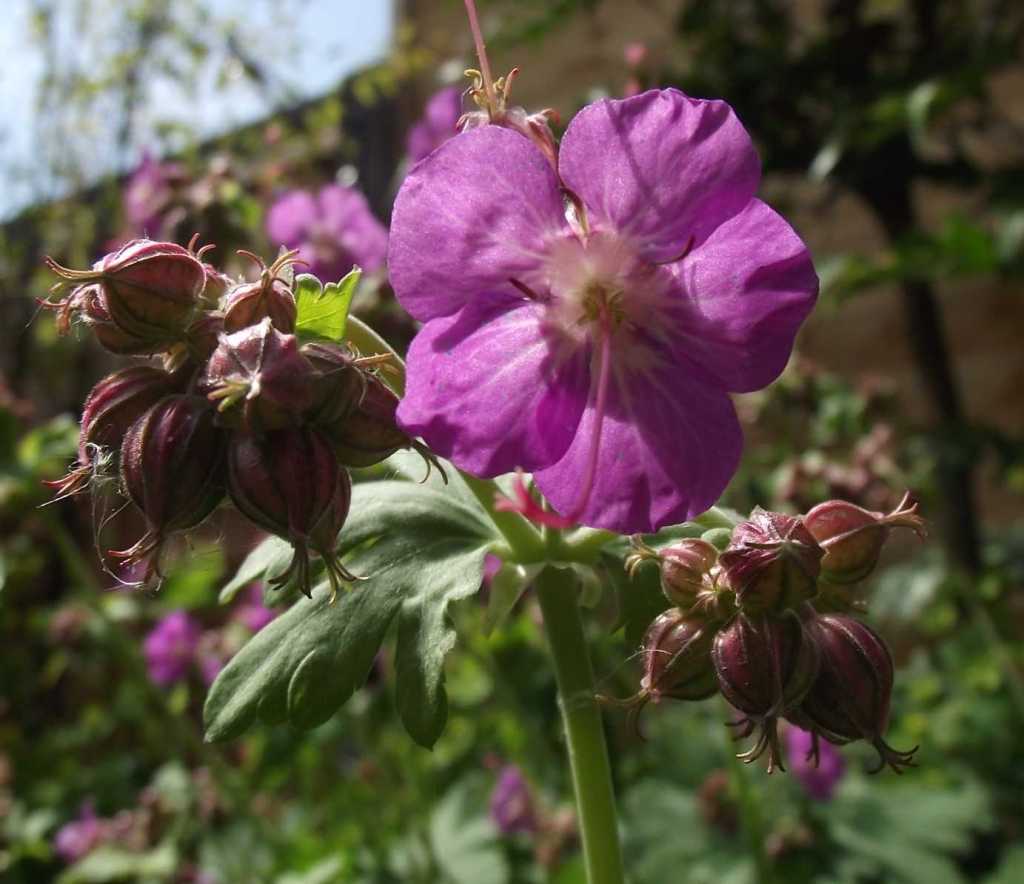
Unfortunately the flower is much pinker than shown, as the name implies. Geranium x oxonianum ‘Dusky Rose’ is a new cultivar which I am hoping should flower right through the summer.
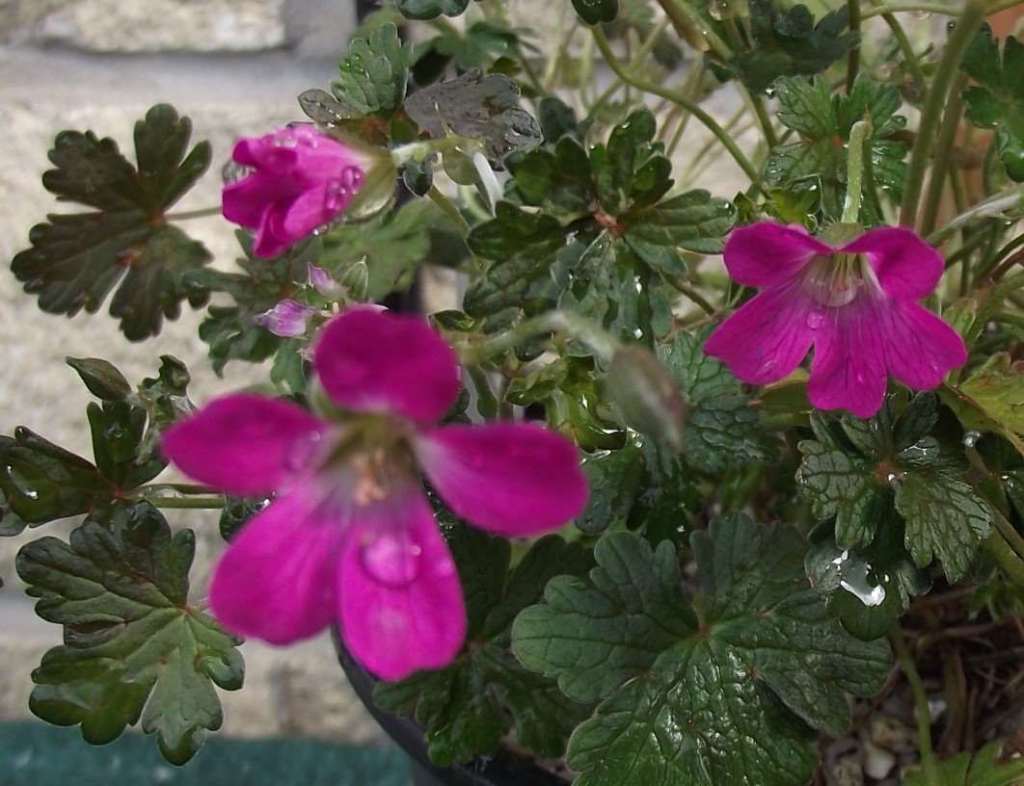
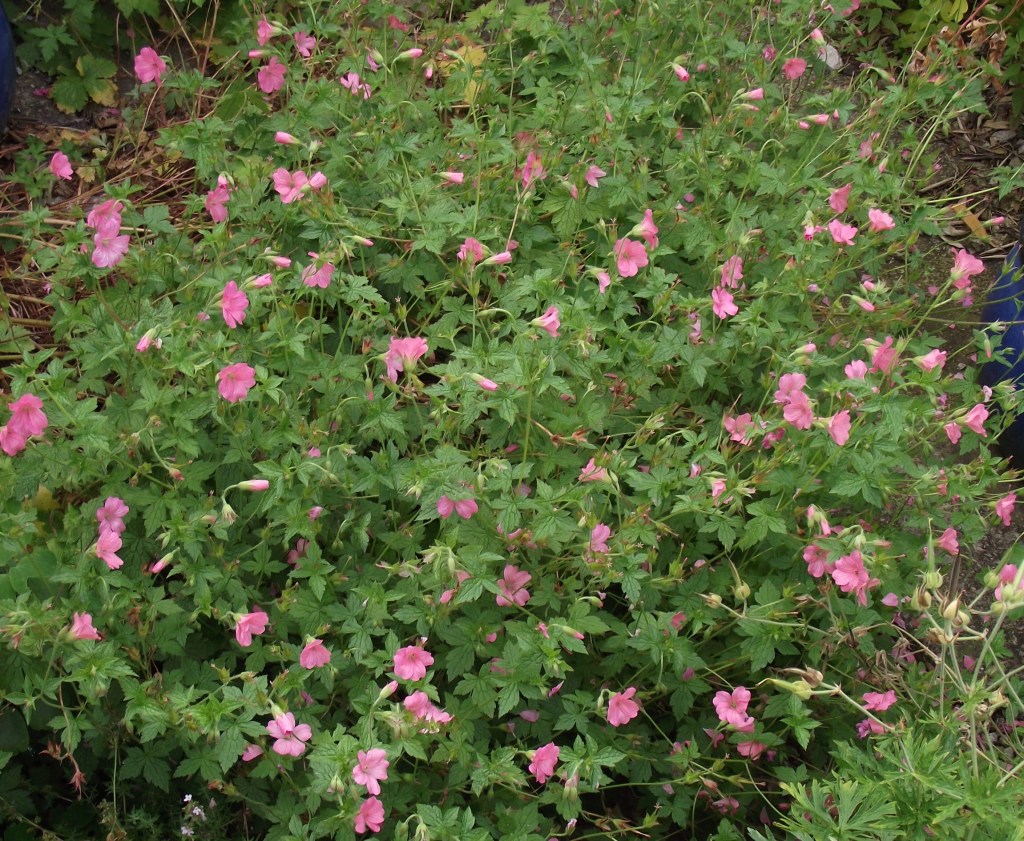
Another low growing geranium (6″). Geranium Orkney Cherry is bred by Alan Bremner in the Orkney Islands so it must be hardy.
Geranium Patricia is another cultivar from Alan Bremner and is the result of Geranium endressii x Geranium psilostomen. I know this one will produce flowers through the summer. Geranium ‘Galactic’ however, I will be cutting back in the next couple of weeks, and hoping for a second flush of flowers.
My favourite pink geranium. I have had Geranium × oxonianum ‘Wargrave Pink’ for many years, even before I made the decision to grow more geraniums. This is another one I know will keep flowering right through the summer.
This meme is hosted by Jim Stevens who is to be found with all the details and links to plenty of other blogs to enjoy at Garden Ruminations.
The heavy rain seems to have died down and temperatures have risen again. We are promised some thunderstorms in the near future, so we will have to wait and see what is in store for us.
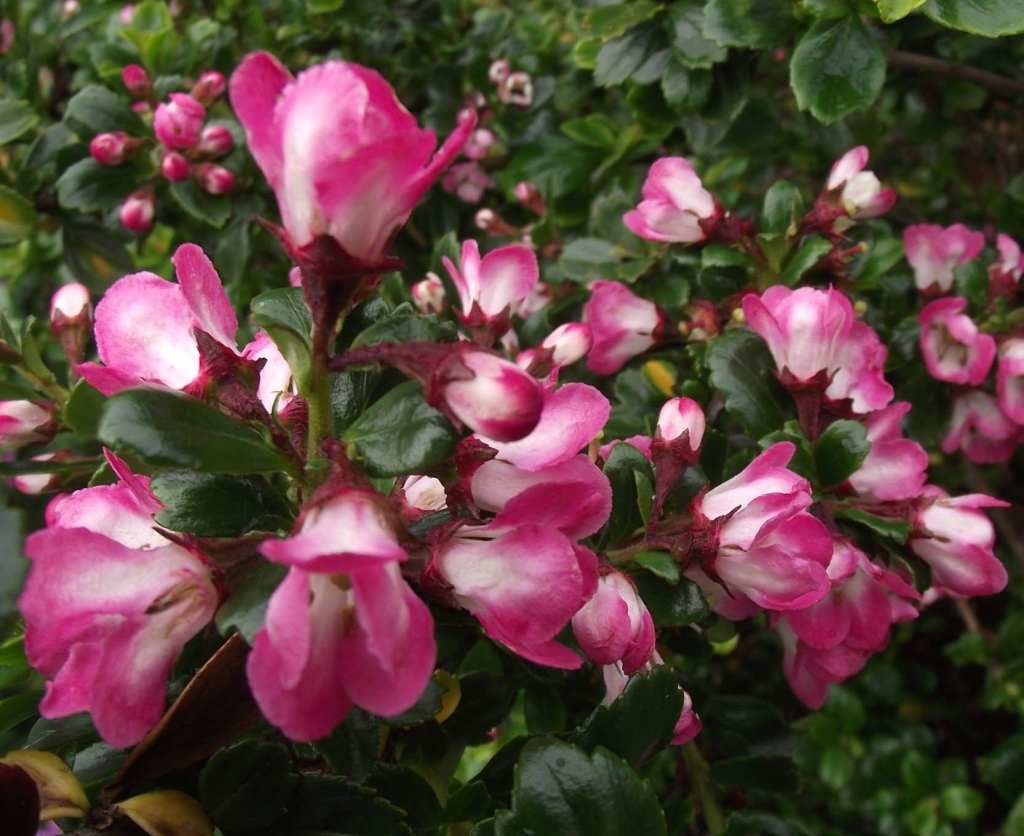
Escallonia ‘Apple Blossom’
Although escallonias don’t seem to be as popular as they used to be, this one is so aptly named. The dark green, evergreen foliage makes an excellent foil for those plants in front of it.
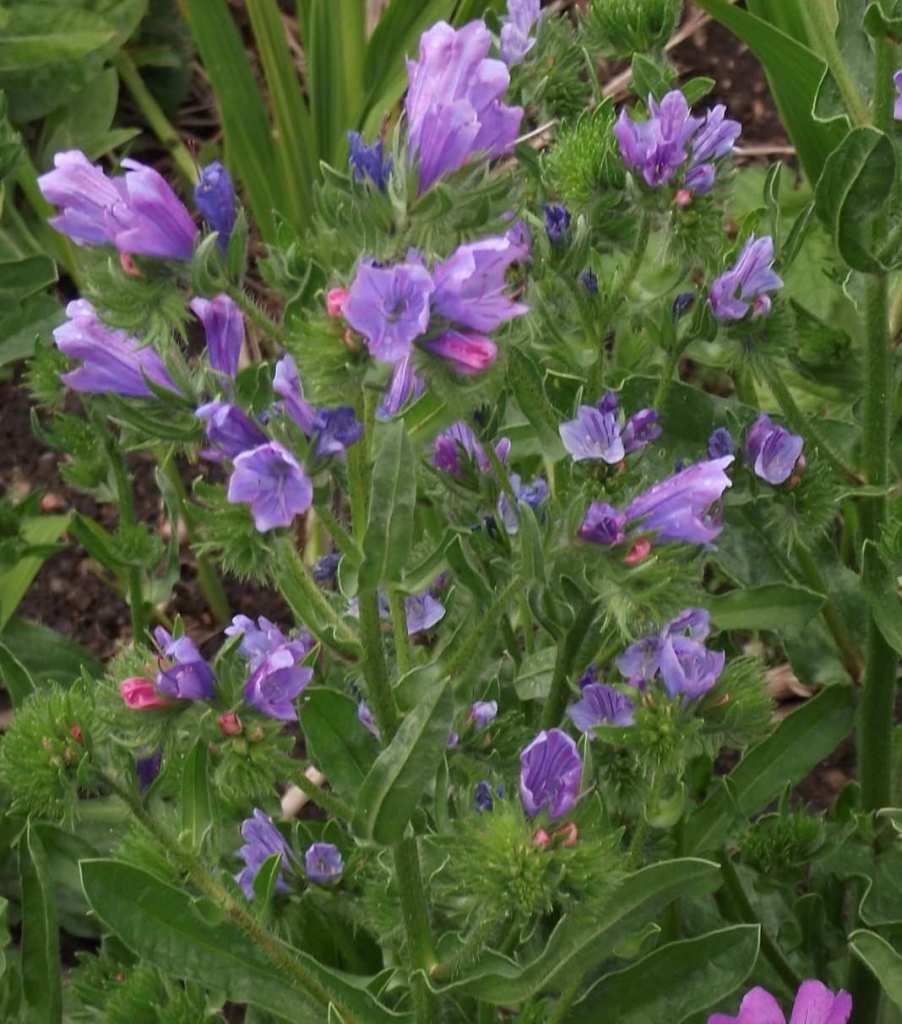
Echium plantagineum
The common viper’s bugloss (Echium vulgare) is a native flower, which I first saw in a garden when I was in my early teens. We had neighbours who had returned from India after serving in the British Raj, which we youngsters found fascinating. Charles was a keen amateur astronomer and my father and I spent a few nights with him gazing at the stars. His wife Effie (Euphemia) was a very keen gardener and an archetypical, indomitable Victorian lady who did much to encourage me in the ways of gardening. One of her favourites was viper’s bugloss, which I have grown in her memory ever since. Echium plantagineum, the purple viper’s bugloss, actually comes from warmer climes, but it is flowering from a February cold sowing.
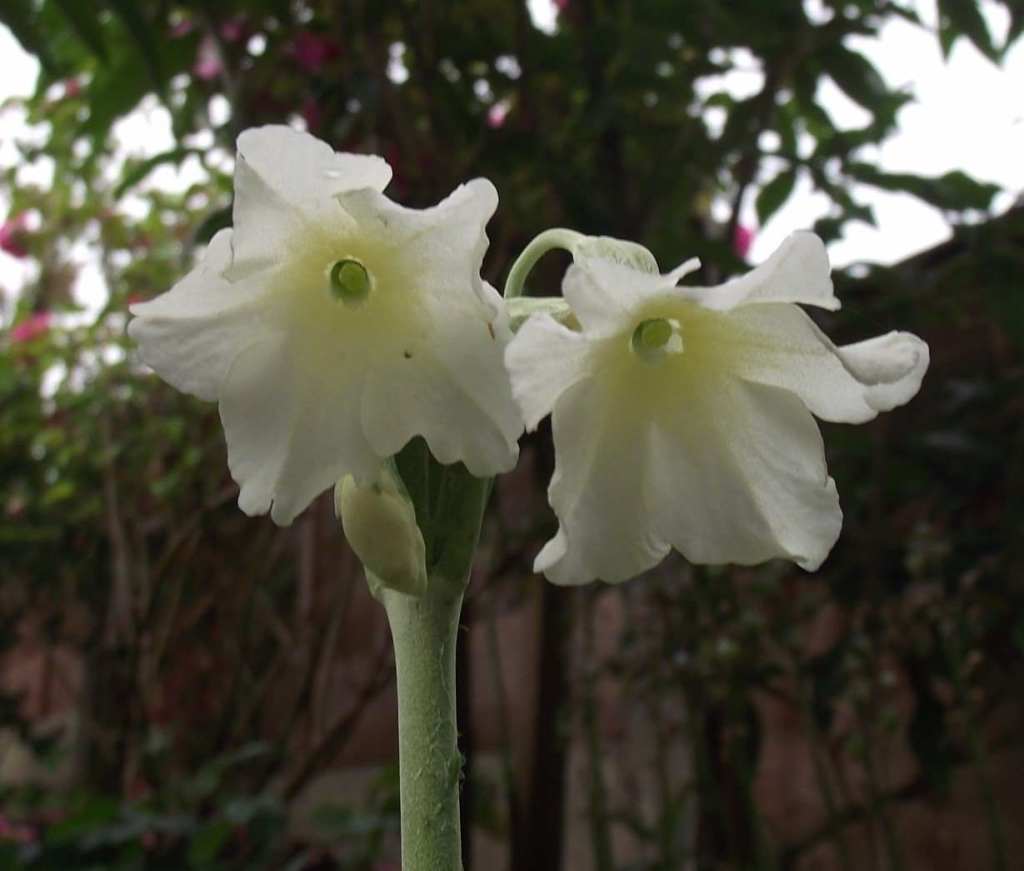
Primula alpicola albaPrimula alpicola violacea
Primula alpicola the moonlight primrose is another little beauty for a damp spot.
Grows virtually anywhere, autumn tints to the leaves, aromatic foliage, bee magnate. What more could anyone want?! Geranium macrorrhizum ‘Bevan’s Variety’ is very similar, in fact, to be honest, I can’t tell them apart.
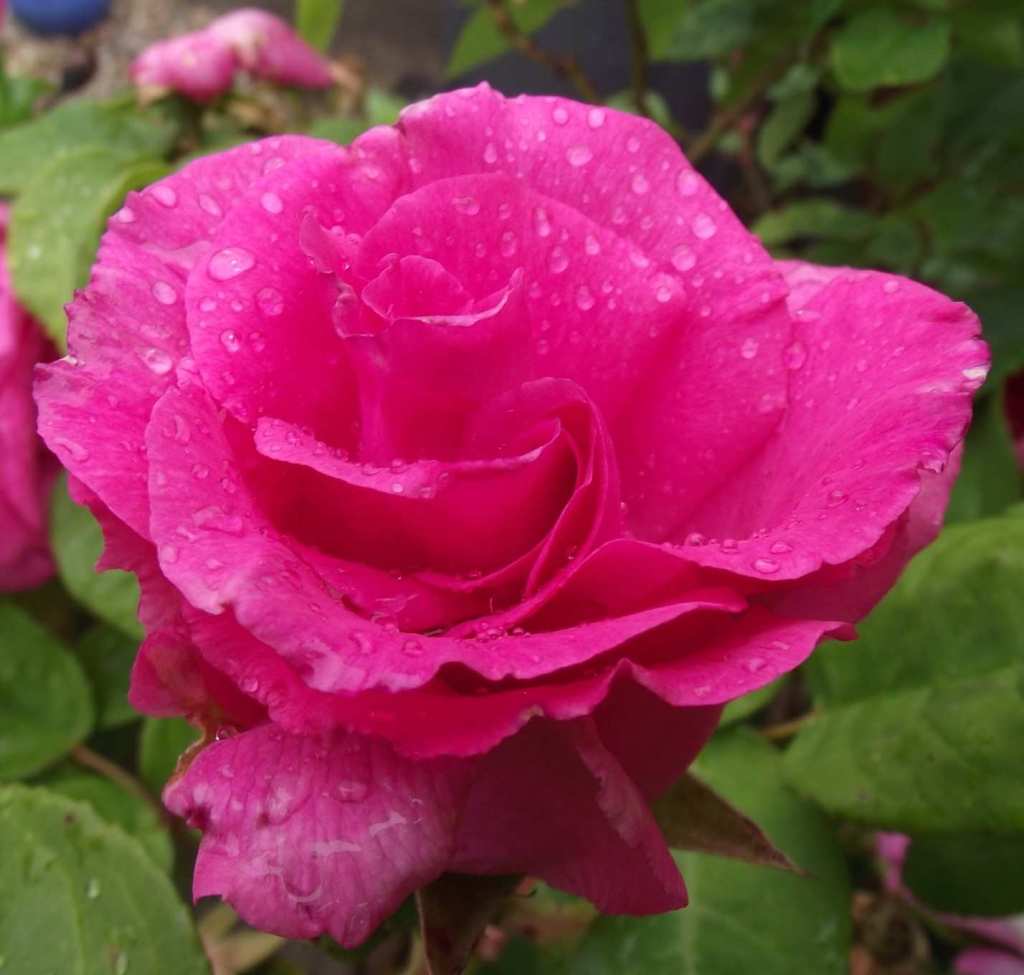
Rosa ‘Zéphirine Drouhin’
Finally a rose. I am really happy to be able to grow roses here, although I have limited them to the climbers and ramblers. I love ‘Zéphirine Drouhin’, it is the only rose that I managed to grow in my previous, shady, damp garden.
This meme is hosted by Jim Stevens who is to be found with all the details and links to plenty of other blogs to enjoy at Garden Ruminations.
We have had a very wet week, with very little sun. In between showers I have discovered a couple of pests causing damage to foliage. The mullein moth caterpillar has been feasting on a clump of verbascums making large holes in the leaves. I have found that the easiest way of combating them is to simply pick them off and dispose of them. It’s the first time I have come across these, even though I have been growing verbascums for years. Another first is the geranium sawfly. I have always thought of geraniums as being pest-free and I have found no reference to the sawfly in earlier textbooks. The larvae make fairly neat, small, round holes in the leaves, which detract more from the appearance, than the actual health of the plant. Besides an odd one, the culprits had disappeared, although it’s possible to get another attack later in the year. The odd thing is that they attacked one geranium but a different species growing right next to it was left alone. The good news is no lily beetle yet!
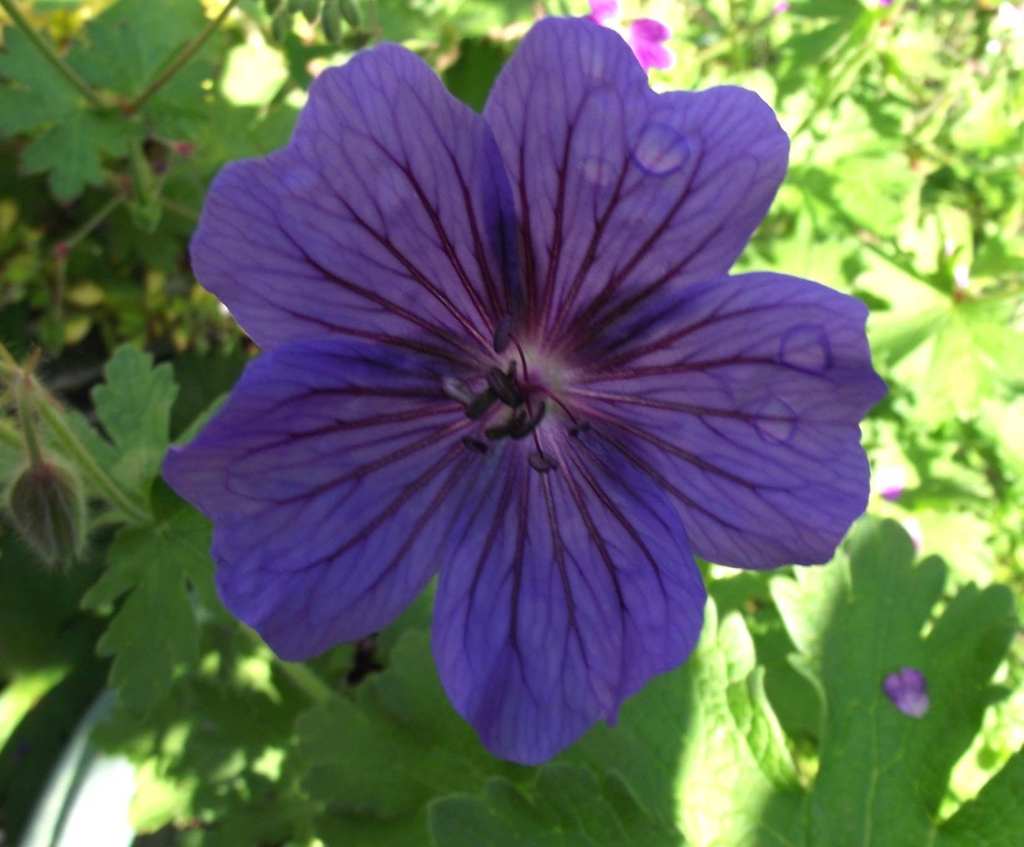
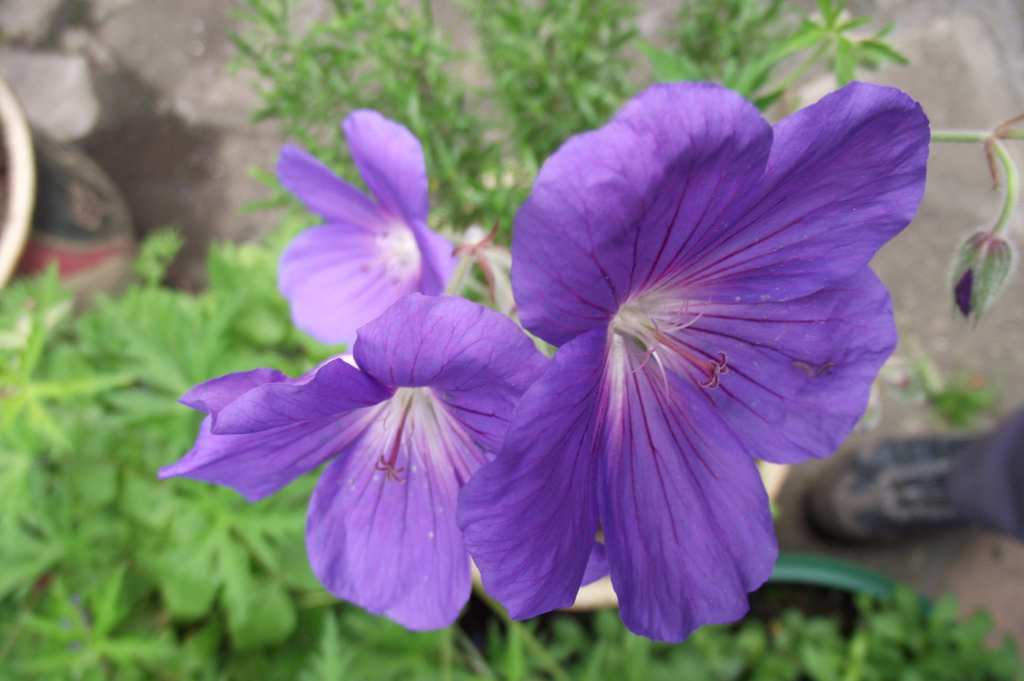
Geranium x magnificum ‘Blue Blood’
Rather magnificent veining of Geranium x magnificum ‘Blue Blood‘ which is a variant of the original cross: G. ibericum x G. platypetalum.
Primula bulleyana
Another of my favourite candelabra primulas. Although this plant was grown from seed last year, overwintered in a container, and only planted out a a month ago it has still produced a reasonably sturdy flower stem. If it had only made a weak attempt to flower I would have removed the stem to allow it to bulk up more.
Rosa ‘Albéric Barbier’Rosa ‘Albéric Barbier’
I have mixed feelings about this rambler. It opens from a really nice tight, typical rosebud. When half- open it till maintains its form. When fully open it becomes a bit of a mess! It might be that the form I have is not as good as it might be, but even though it is also only lightly scented, I am reluctant to part with it.
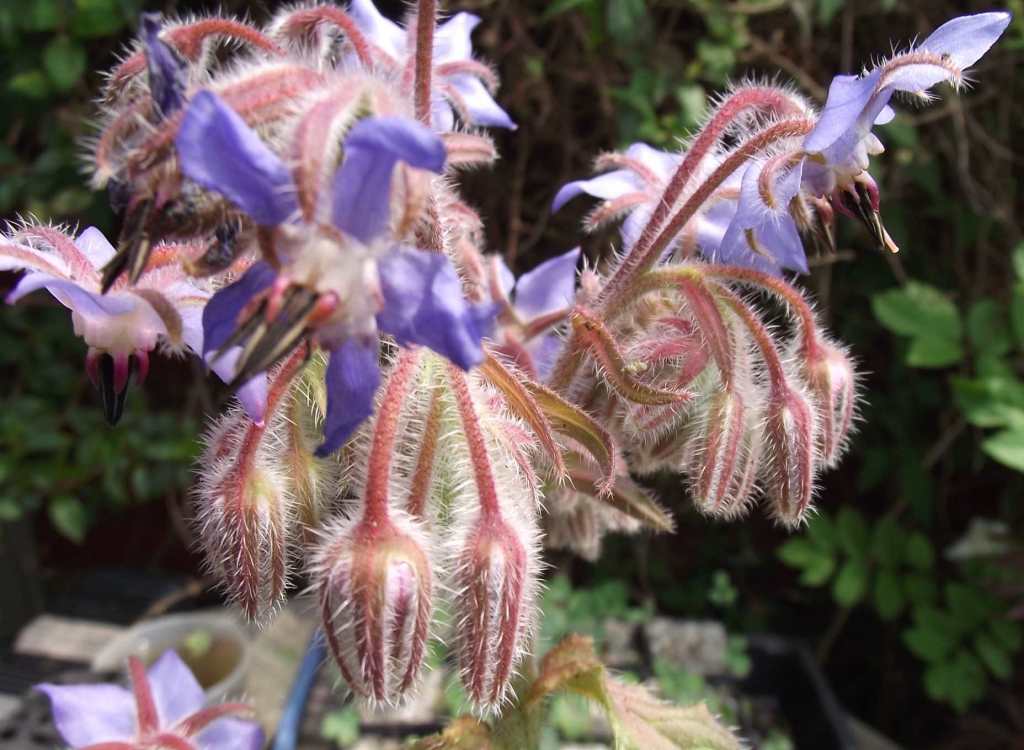
Borago officianalis
I can’t resist the colour and texture of herb borage, I even have a photograph on my wall. This plant is flowering from a cold sowing at the end of January.
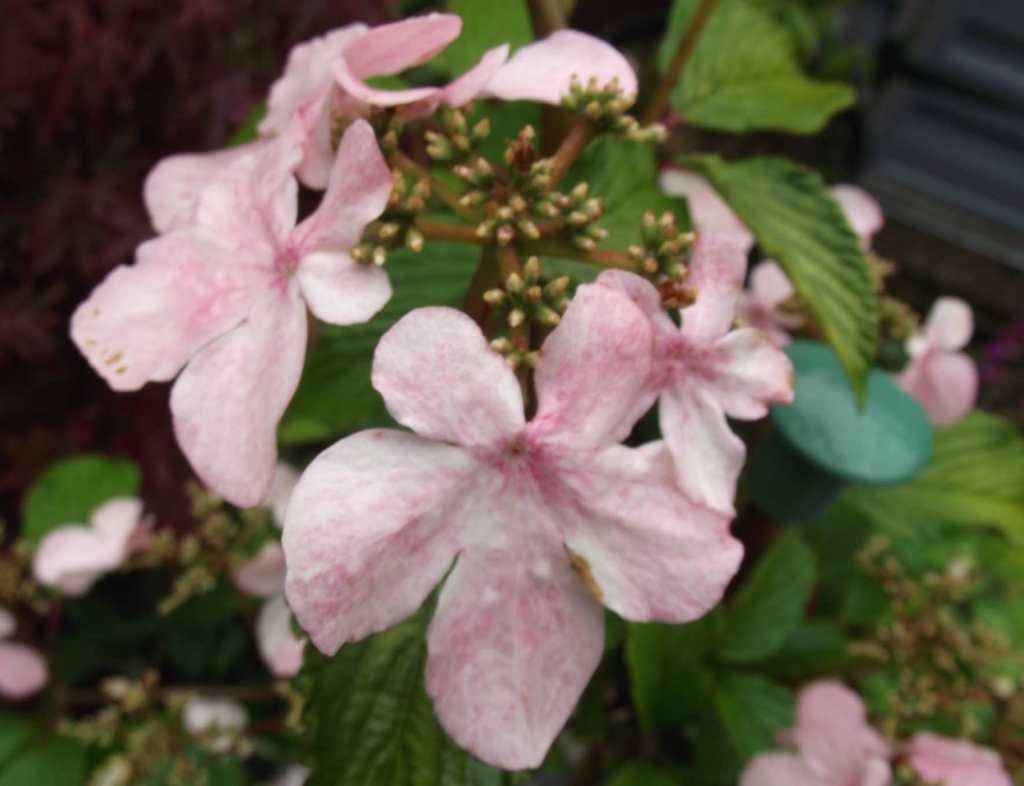
I have cheated a bit here in order to show the various stages of Viburnum plicatum ‘Kilimanjaro Sunrise’. It opens with the petals suffused quite a dark pink, goes to almost pure white, and then fades to a softer pink as it ages. This is a young plant but the flowers lasted quite well. The flowers of Viburnum plicatum f. tomentosum ‘Mariesii’, which flowered earlier, were over very quickly. I think it could have been the long dry spell that caused this to happen.
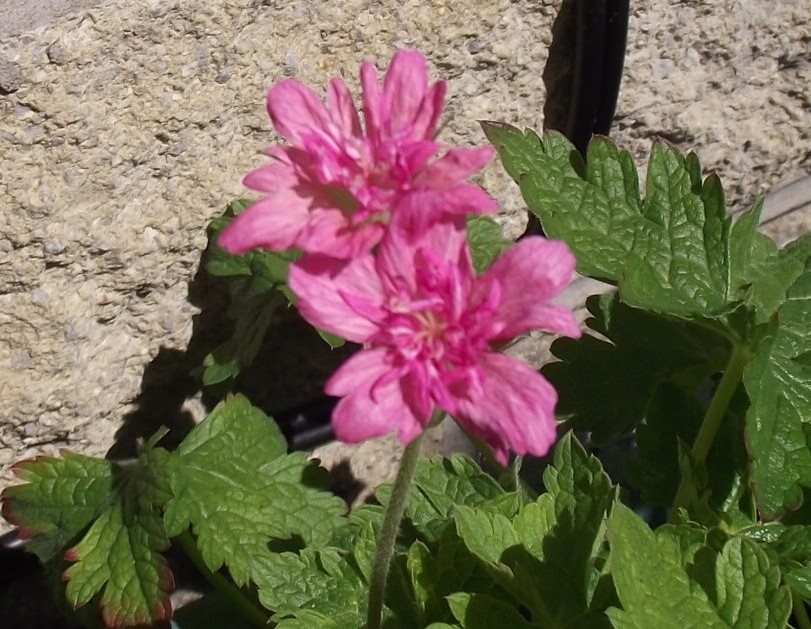
Geranium ‘Southcombe Double’
Geranium × oxonianum f. thurstonianum ‘Southcombe Double’ to give it its full title, is one of a massive group of geraniums which are variants of crosses between G. endressii and G. versicolor, that contain many of my favourites. I think that this is a rather pretty little thing.
This meme is hosted by Jim Stevens who is to be found with all the details and links to plenty of other blogs to enjoy at Garden Ruminations.
We have had three days of quite persistent rain and everything in the garden has shot up. It seems to be getting drier at the moment plus the sun is back, albeit intermittently. There seems to be quite a bit of blue in the garden, so this week I’m having the blues.
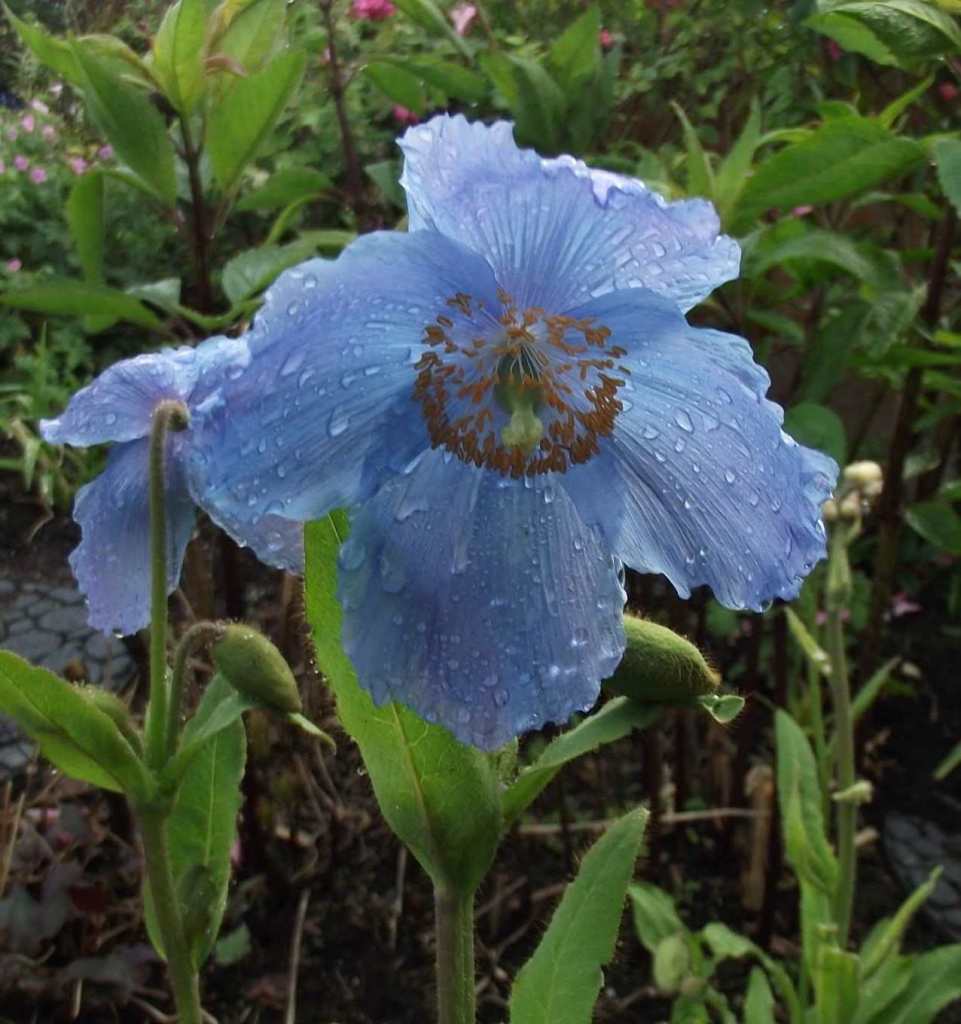
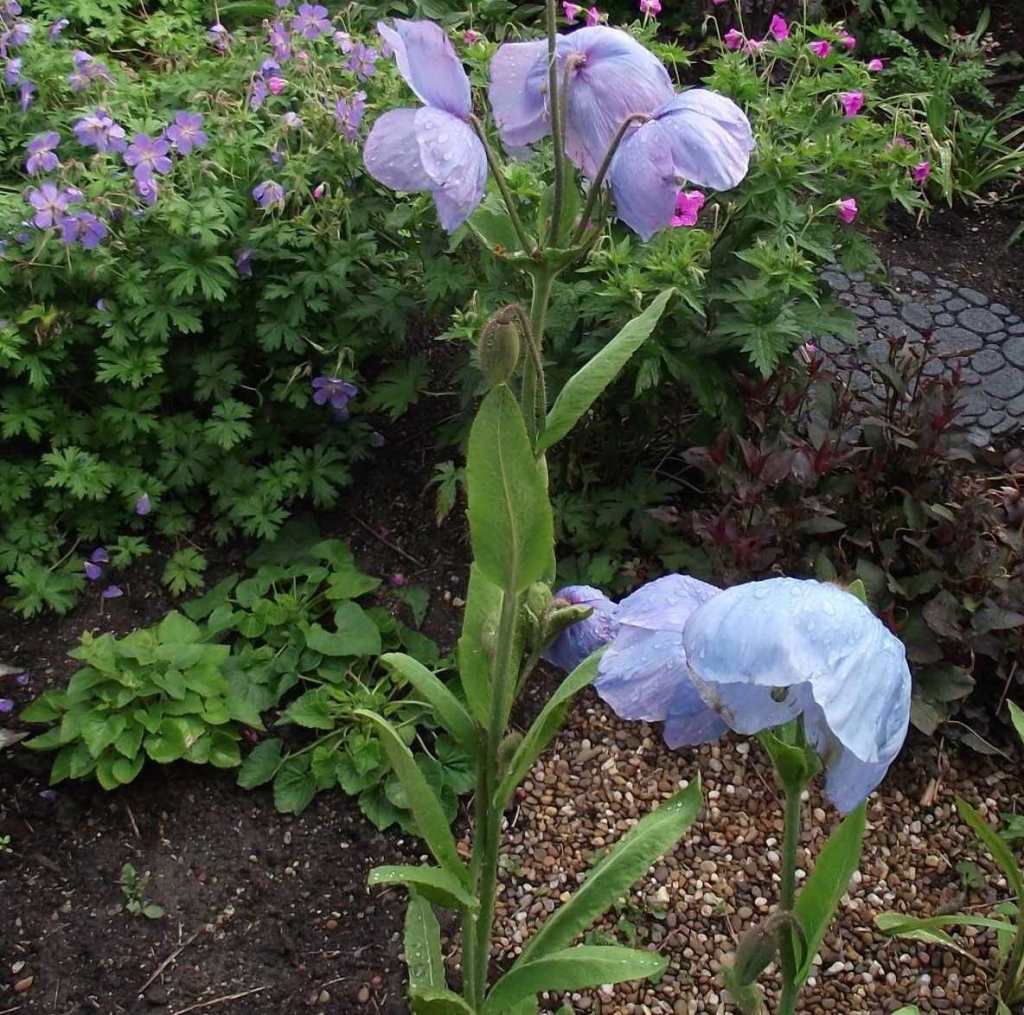
Smaller in stature than ‘Crarae’, Meconopsis ‘Crewdson Hybrid’ has been around for some time. It is believed to be an opportunist cross between M. betonicifolia and M. grandis. The interesting thing about many meconopsis is that although the original cross was made between two fertile species and the resulting plants often produce viable seed, they eventually become sterile in later generations. This means that my plants were produced vegetatively.
Geranium ‘Orion’
Geranium ‘Orion’ is in fact not an interspecies cross but a seedling of “Brookside”. One of what I like to call the “Big Blues”
I don’t think you can beat Geranium ‘Johnson’s Blue’ for strong growth and intense blue flowers. I find it can be rather a rampant grower and be a bit floppy, but I still wouldn’t be without it. As I am sure many of you have experienced geraniums, are notoriously promiscuous. This is an interspecies cross: G. himalayense x G. pratense. Another “Big Blue”!
Geranium ‘Brookside’
Geranium ‘Brookside’ is officially violet/blue so I am including it. Another “Big Blue” this is an interspecies cross: G. clarkei ‘Kashmir Purple’ x G. pratense.
Campanula portenschlagiana ‘Mrs Resholt’
I bought this little bellflower, sometimes known as ‘Resholt’s Variety’, as an edging plant. I will probably move it as it doesn’t seem suited to where it is. The soil is very poor, and I managed to run over it with the recycling bin a few weeks ago! Unfortunately it isn’t in full flower yet but I am running out of blues!
Meconopsis ‘Crarae’
No excuses! I couldn’t resist one last picture.
This meme is hosted by Jim Stevens who is to be found with all the details and links to plenty of other blogs to enjoy at Garden Ruminations.
The unseasonal weather continues although it is beginning to cool down now with the possibility of frost on Monday night. Still no rain so regular watering of containers continues. We have had a very bad moorland fire the smoke from which was visible from where I live. It almost engulfed the site of the famous Cat and Fiddle, which is now a distillery, and we had the unusual sight of a helicopter water bombing the fire. The garden is coming on very quickly and, although there is not a great deal of flower to be seen, I have managed to scrape together a six.
Geranium himalayense
The first of my geraniums to flower. I would like to apologise in advance as I think I will be relying on them rather a lot this year to fill the Six on Saturday slot.
Galium odoratum
British native, Sweet woodruff, has proved useful for ground cover, along with Euphorbia characias, in a rather difficult corner. I’ll have to be careful as they are both invasive, but I think the hostile conditions should limit their ambition. I always think woodruff looks very tatty going into winter, it’s a pity it isn’t evergreen.
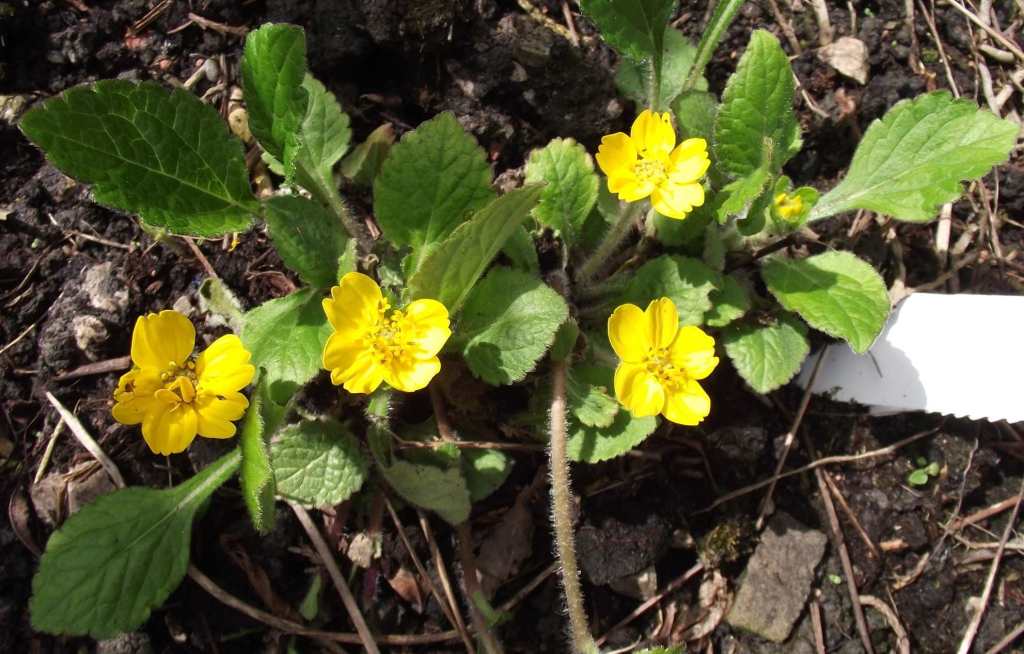
Chrysogonum virginianum
My first time with this rather neat, buttercup-like, little creeping plant from the eastern United States. It appears to be, at the very least, semi-evergreen, as it has kept the majority of its leaves over the, albeit mild, winter.
Spanish or English? Is it a hybrid? This clump of bluebells has a very faint scent and the stems are “nodding” rather than upright, typical of the English bluebell. The flowers are light coloured more like the Spanish species. I also have a clump of more robust plants which are not yet in flower, as soon as they are I am going to try a direct comparison. Until then I rather think these are Spanish, Hyacinthoides hispanica or are they a hybrid…………..?
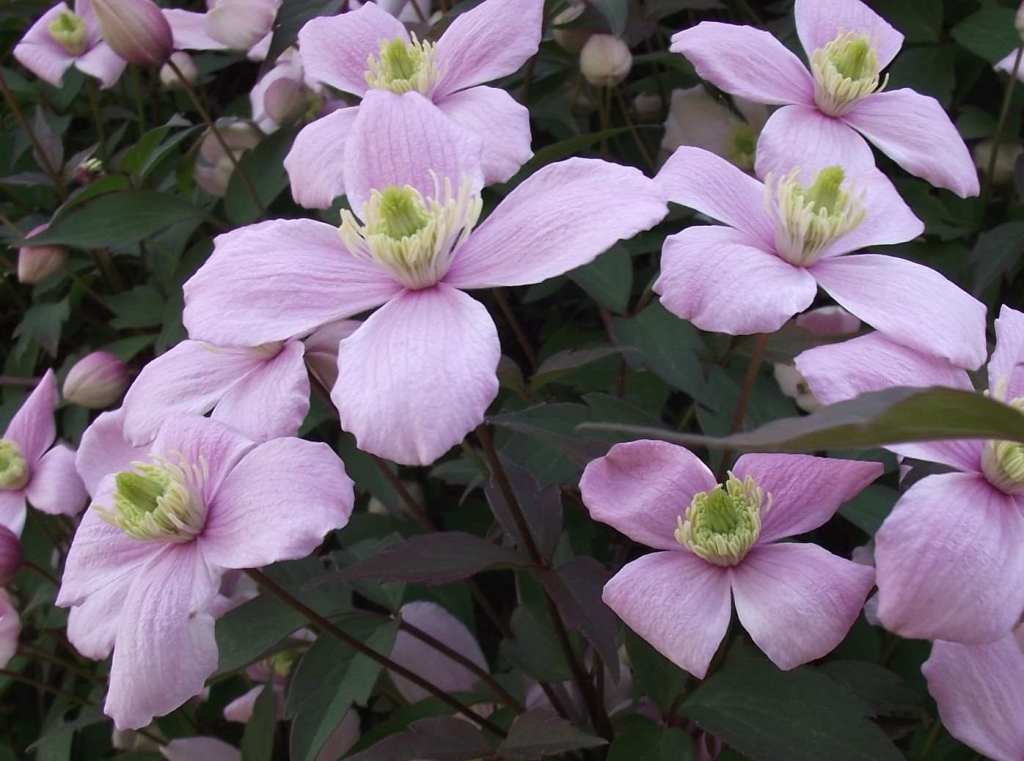
Clematis montana ‘Morning Yellow’Clematis montana
I think Clematis montana ‘Morning Yellow’ is a rather neat cultivar, it is definitely more cream than yellow, fading to white as they age. It doesn’t appear to be as rampant and flower as prolifically as montana, but nevertheless gives a good show. Both have that nice delicate vanilla scent.
Aquilegia vulgaris
A rather nice self-seeded common aquilegia that has appeared in a crack in the paving. I had too many aquilegias appearing in the garden so I ripped out a fair number as they came into flower, leaving only those of interest. This one must have escaped my notice!
This meme is hosted by Jim Stevens who is to be found with all the details and links to plenty of other blogs to enjoy at Garden Ruminations.
There is always confusion when talking about geraniums, the colourful plants that we use as summer bedding are actually pelargoniums the plants that we are looking at here are from the genus Geranium and are generally hardy perennials ranging from the small “alpine” types to probably the most useful border and ground-cover plants available. There are many species, hybrids and cultivars available but the flowers generally range through shades of blue, purple, pink and red with some white forms thrown in.
The thing to remember about geraniums is that they are a promiscuous lot enabling the plant breeders to have a field day when looking for new seedlings, many of the parent plants being British natives or those which have naturalized here. The main aim with border geraniums was to develop plants which will flower for long periods or at least have two flushes and to increase flower size.
Geranium ‘Rozanne’ illustrates just how random selection can be. Rozanne has won many prestigious awards including the public vote for Chelsea Plant of the Centenary for the decade 1993-2002. It flowers for long periods and is very attractive to bees and other insects, the almost perfect plant and a big commercial success yet it was a garden find that luckily was spotted by keen gardeners and then passed on to professional growers. It is believed that it is a naturally occurring hybrid of G. himalayense, the Himalayan geranium, and a cultivar of G. wallichianum known as ‘Buxton’s Variety.’
G.’Eureka Blue’ is a seedling of G.’Orion’ which in turn was a seedling from G.’Brookside’ which is a hybrid between G. clarkei ‘Kashmir Purple’ and G.pratense.
Johnson’s Blue or G.x johnsonii ‘Johnson’s Blue’ is thought to be a cross between G.himalayense and G.pratense our own Meadow Cranesbill, so you can see how bringing plants together from all over the world goes to produce the hybrids and cultivars that we see today.
Geranium ‘Light Dilys’
Geranium ‘Light Dilys’
‘Light Dilys” parents appear to be lost in the mists of time, however Geranium sanguineum is probably in the mix.
Geranium macrorrhizum is a semi-evergreen perennial growing to about 2′ with attractive fragrant foliage which is useful for under-planting trees and shrubs as it is tolerant of some shade and dry soils. Both these were planted in my “woodland” garden.
Geranium nodosum
Geranium nodosum ‘Swish Purple’
Geranium nodosum has a sprawling habit which makes it ideal for ground-cover particularly in a woodland setting where it will tolerate dry shade.
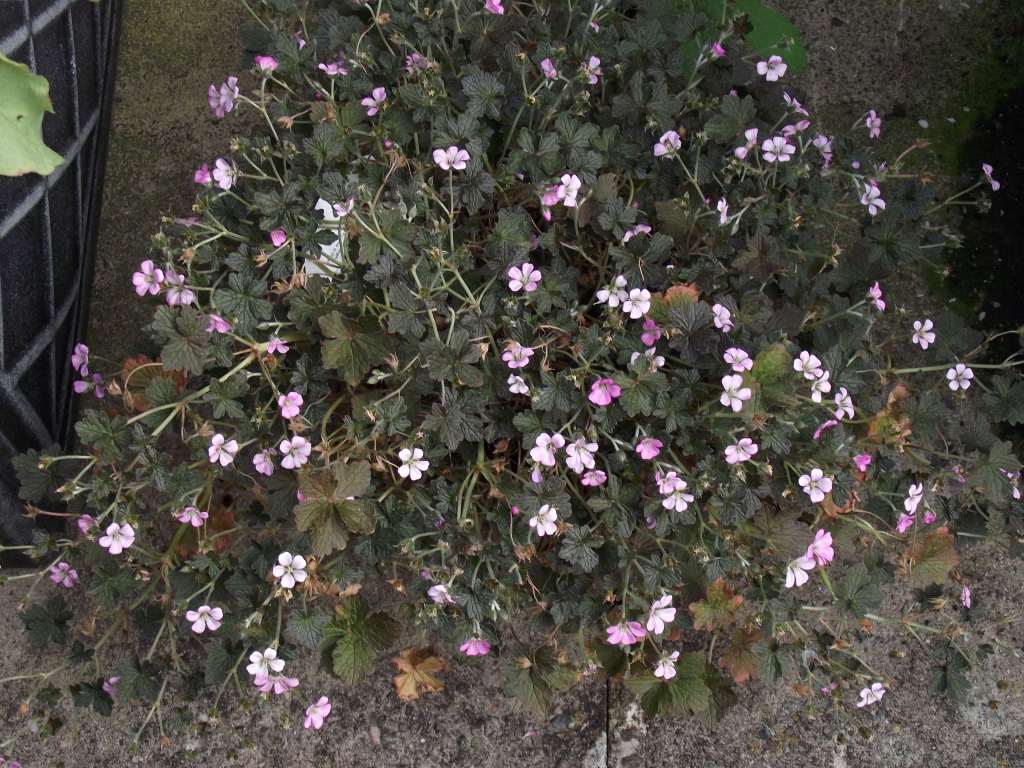
Geranium ‘Orkney Cherry’
Geranium ‘Orkney Cherry’
‘Orkney Cherry’ is an outstanding plant from geranium breeder Alan Bremner who has made many contributions to the geranium world. Bred in the Orkneys its deep green foliage turns to bronze as the year goes on contrasting with the delicate pink flowers which are present from early summer onward. Semi-evergreen.
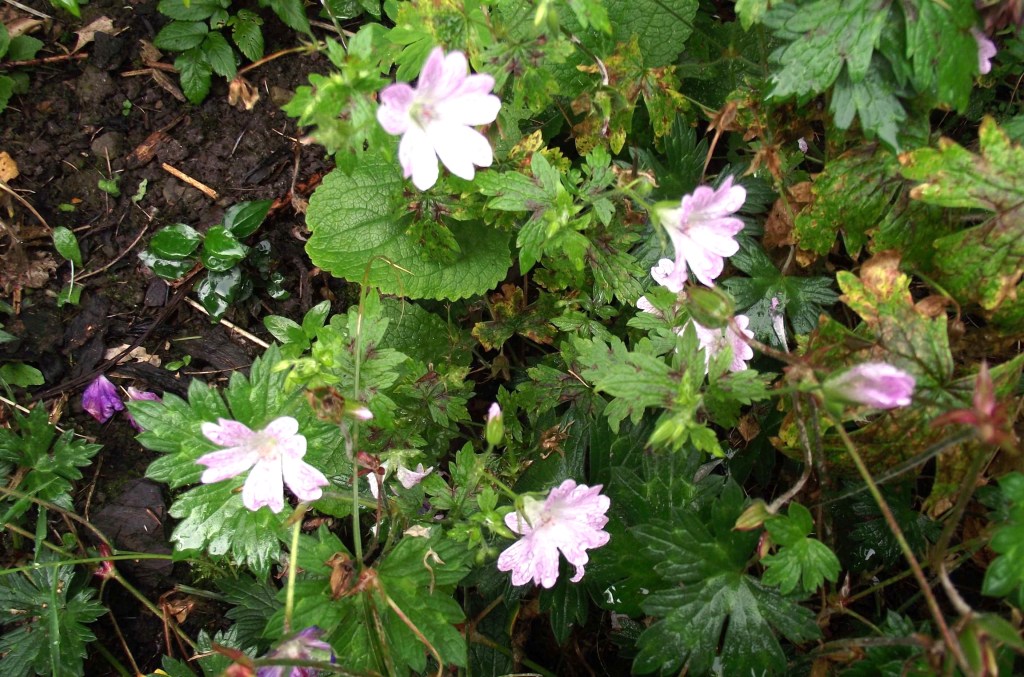
Geranium oxonianum
Geranium x oxonianum ‘Katherine Adele’Geranium x oxonianum ‘Wargrave Pink’
The specie name x oxonianum is given to all crosses between G.endressii and G.versicolor. The parent plants cross-fertilise readily and the resultant hybrids are fertile which allows a myriad of cultivars to be developed. ‘Wargrave Pink’ is probably my favourite geranium, it grows strongly, is tolerant of a wide range of conditions and flowers for at least six months of the year. Another reason I like it is because it is a lovely clear pink and a welcome change from all the blues and purples.
Geranium phaeum
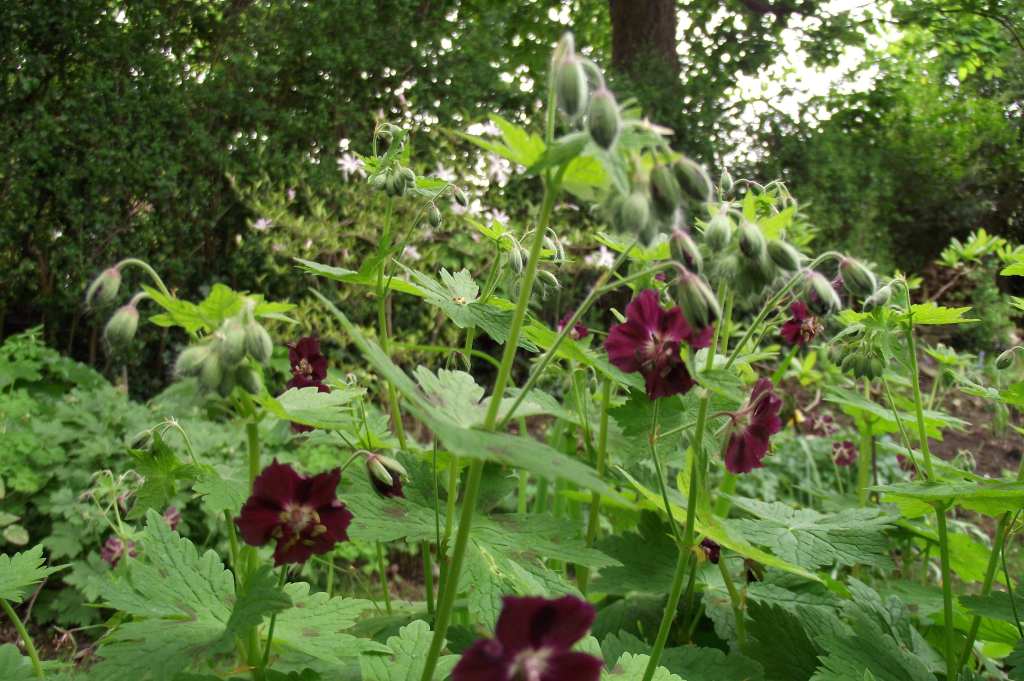
Geranium phaeum ‘Samobor’
Geranium phaeum is a striking upright perennial which is useful in a woodland setting as ground-cover as it will grow in shade. The deep purple flowers of ‘Samobor’ are particularly attractive but there is a white form which shows up well in a shady spot.
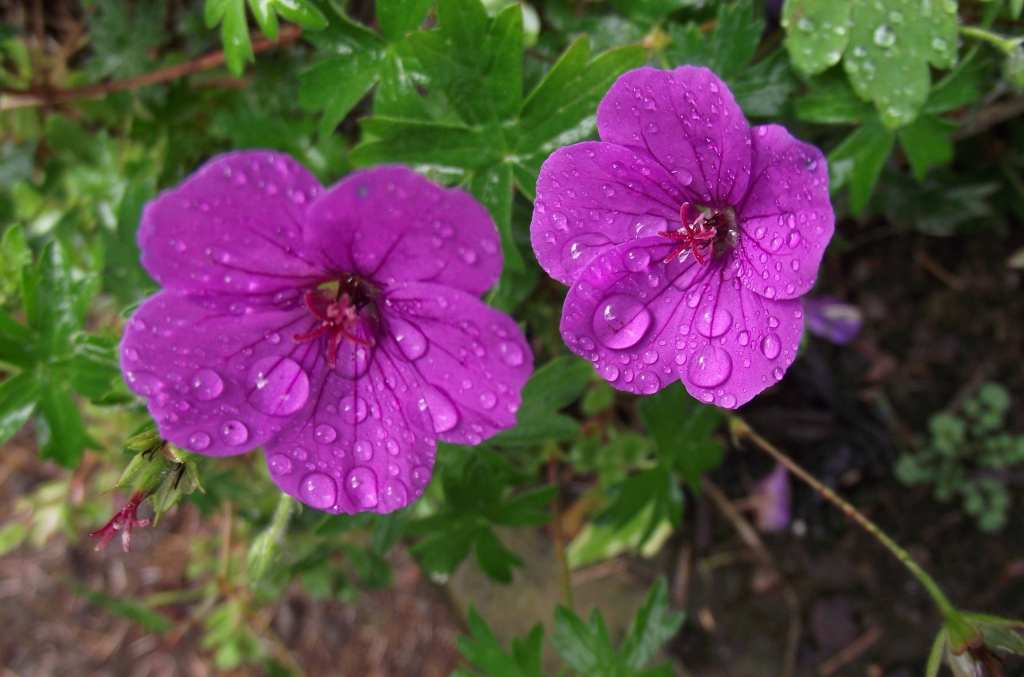
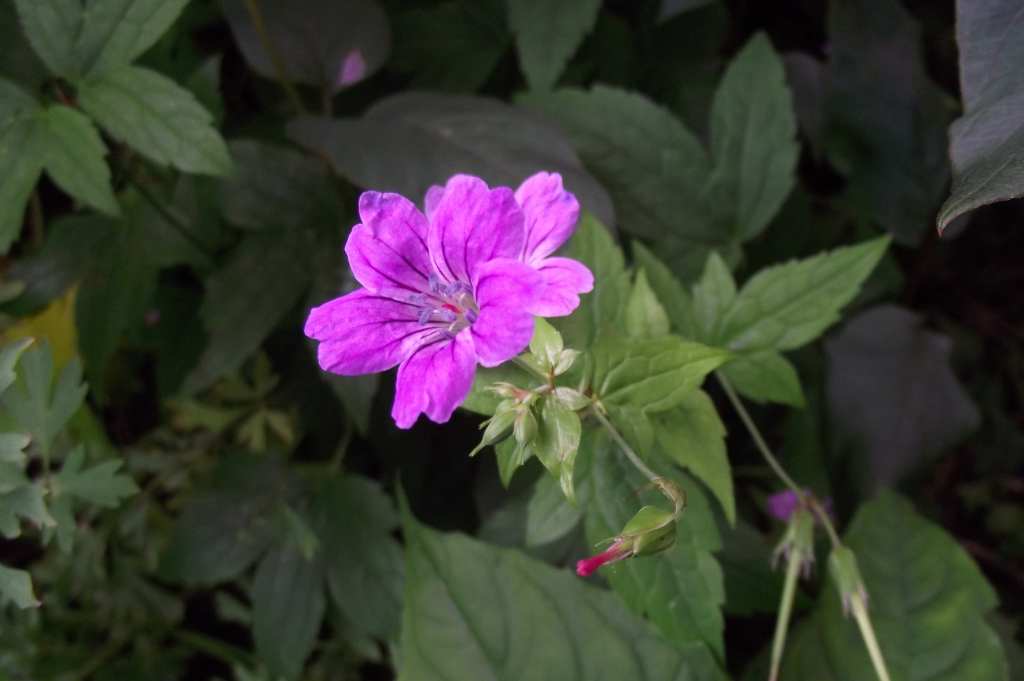
Geranium pratense
Geranium pratense ‘Galactic’Geranium pratense ‘Hocus Pocus’Geranium var. pratense. f. albiflorum. ‘Galactic’Geranium pratense ‘Summer Skies’Geranium pratense var striatum ‘Splish Splash’
Geranium pratense the Meadow Cranesbill is an important contributor to the geranium gene pool and crops up as a parent of many modern hybrids, its upright habit and extreme hardiness are desirable attributes. Along with its roll as a specie to cross with, many cultivars have also been developed from selective breeding.
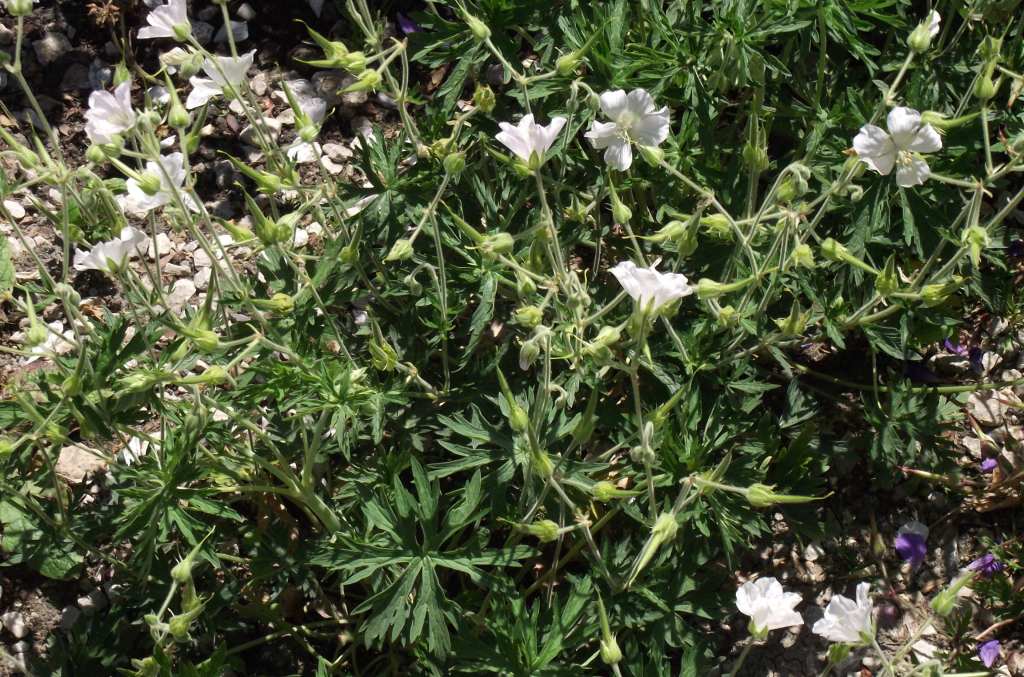
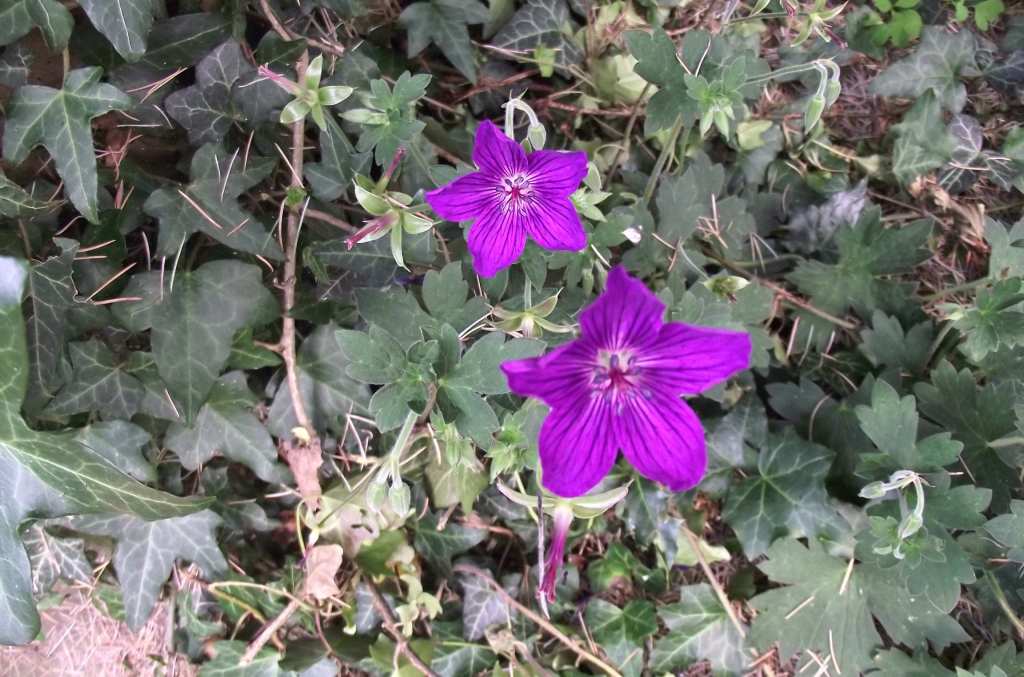
The Hedgerow or sometimes Mountain Cranesbill has flowers which are distinctly different from most geraniums with deeply indented petals giving the illusion of a higher number than normal. It has naturalised itself in the UK where it can be found growing mainly in hedgerows. I have seen it described as coarse but I feel that does this lovely little flowering plant an injustice, it is a prolific seeder and crops up everywhere which, to me, only adds to its charm, probably not so much if you like a nice orderly garden.
Geraniumrenardii
Geranium renardii
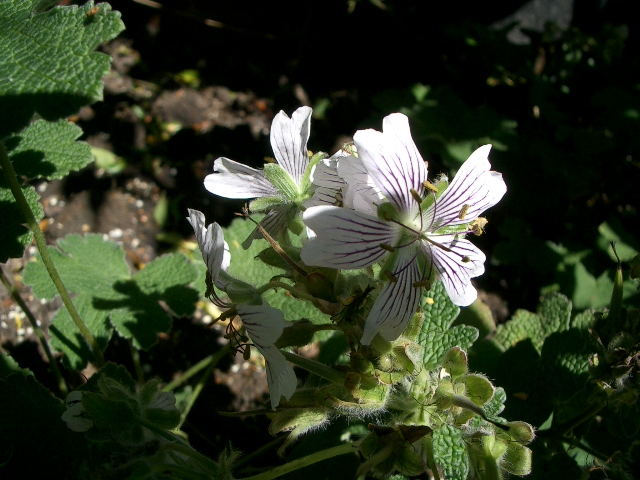
The Caucasian Cranesbill is a little unusual, it forms clumps of velvety, wrinkled, scalloped leaves which change colour as they age, topped by heavily veined flowers. Needs a bit more care than most, a sheltered well-drained sunny site is best.
Geranium sylvaticum
Geranium sylvaticum ‘Album’Geranium sylvaticum
The Woodland Cranesbill is a beautiful little plant ideal for under-planting trees and shrubs, tolerates shade but prefers a moist soil. Found in damp meadows and open woodland in its native habitat, it is also found growing wild in the UK. The name really says it all when it comes to the plant’s growing requirements, the Latin sylvaticum actually means of woodland.
Geranium versicolor
Geranium versicolor
The Pencilled Geranium gets its name from the veined flowers and is one of the parents of the x oxonianum hybrids. This beautiful little plant is semi-evergreen and can tolerate some dryness and shade although it thrives in good moist border soil in a sunny position. Ideal cottage garden plant.
Geranium wlassovianum
Geranium wlassovianum
Geranium wlassovianum has a long flowering period which in addition has sprawling foliage which changes colour through the year, unfortunately this can’t be seen in the picture. Found in damp grasslands in its native habitat, it grows well in any good loam and can tolerate some shade.
Hardy Geraniums Culture
With such a large genus it is impossible to be specific, however in general terms many are semi-evergreen and have either a clump forming, trailing or creeping habit. The single flush types can be cut down after flowering which hopefully will induce a second flush. With the others I tend to leave the old foliage on over winter and cut down in the spring but this can be done after flowering, in autumn, if one prefers. Pretty much all geraniums are happy in a good moist but well drained loam in a sunny position although some are more shade and slightly arid tolerant than others. Propagation is by seed for those which come true, by cuttings, or more usually division, in the garden. For those plants which have to be vegetatively propagated to come true best to buy online from a specialist nursery unless you are lucky enough to have one near you.
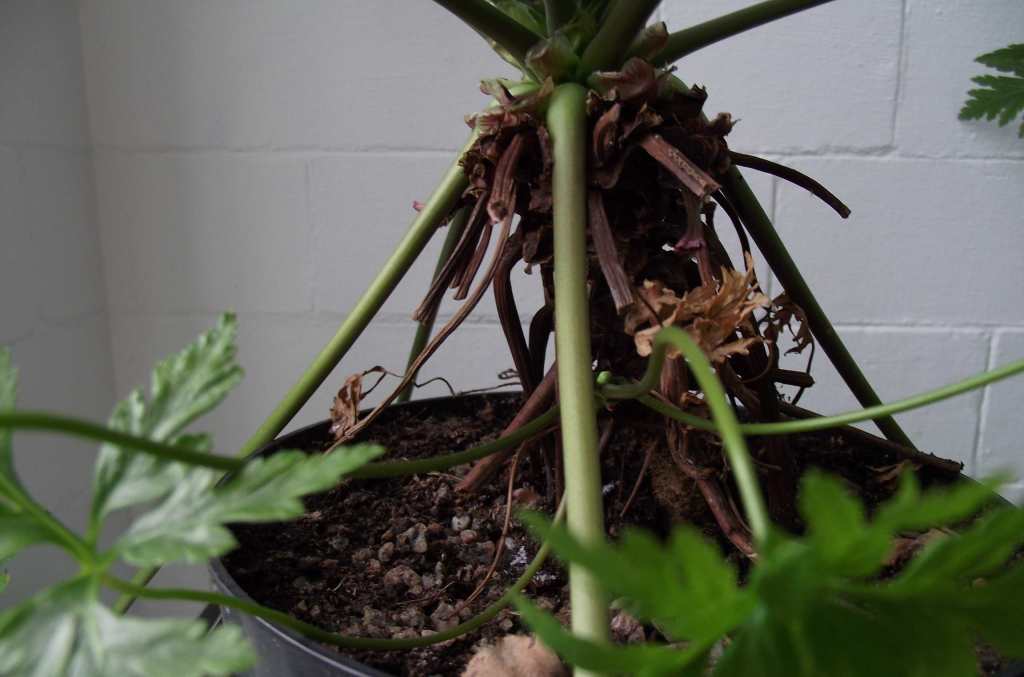
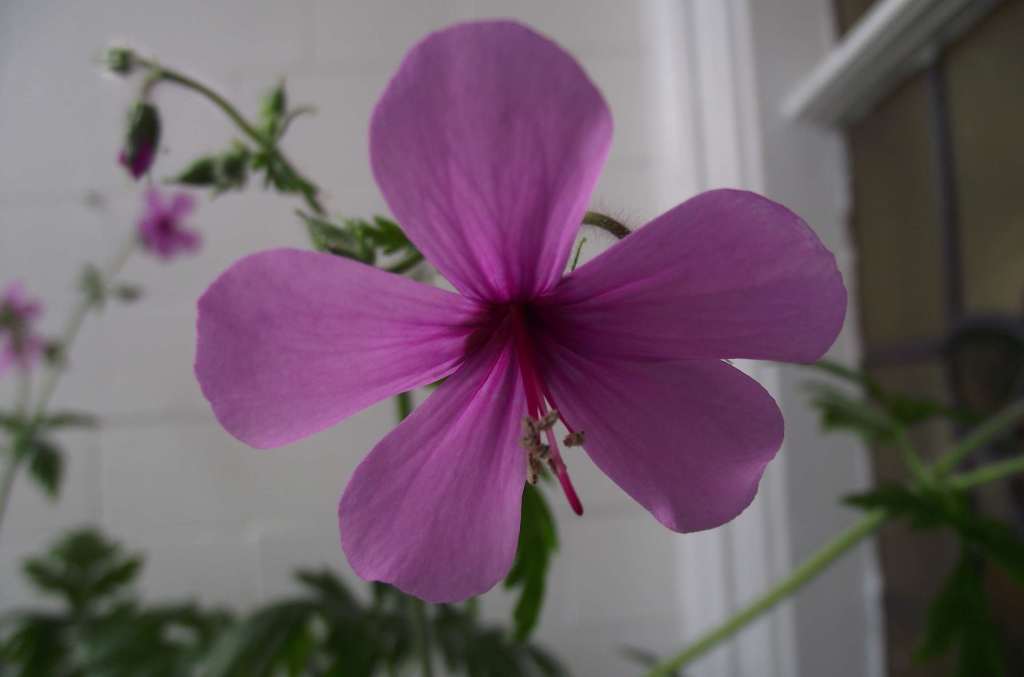
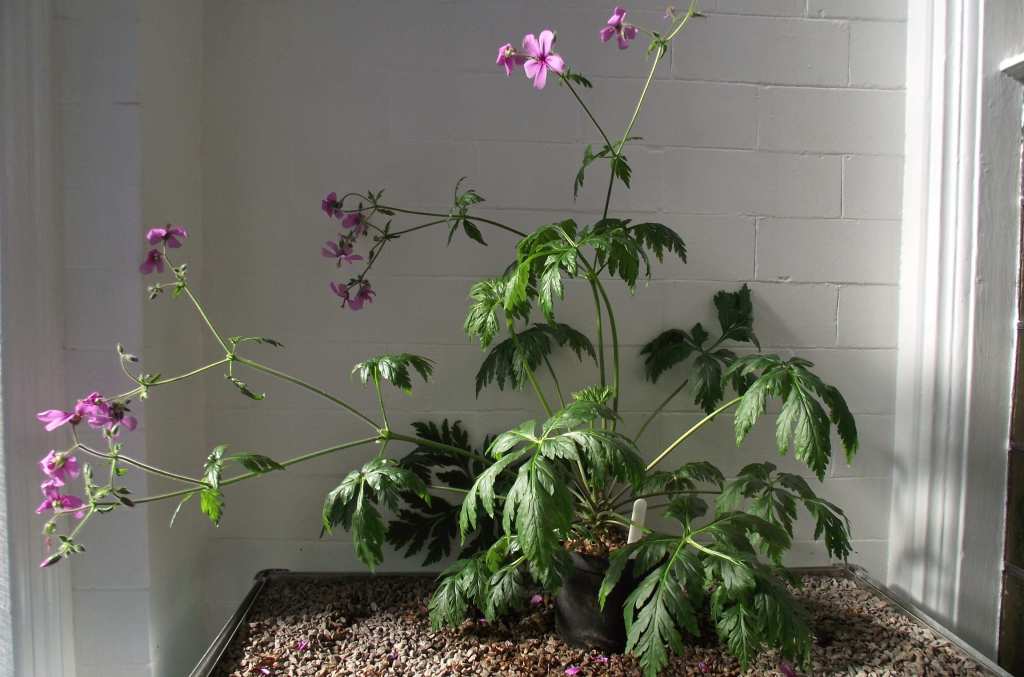
Why bother you might ask, this plant was from a packet of seed I inadvertently bought. The Maderian Cranesbill is the largest of the geraniums, it is biennial and can reach 5′ before flowering in its second year. It may survive in the warmest of gardens but there was absolutely no chance of that happening in the North of England. The plant threw out ariel roots from the crown down the outside of the pot forming a support some of which I, in my ignorance, cut off, however the plant survived and flowered.
Geranium palmatum flowerGeranium palmatum
The Canary Island Cranesbill is an evergreen perennial which needs a warm garden to survive in the UK. Very similar to G.maderense which, at one time, was thought to be a form of G.palmatum until it was identified as a separate species.
Book reviewer and garden enthusiast. Updates from my Hampshire garden. Usually talking about books and plants. People do not forget books or flowers that touch them or excite them—they recommend them.
































 A Plantsman's World