Temperatures are remaining around 20°C which rather suits me. I am writing this on Friday and we are expecting heavy rain later which is much needed. The garden has really filled out now and I can hardly move for plants. Which is making it difficult to get to any weeds without treading on things I’d rather not. A mixed bag this week of plants I can name, and those I can’t.
Update 6.00am Saturday. As always, it seems, the promised heavy rain went north of us. When I looked out this morning everywhere was dry! More heavy rain forecast for early morning tomorrow. Fingers crossed.
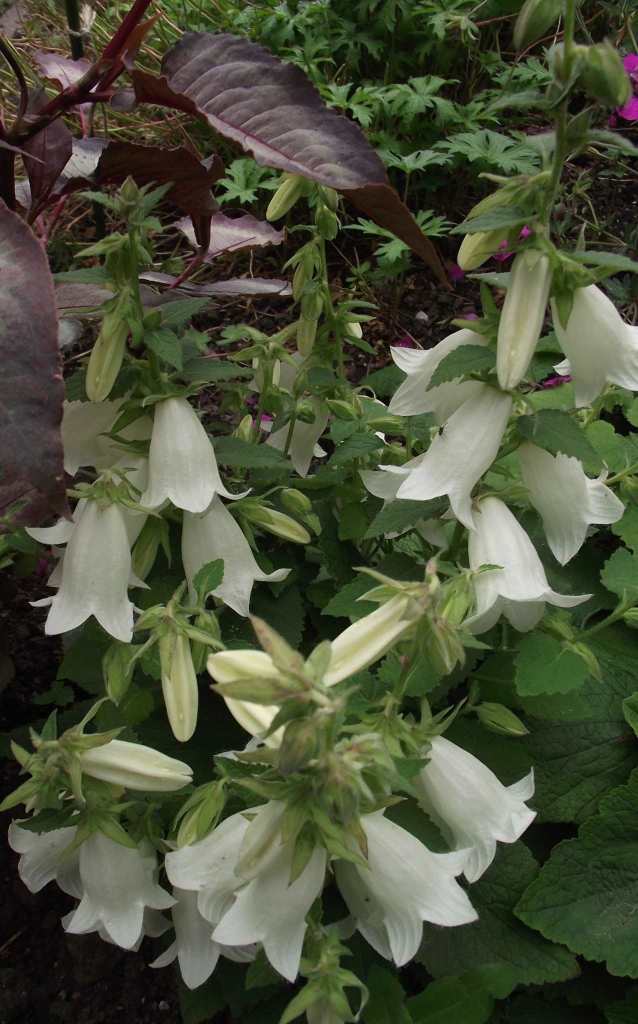
This little campanula is from a packet of seed labeled large white flowered. The flowers are white and also large for the plant, which is typical of campanulas. The plant itself however, is less than a foot tall. It reminds me very much of Symphyandra hoffmannii which I used to grow.
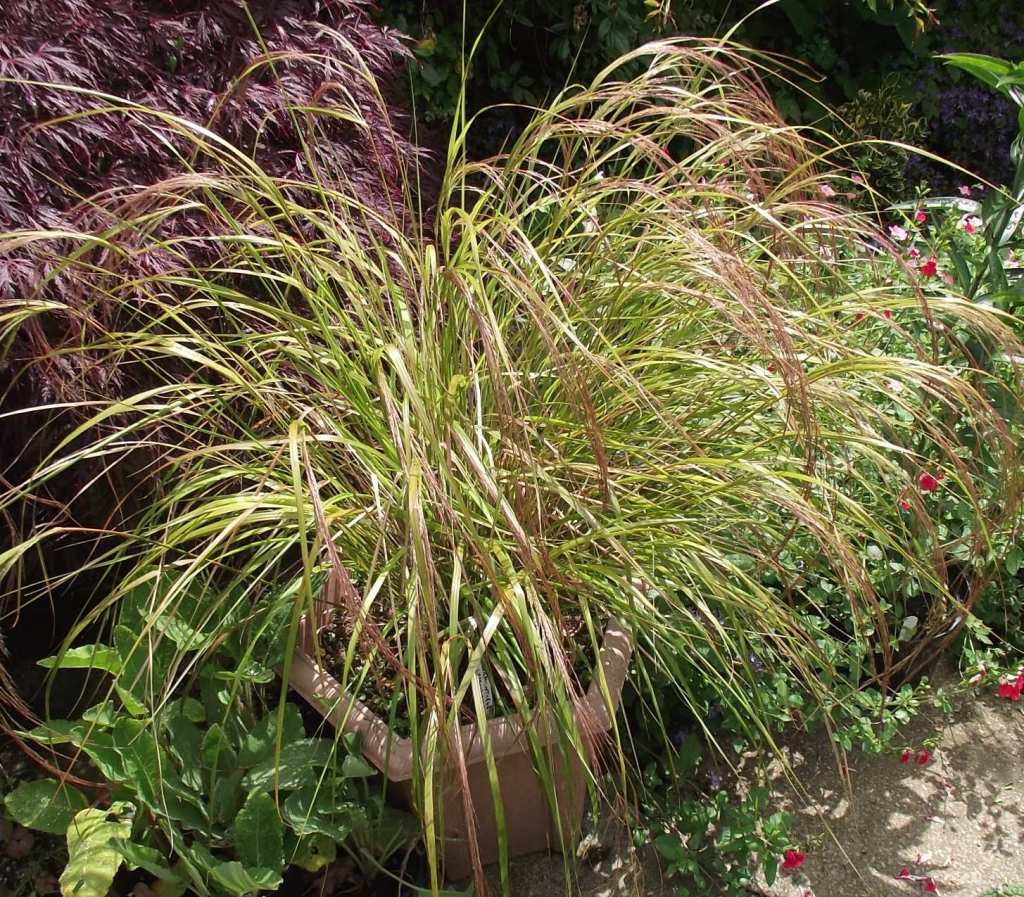
I am not a great fan of grasses but I find Anemanthele lessoniana, the pheasant tail grass outstanding. Unfortunately the picture doesn’t capture the effect of it glinting in the sunlight as it does. It will carry on throughout the year with the leaves taking on yellow, orange and red streaks towards winter.
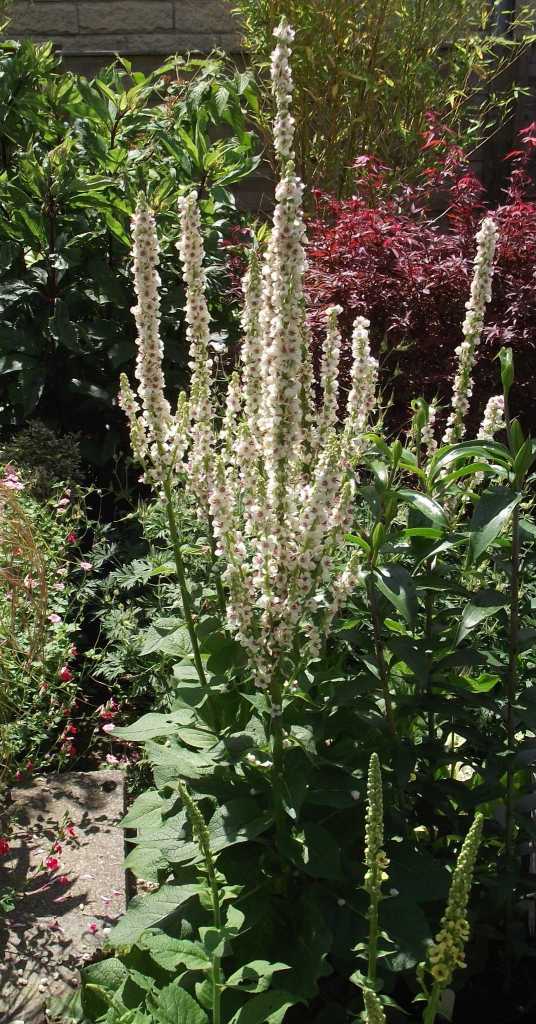
This white, self-seeded verbascum has improved year on year. I know the wild plant is somewhat looked down on as a weed but I find them rather attractive. A big plus is that they are constantly visited by numerous bees. Both the white one, and the smaller yellow one, in the foreground, originated from a packet of mixed verbascum seed, but these plants have seeded themselves, into the paving, from elsewhere in the garden.
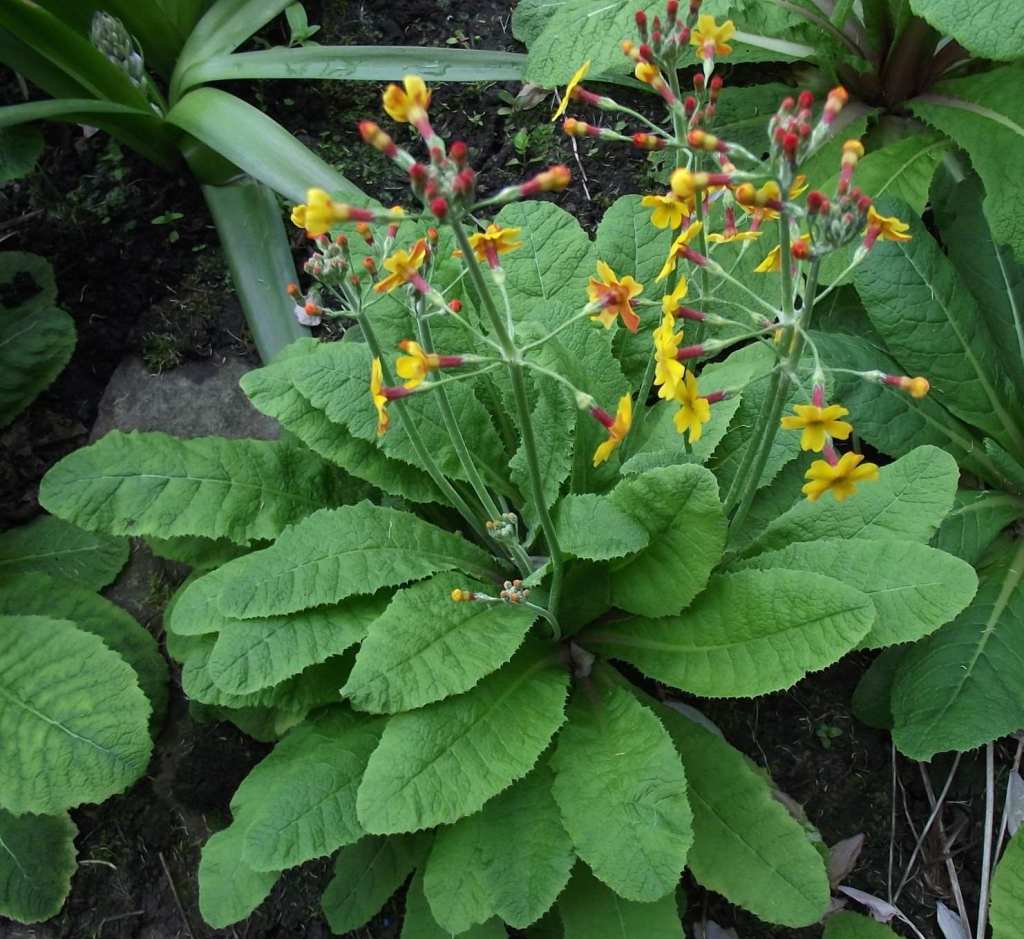
Primula x bulleesiana showing fasciation. This is one of the few botanical “coveralls” that I can relate to. x bulleesiana is obviously the combination of bulleyana and beesiana. Fasciation is quite common in primulas, particularly the candelabra types. There seems to be a myriad of things that can cause it from genetic mutation to viral or insect damage, which means, I think, that nobody is really certain.
Another plant that has seeded itself into the garden. This rather neat astrantia has been with me for several years now, and I have just left it alone to do its thing.
The first lily flower this year from a pot I have had for years, so, naturally I have lost the label! At a guess, I think it could be Lilium ‘African Queen’ a Lilium longiflorum hybrid. But please don’t take my word for it!
This meme is hosted by Jim Stevens who is to be found with all the details and links to plenty of other blogs to enjoy at Garden Ruminations.
The heavy rain seems to have died down and temperatures have risen again. We are promised some thunderstorms in the near future, so we will have to wait and see what is in store for us.
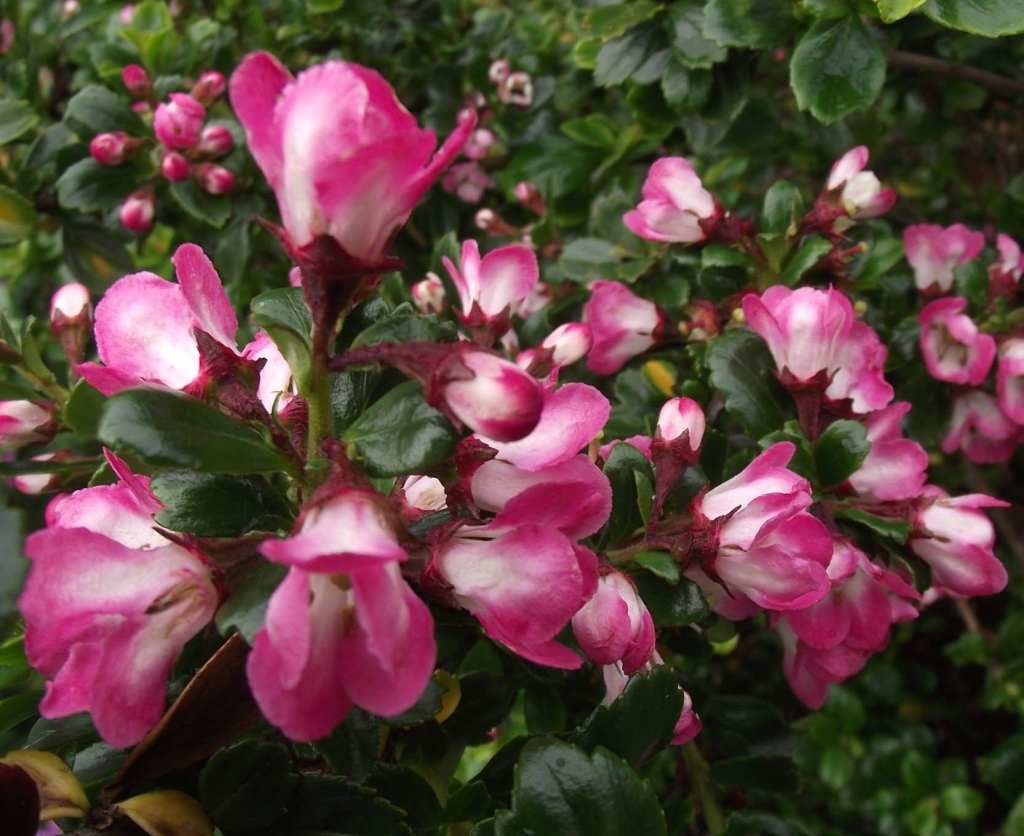
Escallonia ‘Apple Blossom’
Although escallonias don’t seem to be as popular as they used to be, this one is so aptly named. The dark green, evergreen foliage makes an excellent foil for those plants in front of it.
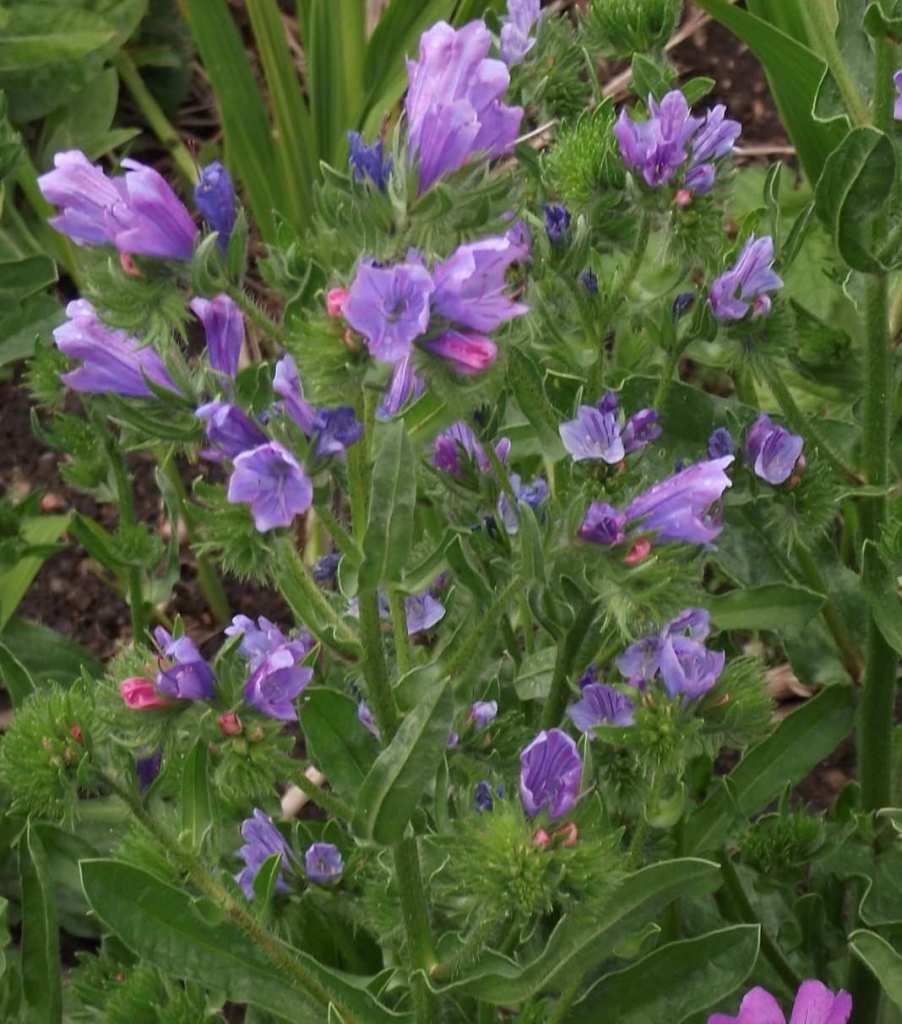
Echium plantagineum
The common viper’s bugloss (Echium vulgare) is a native flower, which I first saw in a garden when I was in my early teens. We had neighbours who had returned from India after serving in the British Raj, which we youngsters found fascinating. Charles was a keen amateur astronomer and my father and I spent a few nights with him gazing at the stars. His wife Effie (Euphemia) was a very keen gardener and an archetypical, indomitable Victorian lady who did much to encourage me in the ways of gardening. One of her favourites was viper’s bugloss, which I have grown in her memory ever since. Echium plantagineum, the purple viper’s bugloss, actually comes from warmer climes, but it is flowering from a February cold sowing.
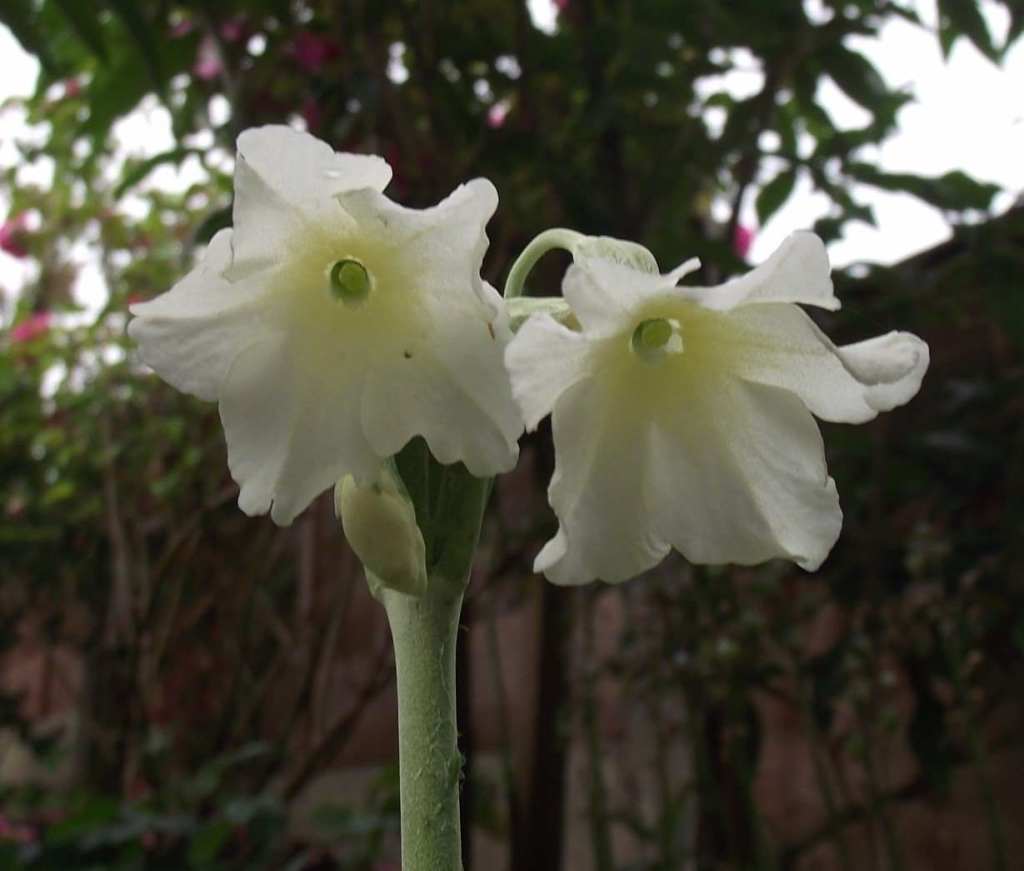
Primula alpicola albaPrimula alpicola violacea
Primula alpicola the moonlight primrose is another little beauty for a damp spot.
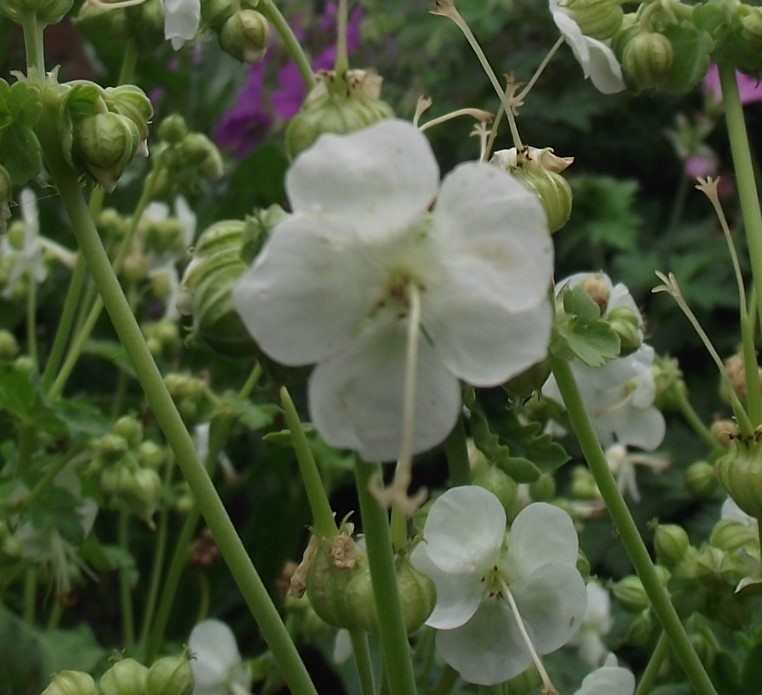
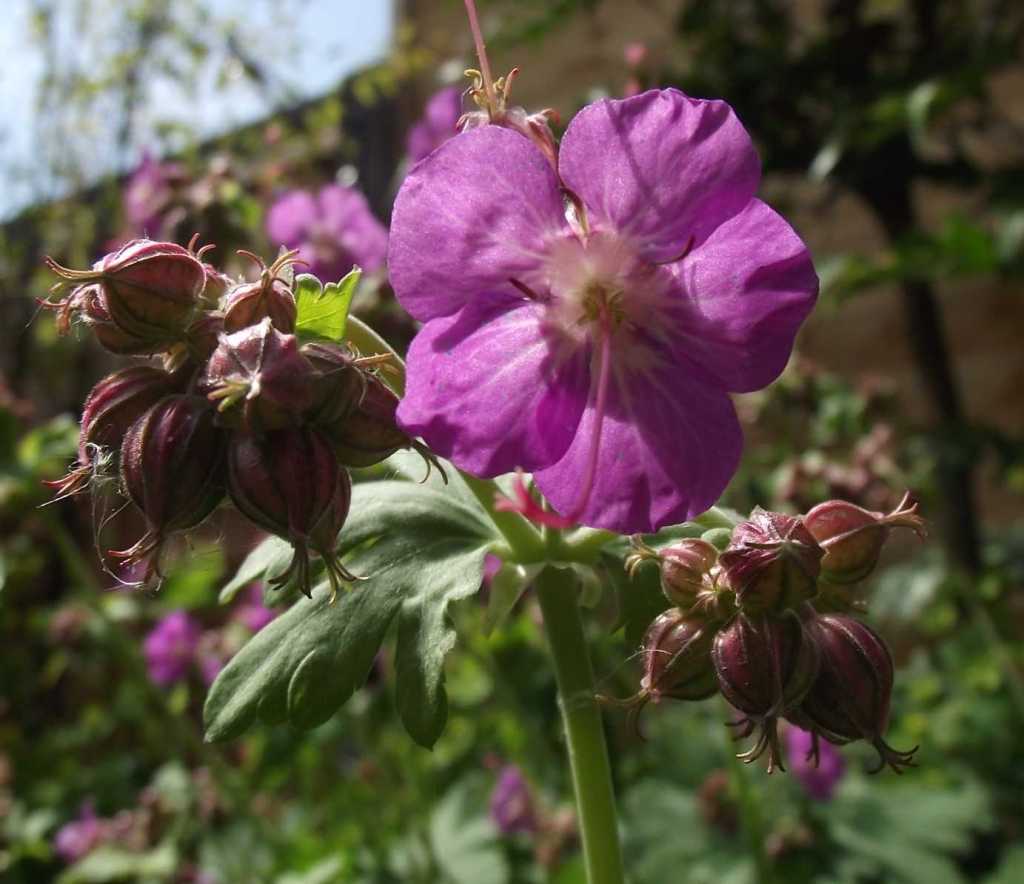
Grows virtually anywhere, autumn tints to the leaves, aromatic foliage, bee magnate. What more could anyone want?! Geranium macrorrhizum ‘Bevan’s Variety’ is very similar, in fact, to be honest, I can’t tell them apart.
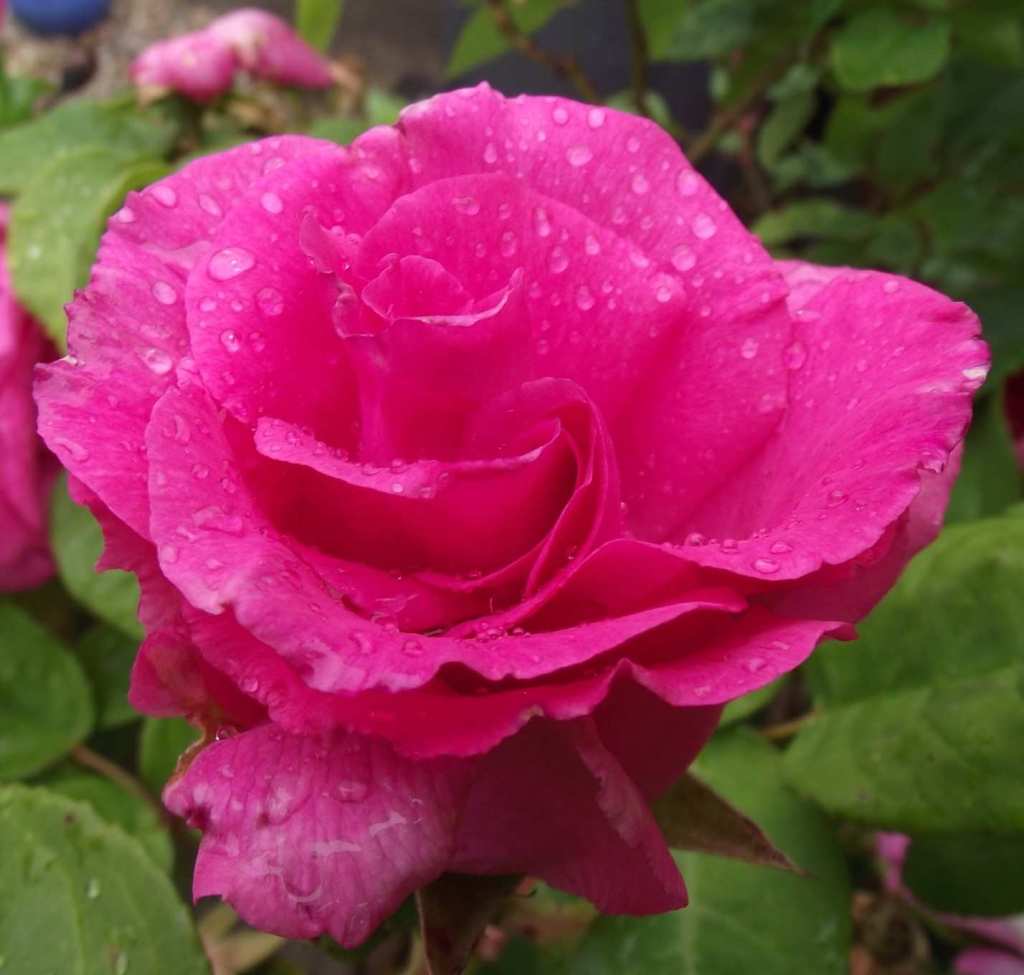
Rosa ‘Zéphirine Drouhin’
Finally a rose. I am really happy to be able to grow roses here, although I have limited them to the climbers and ramblers. I love ‘Zéphirine Drouhin’, it is the only rose that I managed to grow in my previous, shady, damp garden.
This meme is hosted by Jim Stevens who is to be found with all the details and links to plenty of other blogs to enjoy at Garden Ruminations.
We have had a very wet week, with very little sun. In between showers I have discovered a couple of pests causing damage to foliage. The mullein moth caterpillar has been feasting on a clump of verbascums making large holes in the leaves. I have found that the easiest way of combating them is to simply pick them off and dispose of them. It’s the first time I have come across these, even though I have been growing verbascums for years. Another first is the geranium sawfly. I have always thought of geraniums as being pest-free and I have found no reference to the sawfly in earlier textbooks. The larvae make fairly neat, small, round holes in the leaves, which detract more from the appearance, than the actual health of the plant. Besides an odd one, the culprits had disappeared, although it’s possible to get another attack later in the year. The odd thing is that they attacked one geranium but a different species growing right next to it was left alone. The good news is no lily beetle yet!
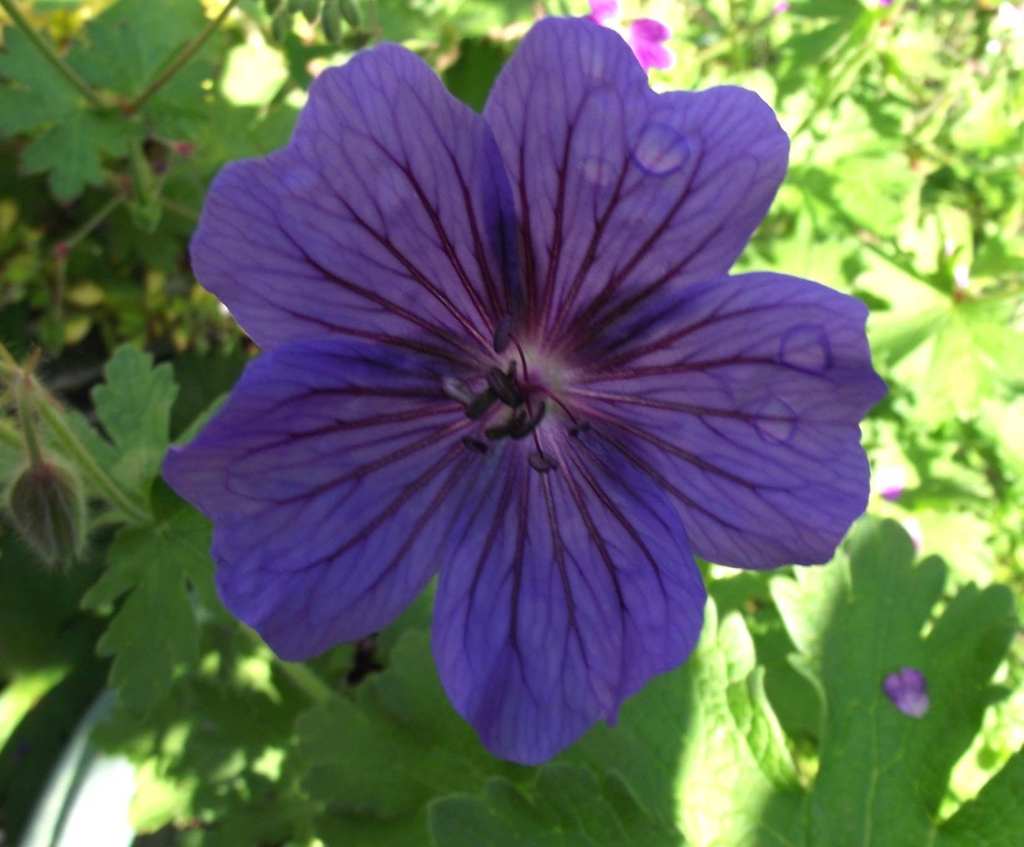
Geranium x magnificum ‘Blue Blood’
Rather magnificent veining of Geranium x magnificum ‘Blue Blood‘ which is a variant of the original cross: G. ibericum x G. platypetalum.
Primula bulleyana
Another of my favourite candelabra primulas. Although this plant was grown from seed last year, overwintered in a container, and only planted out a a month ago it has still produced a reasonably sturdy flower stem. If it had only made a weak attempt to flower I would have removed the stem to allow it to bulk up more.
Rosa ‘Albéric Barbier’Rosa ‘Albéric Barbier’
I have mixed feelings about this rambler. It opens from a really nice tight, typical rosebud. When half- open it till maintains its form. When fully open it becomes a bit of a mess! It might be that the form I have is not as good as it might be, but even though it is also only lightly scented, I am reluctant to part with it.
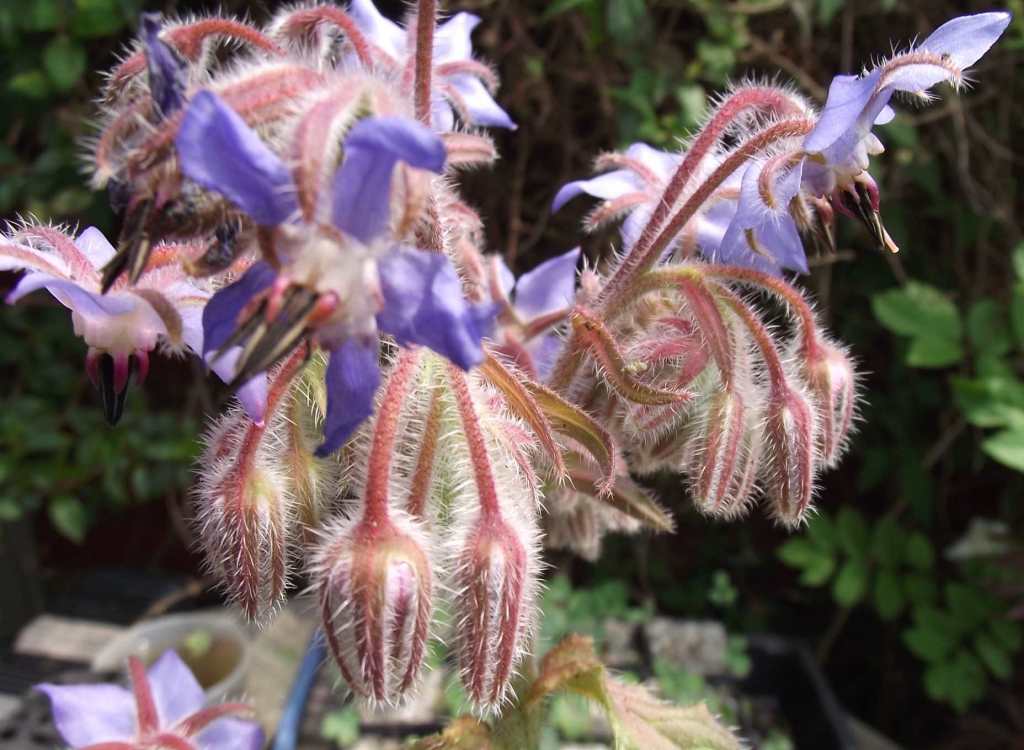
Borago officianalis
I can’t resist the colour and texture of herb borage, I even have a photograph on my wall. This plant is flowering from a cold sowing at the end of January.
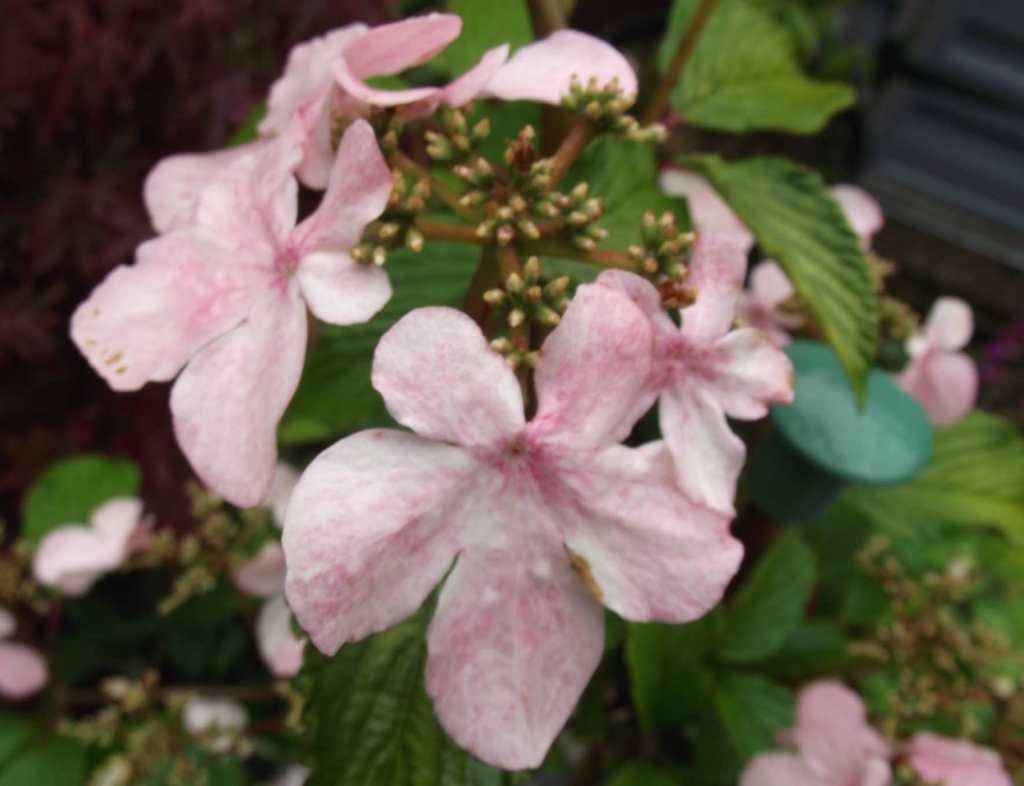
I have cheated a bit here in order to show the various stages of Viburnum plicatum ‘Kilimanjaro Sunrise’. It opens with the petals suffused quite a dark pink, goes to almost pure white, and then fades to a softer pink as it ages. This is a young plant but the flowers lasted quite well. The flowers of Viburnum plicatum f. tomentosum ‘Mariesii’, which flowered earlier, were over very quickly. I think it could have been the long dry spell that caused this to happen.
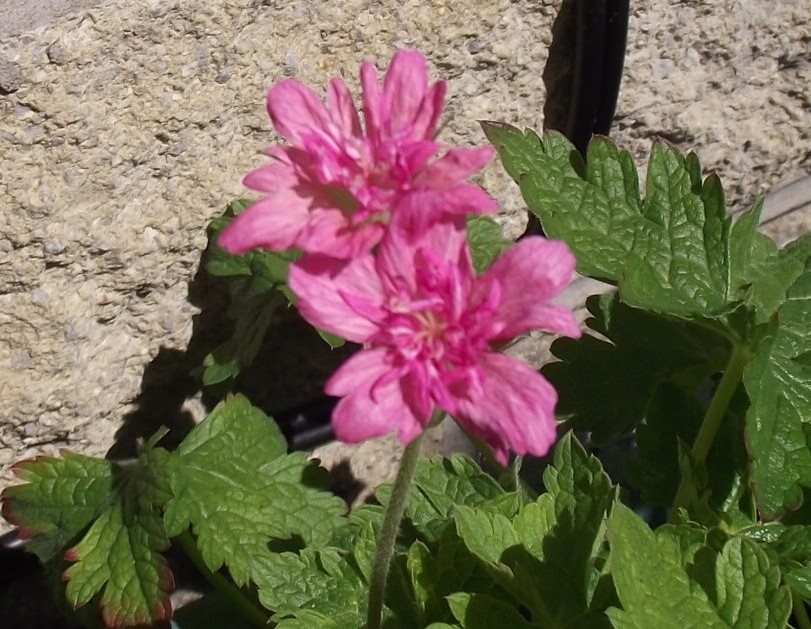
Geranium ‘Southcombe Double’
Geranium × oxonianum f. thurstonianum ‘Southcombe Double’ to give it its full title, is one of a massive group of geraniums which are variants of crosses between G. endressii and G. versicolor, that contain many of my favourites. I think that this is a rather pretty little thing.
This meme is hosted by Jim Stevens who is to be found with all the details and links to plenty of other blogs to enjoy at Garden Ruminations.
The sunshine and dry weather is meant to be coming to an end tomorrow (Saturday) with some welcome rain. Who would have thought that I would have “welcome” and “rain” in the same sentence. We are normally wishing it would stop! There is a possibility of warm weather returning after a week of unsettled weather according to the forecast. I apologise for a complete focus on meconopsis and primulas this week, but my two favourite genera are now in flower.
Meconopsis ‘Crarae’
This is the first time I have actually bought meconopsis plants as I have previously always raised them from seed. Meconopsis ‘Crarae’ comes from Crarae Gardens Argyll, Scotland. It is an infertile hybrid and therefore only propagated vegetatively. I had seen it in Scotland several years ago and have always wanted one, so that, coupled with my impatience after loosing a batch of seedlings two years ago, prompted the purchase last year.
Primula chungensis
Primula chungensis is more delicate looking than the more robust japonica candelabras, but like them, it is a water lover and thrives in a damp spot.
Meconopsis and Primula japonica
Meconopsis ‘Crewdson Hybrid’ coming into flower next to a clump of Primula japonica caught in the early morning sun. If anyone is interested please view my post on primulas at: https://ricksplantworld.blog/2025/03/05/primulas-updated/
Meconopsis ‘Crarae’
More Meconopsis ‘Crarae’ caught in the early morning sun, displaying the fine hairs on the leaves and stem.
Meconopsis betonicifoliaMeconopsis ‘Lingholm’
Two plants from seed sown last year. These will be planted out later in the year if I can find room! Note the much hairier leaves on ‘Lingholm’. If you are interested in the meconopsis please take a look at my post at: https://ricksplantworld.blog/2022/02/09/meconopsis/
Meconopsis ‘Crarae’
Finally a photo’ of Meconopsis ‘Crarae’ without the sun burning out the colour, showing its true self.
This meme is hosted by Jim Stevens who is to be found with all the details and links to plenty of other blogs to enjoy at Garden Ruminations.
Primula, along with meconopsis, is my favourite genus, the slightly acidic damp soil and the areas of dappled shade present in my previous garden provided an ideal micro-climate for both. These conditions made it possible to grow the mainly Asiatic types along with some European and American species, it did mean however, that the lime loving, mainly European species, were excluded.
The family Primulacae includes cyclamen, androsace and soldanella to name a few. The genus Primula is very large and diverse and because of this was split into 20 sections at the beginning of the twentieth century since when it has been updated into seven sections which are probably more botanically correct, however I will stick to the old classifications as I find them easier to comprehend. I have only included sections where I have grown plants and can provide pictures unless stated.
Section 1 Cortusoides
Primula heucherifoliaPrimula kisoana
These attractive plants have soft velvety leaves which die back to rhizomes in winter, in drier conditions they will tend to go dormant very quickly after flowering which impedes growth. To ensure strong healthy plants a damp spot preferably in light shade is much preferred.
Section 5 Obconica
Once a very popular house plant found everywhere, Primula obconica has now waned in popularity and is rarely seen. Some people had a skin reaction when the plant was handled but I very much doubt this was the only reason for its demise, more probably the advent of orchids being everyone’s favourite was to blame. The picture is not mine and is of a T&M selection.
Section 9 Vernales
The Vernales Section is a large European group containing primroses and polyanthus both of which are very familiar as bedding, in containers and even as house plants. I could only find a couple of pictures of primroses as, to be honest, I have never been a great fan as I have always felt that many primulas, particularly polyanthus, tend to be artificial looking and have consequently been neglected when taking ‘photos. They tend to prefer slightly acid moist soils and can generally be propagated by division or from seed. It is worth noting that most of the primulas that are pictured on this site have been raised from seed.
Section 12 Petiolares
Primula ‘Linnet’Primula tanneri ssps nepalensis
The Petiolaris Section contains around sixty species which are themselves split into several subspecies, however for the sake of sanity, I will not go down this avenue. The whole section is notoriously difficult to grow although there are quite a few species in cultivation. Primula gracilipes minor now named P.’Linnet’ is one of the easiest. Primula tanneri is another that I have grown in a poly tunnel and in the garden. They all like cool conditions in a moist gritty soil. Primula ‘Linnet’ is very close in appearance to P. petiolaris itself which is rarely seen. The plants shown were grown from seed which is the best way, although very careful division is an alternative.
The largest section of the genus, also the most diverse, ranging through Asia, Europe and the Americas including our very own Primula scotica. As the name suggests the prominent characteristic is that they all are covered in farina to varying degrees. Although requiring much the same conditions as all the other primulas that I have grown, I raise many of them under cover as they tend to be small in stature and are best established before planting out. All the primulas shown above are easily raised from seed.
Section 20 Denticulata
Primula denticulata is a plant with which nearly every gardener is familiar, commonly known as the ‘drumstick primula’ it has been an early spring flowering feature in many gardens for years. Easy to grow, you can even propagate it from its fleshy roots. The pictured specimen is not very strong having self-seeded itself into a gap with stone either side but it is the only picture I have unfortunately. There is also a rather nice white form, which I now have, with red and purple pink also being available.
Section 21 Capitatae
Primula capitata ‘Noverna Deep Blue’Primula capitata ‘Noverna Deep Blue’
Primula capitata is a neat little plant from the Himalayas, very definitely a peat lover it tends not to be long-lived.
Section 22 Muscarioides
Primula bellidifoliaPrimula cernuaPrimula deflexa
The best known plant in this section is Primula vialii which is even available as seed and plugs from some of the main online garden companies. The name of the section relates to the flower shape being that of muscari or grape hyacinth. For some reason I have never grown P.vialii, perhaps because it just doesn’t appeal to me. Basically, members of the section need the same treatment as most of the primulas I have described, its smaller relatives are probably safer in a peat bed or alpine house. The primulas in this group that I have grown were all raised and grown in a poly-tunnel as they were a bit too delicate for the main garden. Truth be told the only plant I managed to raise from seed of P. cernua perished before it flowered.
Section 23 Soldanelloides
Primula flaccida (Primula nutans)
Primula flaccida, formerly P.nutans, from Yunnan is the only success I have had with members of this section, three plants came from seed but only one survived to flowering and then died. Very difficult group to grow but contains some of the most beautiful plants which are often scented. The star turn is Primula reidii which is not only probably the most beautiful, but has a particularly strong scent as a bonus. Definitely subjects for careful cultivation in the alpine house.
Section 25 Nivales
Primula handelianaPrimula maximowiczii
Primula chionantha, is the best known of the Nivalids. They are Asiatics which generally are to be found growing on damp meadows and prefer the damper peaty conditions to be found in the north of England and Scotland. The two pictured above, which are both robust species with large strap-shaped leaves, were raised in the poly-tunnel and then planted outside where they were perfectly happy. I have grown P. chionantha but unfortunately I can’t find a picture.
Easy to grow section but needs peaty conditions and plenty of water to thrive. Many people will be more familiar with P.florindae, known as the Giant Cowslip, rather than the eponymous Primula sikkimensis, it comes in other colours ranging from red through orange. Generally easy from seed and division of vigorous clumps.
Hailing from the Himalayas these easy to grow plants with their tiered flowers are what started my interest in all plants from the alpine regions particularly the Asiatics, I was also lucky in that living in North West provided almost ideal conditions for my favourites. I first saw these in any quantity at Fletcher Moss Gardens, Didsbury but large plantings can be seen at Ness Gardens and Harlow Car Gardens. Although they will grow in any good peaty soil they need water to really thrive and make an excellent pond-side planting especially in numbers.
Section 30 Floribunda
Primula x Kewensis
Primula x Kewensis is a remarkable hybrid bred at Kew, as its name suggests, which comes true from seed. It was bred from P verticillata and P floribunda and is not fully hardy as I found out to my cost when I first raised it. If kept under glass it will flower in very early spring.
That completes my review of the genus Primula where I have included all the sections that I have successfully grown. When it comes to my failures with some of the more challenging plants, I can only say a poly-tunnel is really not adequate when compared with a dedicated alpine house however the pleasure and satisfaction I gained from actually raising some of these subjects from seed was very much worth the effort.
In many descriptions I have mentioned peat as being an essential component to the growth of these plants, many of which grow best in a peat bed. In a future post I hope to show the totally illogical approach the government is taking by banning the sale of peat for horticultural use.
Peat for horticultural use is extracted from 4,500 hectares of peatland which is 0.15% of the 3,000,000 hectares in the UK. Why are they banning the sale of peat?
Primula, along with meconopsis, is my favourite genus, the slightly acidic damp soil and the areas of dappled shade present in my previous garden provided an ideal micro-climate for both. These conditions made it possible to grow the mainly Asiatic types along with some European and American species, it did mean however, that the lime loving, mainly European species, were excluded.
The family Primulacae includes cyclamen, androsace and soldanella to name a few. The genus Primula is very large and diverse and because of this was split into 20 sections at the beginning of the twentieth century since when it has been updated into seven sections which are probably more botanically correct, however I will stick to the old classifications as I find them easier to comprehend. I have only included sections where I have grown plants and can provide pictures unless stated.
Section 1 Cortusoides
Primula heucherifoliaPrimula kisoana
These attractive plants have soft velvety leaves which die back to rhizomes in winter, in drier conditions they will tend to go dormant very quickly after flowering which impedes growth. To ensure strong healthy plants a damp spot preferably in light shade is much preferred.
Section 5 Obconica
Once a very popular house plant found everywhere, Primula obconica has now waned in popularity and is rarely seen. Some people had a skin reaction when the plant was handled but I very much doubt this was the only reason for its demise, more probably the advent of orchids being everyone’s favourite was to blame. The picture is not mine and is of a T&M selection.
Section 9 Vernales
The Vernales Section is a large European group containing primroses and polyanthus both of which are very familiar as bedding, in containers and even as house plants. I could only find a couple of pictures of primroses as, to be honest, I have never been a great fan as I have always felt that many primulas, particularly polyanthus, tend to be artificial looking and have consequently been neglected when taking ‘photos. They tend to prefer slightly acid moist soils and can generally be propagated by division or from seed. It is worth noting that most of the primulas that are pictured on this site have been raised from seed.
Section 12 Petiolares
Primula ‘Linnet’Primula tanneri ssps nepalensis
The Petiolaris Section contains around sixty species which are themselves split into several subspecies, however for the sake of sanity, I will not go down this avenue. The whole section is notoriously difficult to grow although there are quite a few species in cultivation. Primula gracilipes minor now named P.’Linnet’ is one of the easiest. Primula tanneri is another that I have grown in a poly tunnel and in the garden. They all like cool conditions in a moist gritty soil. Primula ‘Linnet’ is very close in appearance to P. petiolaris itself which is rarely seen. The plants shown were grown from seed which is the best way, although very careful division is an alternative.
The largest section of the genus, also the most diverse, ranging through Asia, Europe and the Americas including our very own Primula scotica. As the name suggests the prominent characteristic is that they all are covered in farina to varying degrees. Although requiring much the same conditions as all the other primulas that I have grown, I raise many of them under cover as they tend to be small in stature and are best established before planting out. All the primulas shown above are easily raised from seed.
Section 20 Denticulata
Primula denticulata is a plant with which nearly every gardener is familiar, commonly known as the ‘drumstick primula’ it has been an early spring flowering feature in many gardens for years. Easy to grow, you can even propagate it from its fleshy roots. The pictured specimen is not very strong having self-seeded itself into a gap with stone either side but it is the only picture I have unfortunately. There is also a rather nice white form, which I now have, with red and purple pink also being available.
Section 21 Capitatae
Primula capitata ‘Noverna Deep Blue’Primula capitata ‘Noverna Deep Blue’
Primula capitata is a neat little plant from the Himalayas, very definitely a peat lover it tends not to be long-lived.
Section 22 Muscarioides
Primula bellidifoliaPrimula cernuaPrimula deflexa
The best known plant in this section is Primula vialii which is even available as seed and plugs from some of the main online garden companies. The name of the section relates to the flower shape being that of muscari or grape hyacinth. For some reason I have never grown P.vialii, perhaps because it just doesn’t appeal to me. Basically, members of the section need the same treatment as most of the primulas I have described, its smaller relatives are probably safer in a peat bed or alpine house. The primulas in this group that I have grown were all raised and grown in a poly-tunnel as they were a bit too delicate for the main garden. Truth be told the only plant I managed to raise from seed of P. cernua perished before it flowered.
Section 23 Soldanelloides
Primula flaccida (Primula nutans)
Primula flaccida, formerly P.nutans, from Yunnan is the only success I have had with members of this section, three plants came from seed but only one survived to flowering and then died. Very difficult group to grow but contains some of the most beautiful plants which are often scented. The star turn is Primula reidii which is not only probably the most beautiful, but has a particularly strong scent as a bonus. Definitely subjects for careful cultivation in the alpine house.
Section 25 Nivales
Primula handelianaPrimula maximowiczii
Primula chionantha, is the best known of the Nivalids. They are Asiatics which generally are to be found growing on damp meadows and prefer the damper peaty conditions to be found in the north of England and Scotland. The two pictured above, which are both robust species with large strap-shaped leaves, were raised in the poly-tunnel and then planted outside where they were perfectly happy. I have grown P. chionantha but unfortunately I can’t find a picture.
Easy to grow section but needs peaty conditions and plenty of water to thrive. Many people will be more familiar with P.florindae, known as the Giant Cowslip, rather than the eponymous Primula sikkimensis, it comes in other colours ranging from red through orange. Generally easy from seed and division of vigorous clumps.
Hailing from the Himalayas these easy to grow plants with their tiered flowers are what started my interest in all plants from the alpine regions particularly the Asiatics, I was also lucky in that living in North West provided almost ideal conditions for my favourites. I first saw these in any quantity at Fletcher Moss Gardens, Didsbury but large plantings can be seen at Ness Gardens and Harlow Car Gardens. Although they will grow in any good peaty soil they need water to really thrive and make an excellent pond-side planting especially in numbers.
Section 30 Floribunda
Primula x Kewensis
Primula x Kewensis is a remarkable hybrid bred at Kew, as its name suggests, which comes true from seed. It was bred from P verticillata and P floribunda and is not fully hardy as I found out to my cost when I first raised it. If kept under glass it will flower in very early spring.
That completes my review of the genus Primula where I have included all the sections that I have successfully grown. When it comes to my failures with some of the more challenging plants, I can only say a poly-tunnel is really not adequate when compared with a dedicated alpine house however the pleasure and satisfaction I gained from actually raising some of these subjects from seed was very much worth the effort.
In many descriptions I have mentioned peat as being an essential component to the growth of these plants, many of which grow best in a peat bed. In a future post I hope to show the totally illogical approach the government is taking by banning the sale of peat for horticultural use.
Peat for horticultural use is extracted from 4,500 hectares of peatland which is 0.15% of the 3,000,000 hectares in the UK. Why are the banning the sale of peat?
Book reviewer and garden enthusiast. Updates from my Hampshire garden. Usually talking about books and plants. People do not forget books or flowers that touch them or excite them—they recommend them.















 A Plantsman's World