I have not posted since last October when I ran out of subjects in my tiny garden however there are now signs of spring and, with rising temperatures and dry weather forecast for next week, I remain hopeful. Although it may be a few more weeks before I can post again I have managed to scrape together a rather contrived six for this week.
Slight problem with the header, I must have decided I was having my own leap year!Too late to change it now.
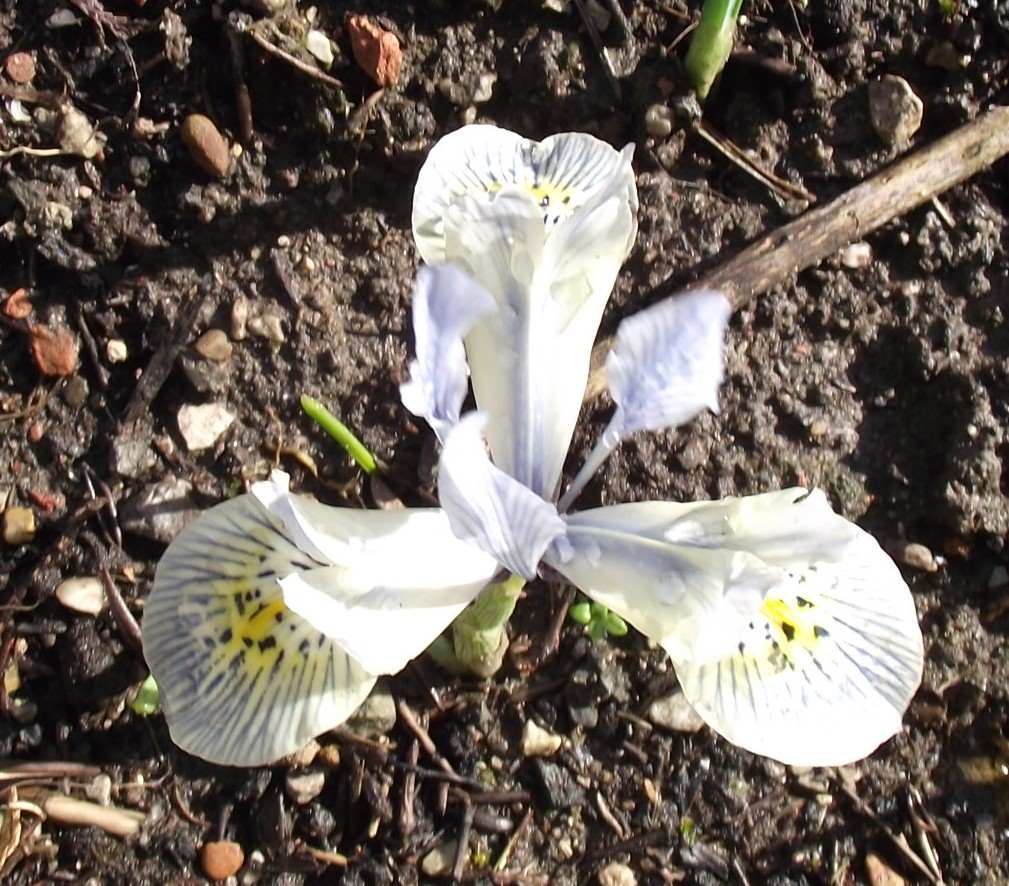
Iris reticulata ‘Katharine Hodgkin’
A real favourite of mine, particularly as it’s such an early flowerer. Unfortunately this one is almost all that is left of a clump I planted about five years ago, time to renew!
Anemanthele lessoniana
I am not a great fan of grasses, although I can appreciate them planted in drifts. I raised Anemanthele lessoniana (syn. Stipa arundinacea) Pheasant’s tail grass, from seed many years ago and had three large containers of it in my previous garden which were spectacular when viewed with the sun behind them. This is a recent acquisition which I hope thrives. Incidently I never cut them back just “combed” them, wearing a stout pair of gloves, in the late spring.
Hedera helix atropurpurea
This leaf caught my attention, unfortunately when I tried to reposition it to get a decent photo I snapped it off! I am guessing at its nomenclature but I think I am correct.
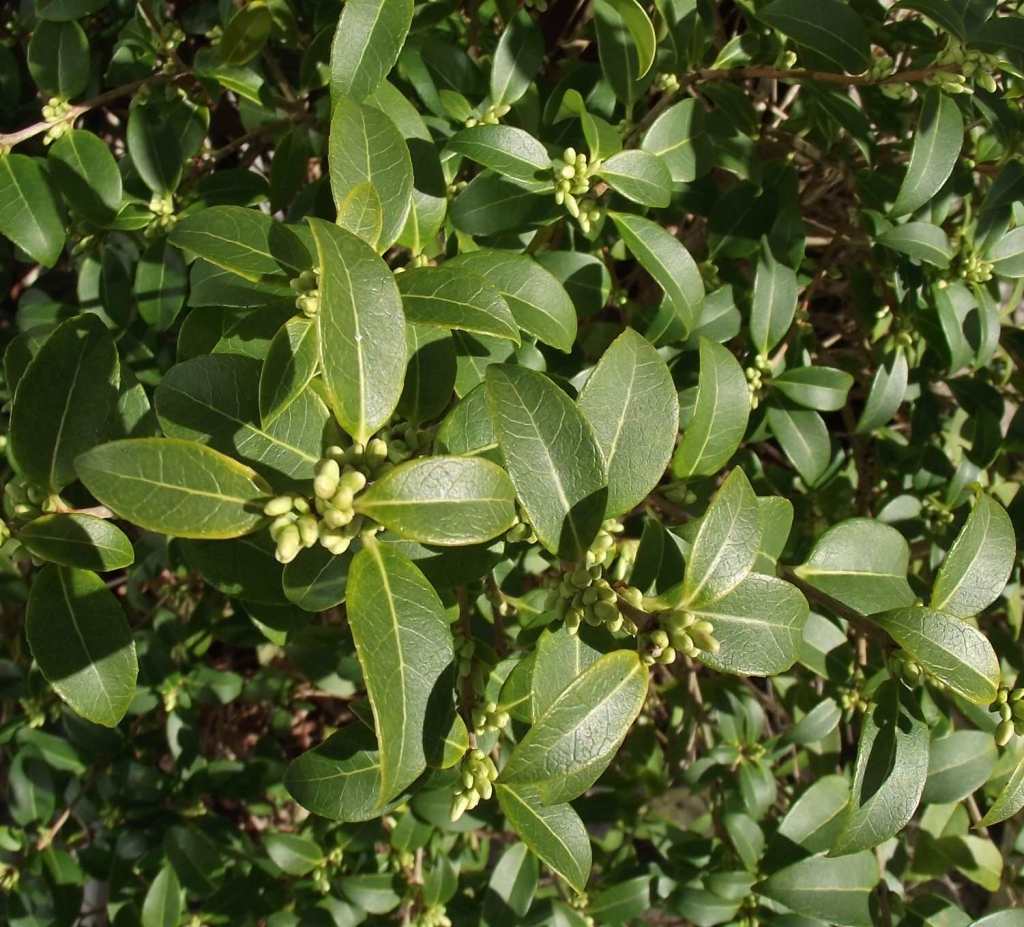
Osmanthus burkwoodii
The osmanthus is growing in a large container next to the door into the garden so I am hoping there are some warm days when it does flower so I can fully appreciate the scent.
Galanthus nivalis
I know snowdrops are everywhere but I just thought they would make up the numbers. I have no idea where the shell in the background came from!
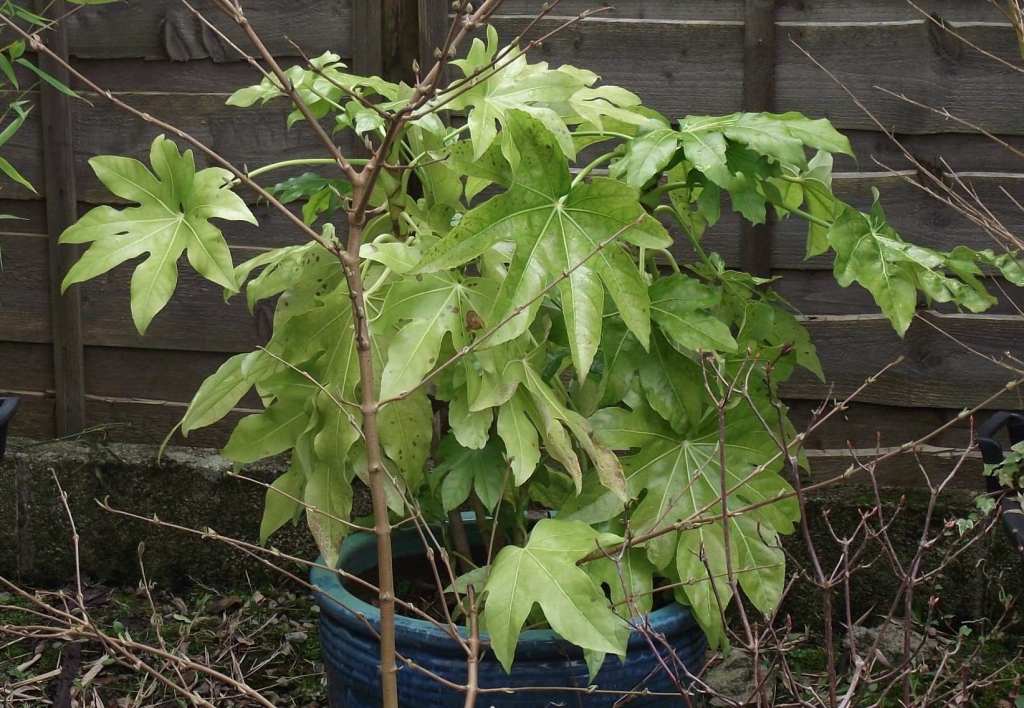
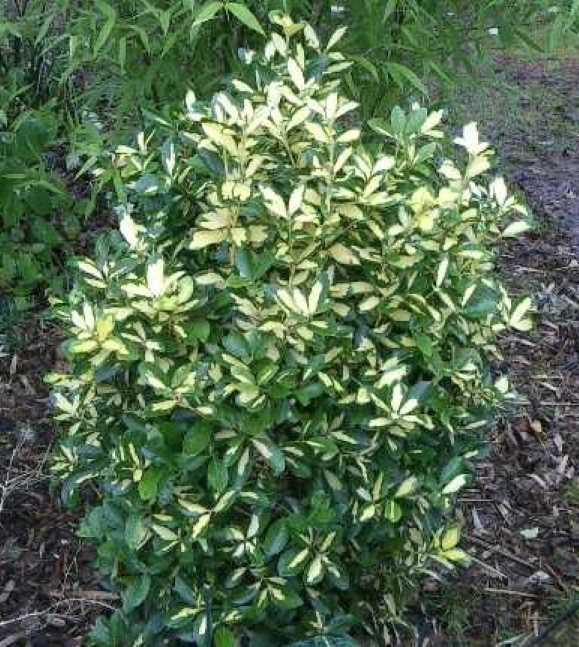
Fatsia japonica
Not everyone’s cup of tea and actually the first time I have grown it, Fatsia japonica just happened to fulfil a purpose and is currently in a container. The thing I did like was to have some healthy green leaves to look at during the grey winter months.
This meme is hosted by Jim Stevens who is to be found with all the details and links to plenty of other blogs to enjoy at Garden Ruminations.
Here are some photos of plants I missed earlier from the old garden and some from the new.
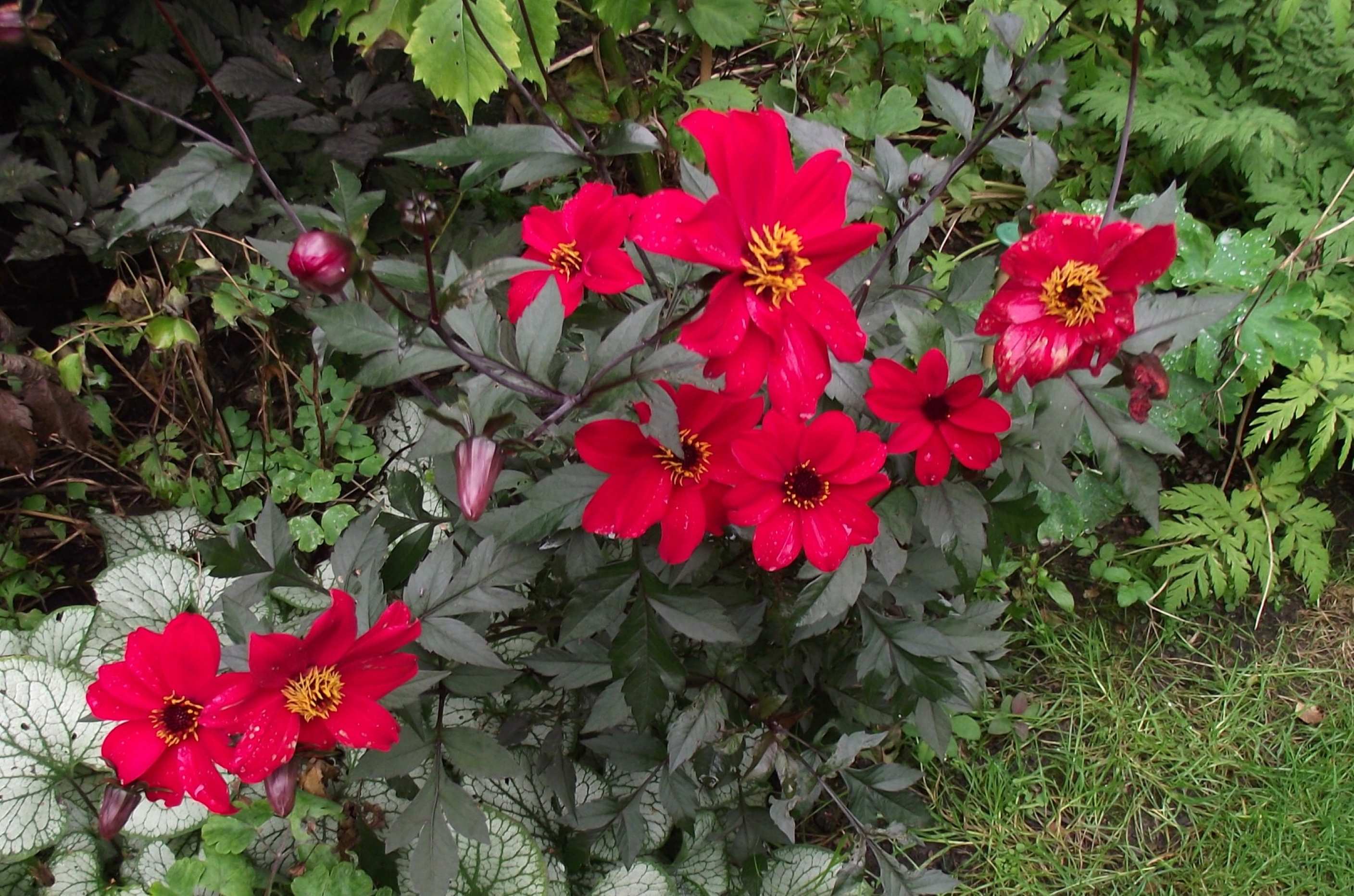
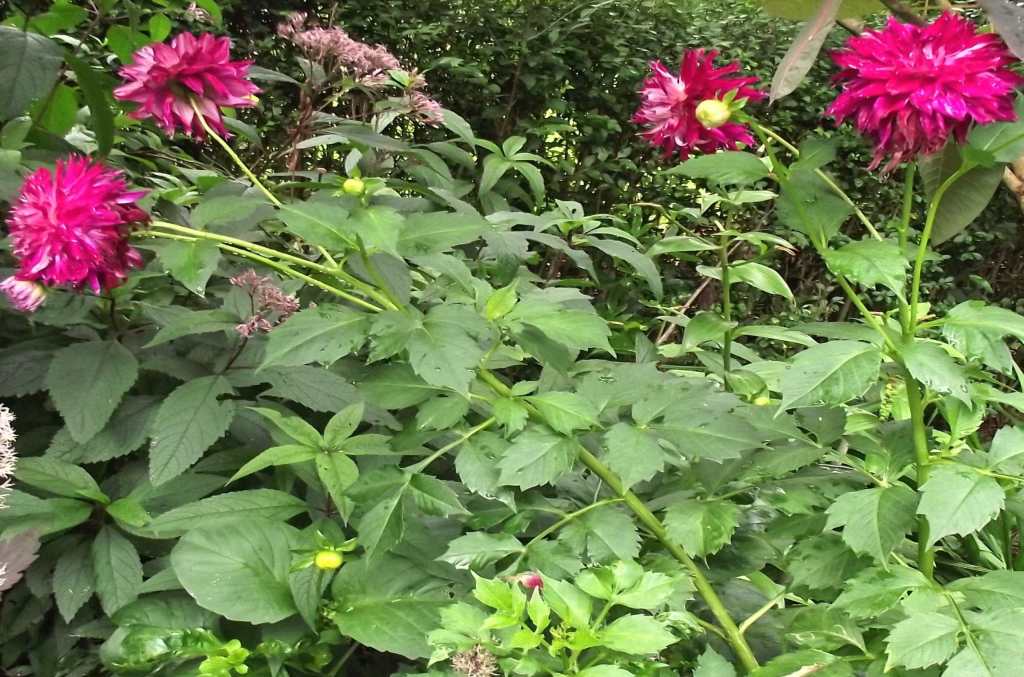
Dahlias
Dahlia ‘Mel’s Orange Marmalade’Dahlia ‘Bishop of Llandaff’Dahlia ‘Café au Lait’
Everybody is familiar with dahlias, so no more needs writing. Probably the camera but the colour of ‘Mel’s Orange Marmalade’ looks decidedly off and ‘Cafe au Lait’ is looking definitely droopy. I used to raise ‘Bishop of Llandaff’ and his children from seed and they were the only dahlias I actually engaged with, dahlias are not really a favourite. My father used to love his dahlias as well as growing giant delphiniums, every year the tubers were lifted carefully, cleaned, dusted with sulphur and stored in the cellar in tomato boxes and every year half of them rotted off. I was hoping that one year everything would be perfect but it never was.
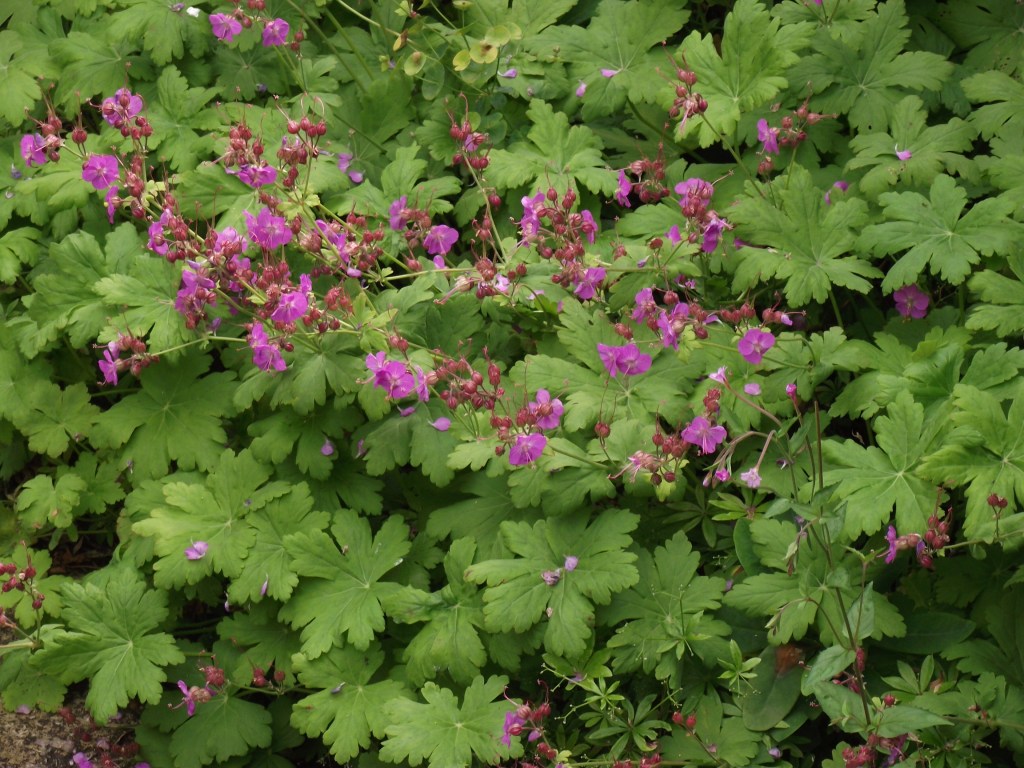
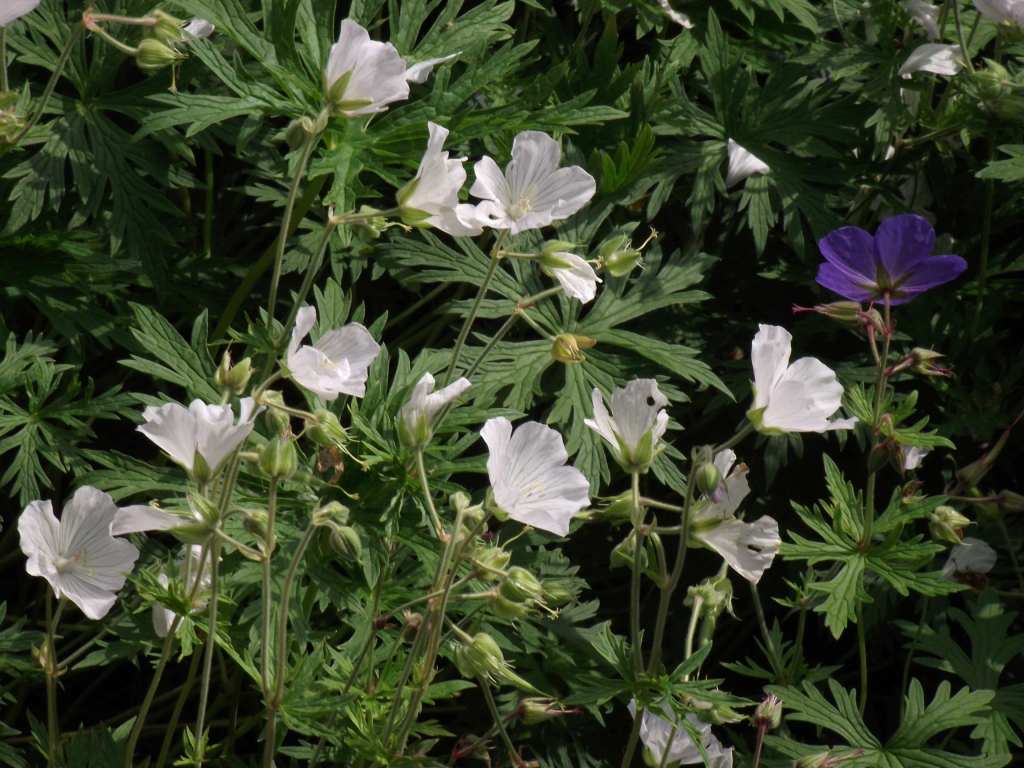
A couple of new Geraniums
Geranium macrorrhizum ‘Ingwersen’s Variety’Geranium var. pratense. f. albiflorum. ‘Galactic’
‘Ingwersen’s Variety’ was grown from seed last year whilst ‘Galactic’ has been in the garden for a few years now, but I lost the label and have only recently been able to re-identify it by chance.
Canna ‘Cannova’
Canna lilies from tropical America, have been in cultivation for many years and consequently there are many cultivars in a range of vibrant colours available. I grew several in pots for a couple of years but ceased when I decided to no longer have winter heat in my tunnel. Note the use of plastic containers, I had so many that it would have cost a fortune to do otherwise, plus the weight factor when moving them around, although I did buy a sack-truck in later years.
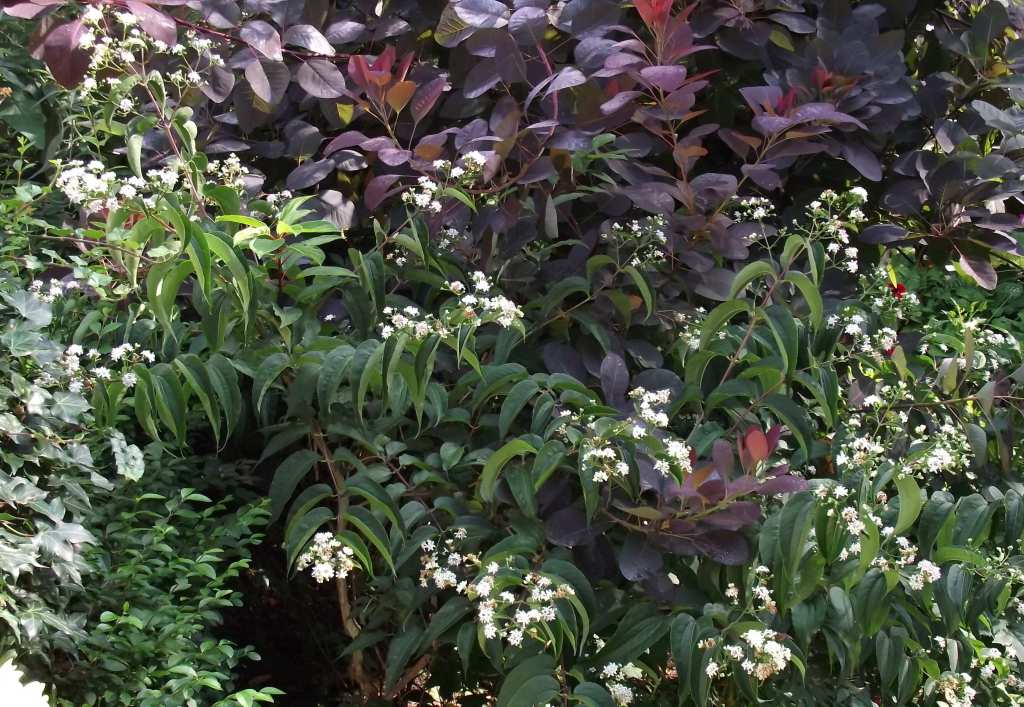
Heptacodium miconioides
I have no recollection of taking this photograph, although Heptacodium miconioides is certainly a worthy subject. A vigorous tall shrub from China with peeling bark, its scented flowers appear late in the year lasting well into October, which makes it an ideal subject for the woodland garden. There is also the benefit that it sets plenty of seed. Sometimes known as ‘Seven son flower of Zhejiang’
I bought this when T&M were advertising this new ‘Incrediball’ hydrangea and it is still going strong in a very large container in my new garden. Flowers reliably every year although they are not attaining the size that they should which is probably down to me. I am going to hard prune it this winter to see what happens.
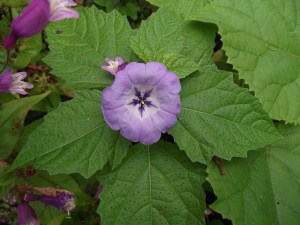
Nicandra physalodes ‘Violacea’
The shoo-fly plant or apple of Peru used to be quite widely grown for bedding schemes but seems to have gone out of favour. It is an extremely fast growing large annual rapidly attaining anything from 3 to 6 feet. The purple flowers die leaving a lantern shaped calyx which can be used in dried flower arrangements. It has a habit of appearing out of the blue, which is exactly what the pictured plant did.
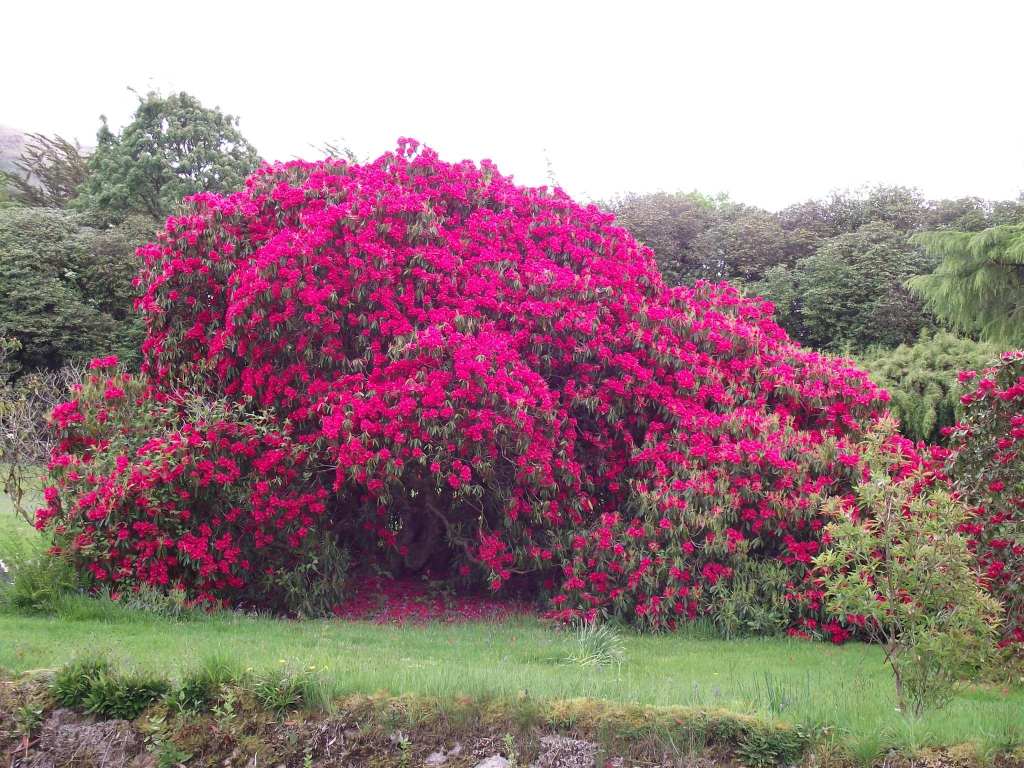
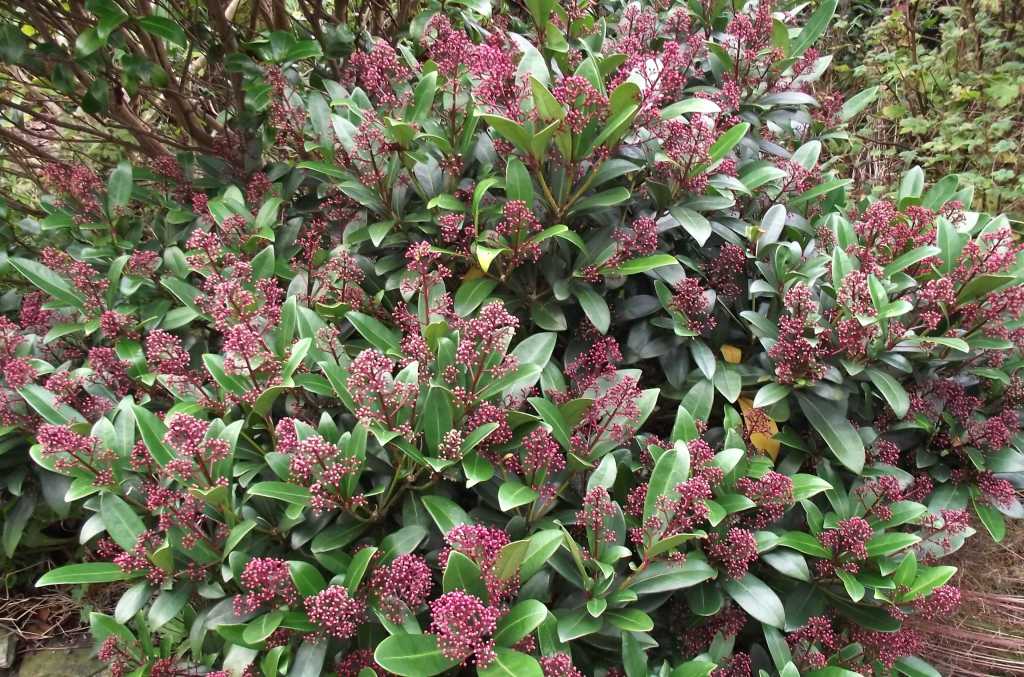
Small evergreen shrubs, very popular with garden centres as they carry their coloured buds through the winter and flower in the spring making an attractive package for containers. Like many similar shrubs a cool root run in acid soil is best in dappled shade. Although they will look good for one season in a container there is absolutely no substitute for a position in a suitable border.
Sophora
Sophora microphylla ‘Sun King’
Not a very impressive picture, Sophora microphylla ‘Sun King’ is a large shrub which flowers through winter into spring, definitely for a well drained sheltered spot in full sun. My specimen never really attained its potential as it just wasn’t in the right spot.
Sorbus (Rowan)
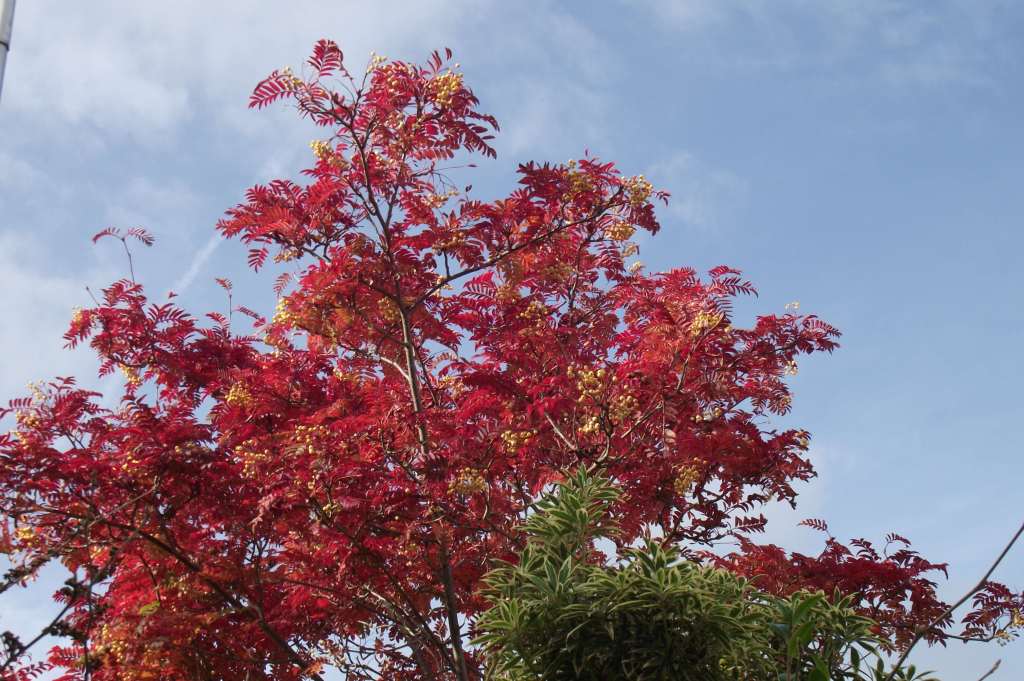
Sorbus ‘Joseph Rock’Sorbus ‘Joseph Rock’
Rowans are my favourite medium sized trees for the smaller garden, in fact my favourite trees altogether so I was doubly blessed as ‘Joseph Rock’ is my favourite rowan. Also known as the mountain-ash, the rowan is steeped in both Nordic and Celtic folklore and figures in local superstition to this day. Sorbus is distributed throughout the northern hemisphere and into N.Africa and can be found growing in most soils and even out of mountain crevices it is also pollution tolerant. Although Joseph Rock has yellow/white berries, red is the more common colour by far, it’s just that I am rather partial to the contrast between the berries and the red autumn foliage colour. What more can I say about this rewarding member of the rose family?!
Spiraea
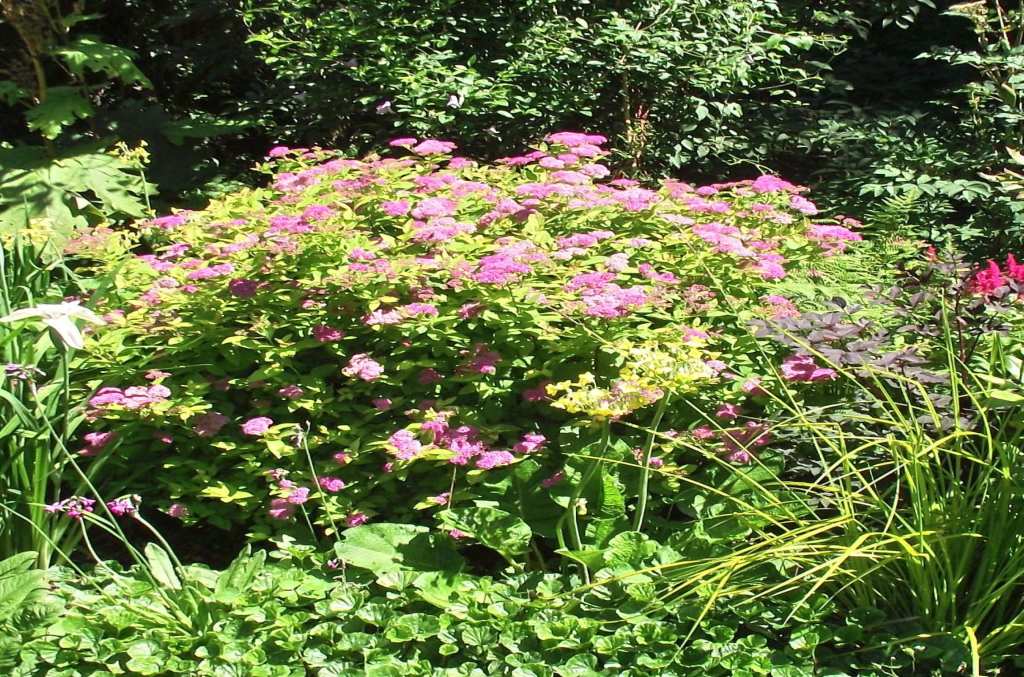
Spiraea japonica ‘Golden Princess’
Another one of those sources of confusion between the botanical and common names arises here, many people will think of the attractive plumes of the spirea growing in the damp areas of the garden but, in fact, they are astilbes botanically not spiraeas. Spiraeas are a genus of deciduous leaved shrubs which are members of the rose family and found throughout the northern hemisphere in most soil types. Spiraea japonica ‘Golden Princess’ is an outstanding plant which I found many years ago. I believe that it evolved as a naturally occurring cross, basically nature doing its own thing. The plant I have now, is nowhere near as robust as the original and I am almost tempted to think that there is some sort of reversion going on or perhaps I should try it in another spot.
Syringia
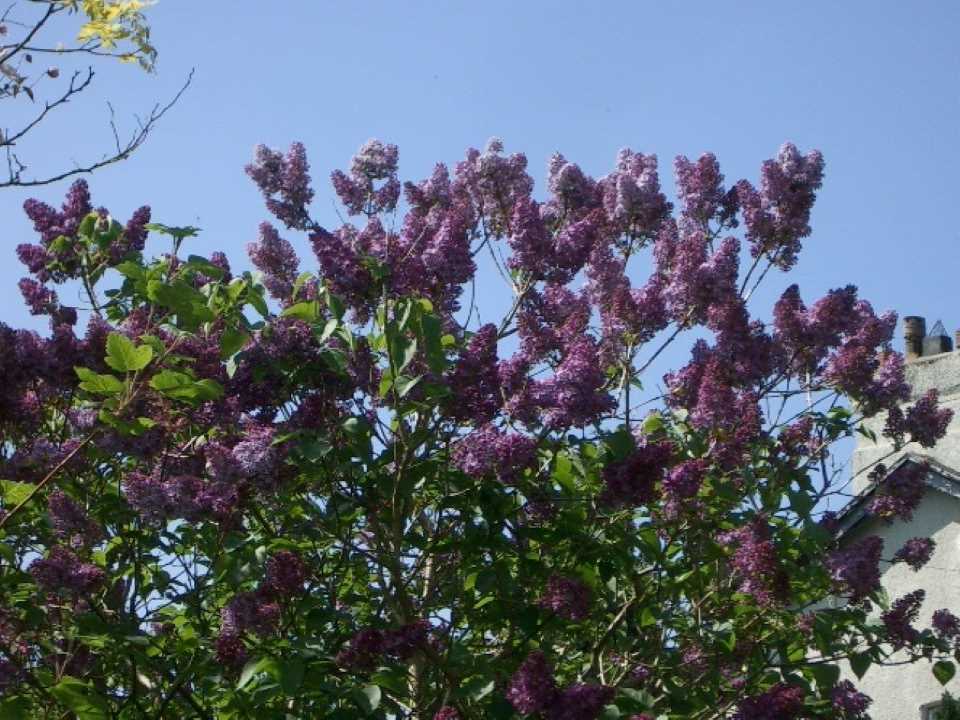
Syringia vulgaris
The wild or common lilac is the plant from which all modern cultivars have been bred. Easy to grow, a common sight for as long as I can remember, the heavily scented purple flowers were very popular with other than my superstitious mum who wouldn’t have them in the house. I first remember a white flowered variety appearing but now there are all sorts of variations ranging from reds, doubles (French lilac) and patio plants as the breeders have developed them for the domestic market. Despite this I still regard them as a one trick pony, aside from the scented flowers, and I have to say the scent is really something, the rest of the year the shrub itself is rather uninspiring.
Viburnum
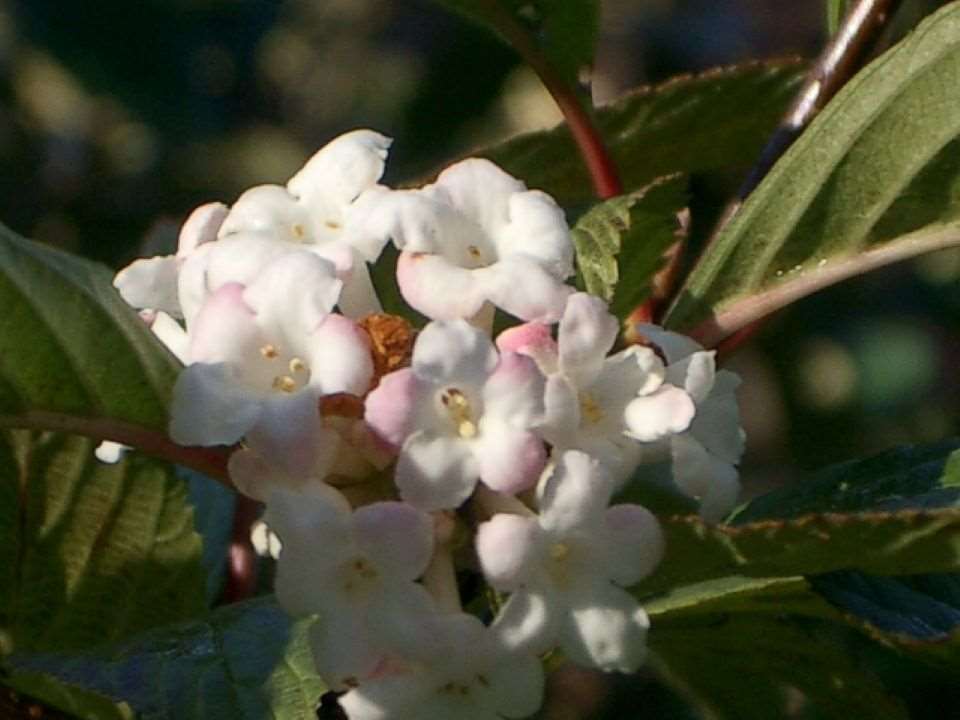
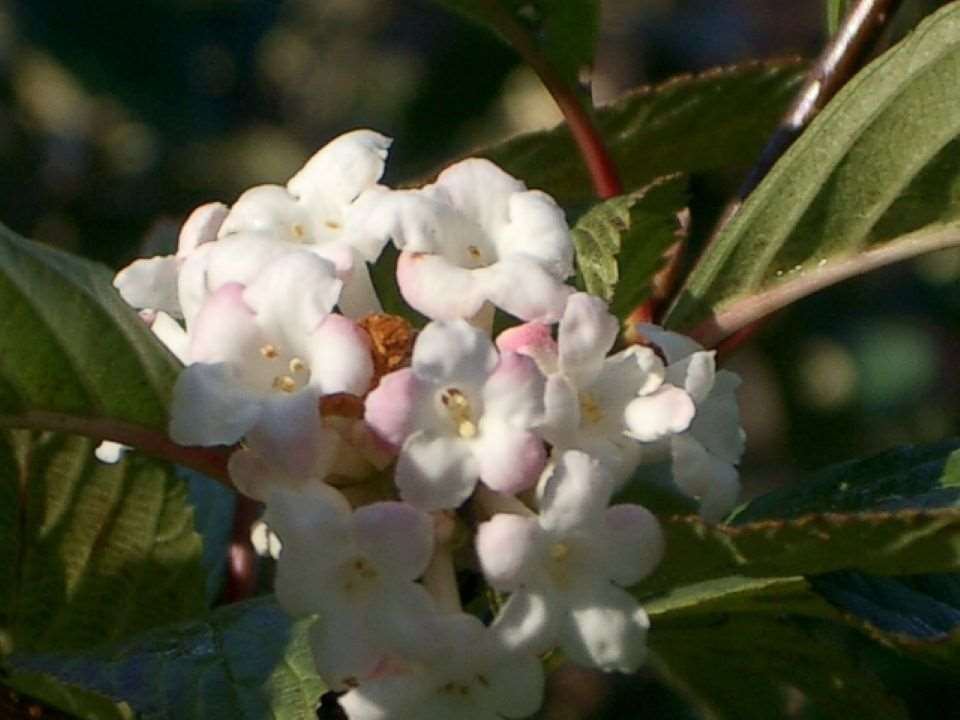
Viburnum x bodnantse ‘Dawn’Viburnum x bodnantse ‘Dawn’Viburnum rhytidophyllumViburnum plicatum ‘Mariesii’ berries.Viburnum tinus
Viburnum plicatum f. tomentosum ‘Mariesii’
There is only one thing I can criticise with V.plicatum and that is it isn’t evergreen, nevertheless it still ranks as my all-time favourite shrub. Mine also had the advantage of being adjacent to a similar size specimen of Berberis thunbergii f. atropurpurea which was a perfect foil. The tiered branches of V.plicatum give it a pyramid shape, covered by a profusion of white flowers followed by red/black berries, what’s not to like? Although V.plicatum is not an evergreen in some ways it is perhaps a blessing as another species the evergreen V.tinus is very susceptible to Viburnum beetle attack which can severely damage the appearance of the plant, and being an evergreen, is much more difficult to rectify. Another fine viburnum is Viburnum x bodnantse ‘Dawn’, the original plant was bred at Bodnant Gardens in North Wales, the improved cultivar ‘Dawn’ being developed later. This remarkable plant flowers on bare wood anytime throughout the winter emitting a powerful sweet scent, which is why it is often recommended to plant near to the house to take advantage. Viburnum rhytidophyllum is a bold architectural plant but unfortunately I found the foliage interesting but a bit too coarse for my taste so I did actually uproot it, probably better off in a much bigger garden. Overall the Viburnum genus has provided me with two remarkable but totally diverse specimens. (Viburnum tinus photo’ taken in local park.)
First, let me identify just where I stand on matters of climate change and the response to it. The reason I am stating this is because the whole issue of banning peat is now inexorably linked to the so called “climate crisis”. The climate is changing, it always has, but I have the advantage of being lucky enough to be of an age to have had an education that taught me to think for myself, not what to think, which seems to have been the case for the last forty years and even more apparent since the turn of the century. The way I see it is that the whole question has become politicised, and some people are making a lot of money out of a narrative which is now completely divorced from the science.
For anyone reading this outside the UK it must be difficult to comprehend that the sale of peat is related to the actions taken by UK governments in the name of the “climate crisis”. Other than Germany mulling over proposals to limit the extraction of peat, the UK’s response is unique in the western world. For some reason, probably because we are now world leaders in very little, the UK governments have decided they must lead the world in tackling climate change, the fact that we contribute less than 2% of the world’s CO2 emissions doesn’t seem to have occurred to them.
Originally it was planned for the sale to the general public of bagged peat products to be banned from 2024, a typical response from an NGO by Ailis Watt, peat policy officer at The Wildlife Trusts is:
“Today’s announcement is bitterly disappointing. Last year we welcomed the news that the UK Government would ban the sale of bagged peat compost in England by the end of 2024. The Wildlife Trusts hoped that a ban on all peat products would follow shortly after this date.”
UK Government confirms ban on all peat-based gardening products will not be implemented until 2030
Today, Defra (Department for Environment Food and Rural Affairs) has confirmed that while some peat-containing products will be banned from shelves in 2027, others will be exempt from a ban until 2030.
Ailis Watt continues:
“The decision to allow the sale of peat-containing products to continue until 2030 does not reflect the value of peatlands – here and abroad – and is at odds with this Government’s manifesto commitment to ‘deliver the most ambitious environmental programme of any country on earth’.
“It contradicts the notion that gardening is an activity which is beneficial to nature and places a burden of responsibility on the consumer to ensure they are not inadvertently buying environmentally destructive peat-based products.”
The Wildlife Trusts estimate that policy failure to stop peat extraction has caused up to 31 million tonnes of CO2 to be released since 1990.
80% of the UK’s peatlands are now degraded as a direct result of damaging practices such as drainage for agriculture, burning and peat extraction for horticulture. Peatlands are important for biodiversity, home to a host of highly specialised and rare species – from the carnivorous plant, sundew, to Red-listed birds as well as reptiles, amphibians, insects and mammals. It is the lack of protections afforded to habitats like peatlands which has propelled the loss of almost 50% of the UK’s biodiversity.
Peatlands are also crucial carbon stores, locking away over three billion tonnes of carbon in the UK alone. However, when peatlands are damaged, this carbon is released. Today, emissions from peatlands make up 4% of all UK annual greenhouse gas emissions, and the UK is a world leader in emissions from degraded peatlands. To put this into context, every year emissions from degraded peatlands are equivalent to the carbon footprints of over 1.9 million British citizens.*
*Thursday 23 March 2023. The Wildlife Trusts’ website.
I could dissect much of this statement and show it, at best, to be misinformation, but that is not the point I am making. The Wildlife Trusts’ focus should be on wildlife but the card isn’t strong enough, so like many others of their ilk the focus is switched to climate change which is definitely not their core doctrine. I wholeheartedly agree with Kenneth Cox director of Glendoick Gardens when he says:
“The RHS, National Trust RBG, Kew & Edinburgh and other influential organisations, as well as TV presenters such as Monty Don should have a little more courage than simply to jump on this bandwagon. Instead they should appraise themselves of the facts and have the courage to portray both sides of the argument. Rather than condemn peat they should explain the facts and defend the sustainable and sensible of peat. At the moment the only reduction in peat seems to be in sales of bags marked ‘peat’. If the bag says ‘multi-purpose compost’ or ‘ericaceous compost’ it sells as well as ever. Such bags usually contain 40-90% peat.
Many well informed gardeners and writers such as Peter Seabrook and the best selling author Dr Hessayon (author of the ‘Expert’ series) take a pragmatic view. Dr Hessayon writes: ‘don’t use peat as for overall soil improvement- it is not efficient and garden compost and manure will do a much better job. However moss peat has a role to play in planting and seed composts where there are no substitutes of equal merit’ (The Bedside Book of the Garden)” *
*Peat Policy at Glendoick Gardens
The demonization of CO2
There seems to be a train of thought which has developed over the last 20 to 40 years that has been etched into the psyche of western society, aided by our controlled media and education system. It looks something like this: Climate crisis >global warming> greenhouse gases >CO2. The question is: Why is having a greater concentrations of Co2 in the atmosphere a bad thing, as gardeners we all know Co2 is the proverbial staff of all life.
Before climate science became politicized, warm periods were referred to by scientists as “climate optima” because, for almost all species on Earth, warmer is better than colder. The most dramatic advances in civilization took place during the last four warm periods—including our own. The advancement of science, technology and the arts have been directly linked to warmer weather. The warming, which made possible an abundance of food, freed the population from its preoccupation with daily survival to do other things. It led to cultural development, something impossible during the cold periods. These prosperous warm periods were followed by declining temperatures with names like the Greek Dark Ages, the Dark Ages and the Little Ice Age. These were times of great despair as the Earth plunged into global cooling that featured crop failure, famine and mass depopulation. Make no mistake; bad things happen during cold periods, very bad things.
This data is from Greenland ice cores where temperatures are extremely cold.
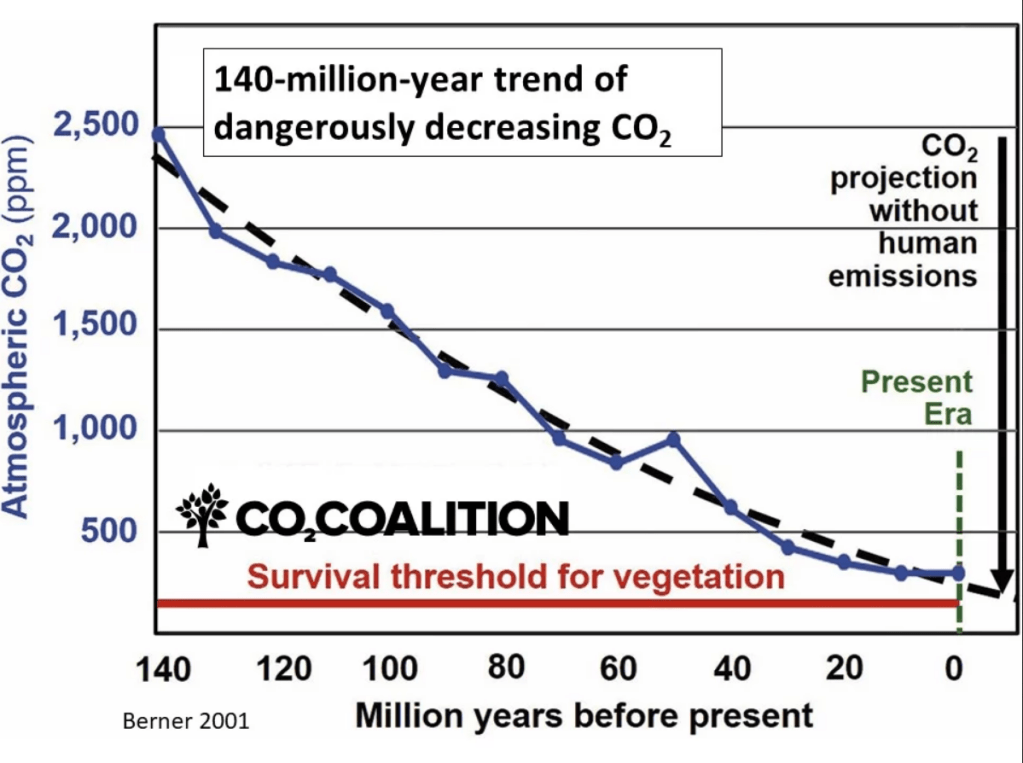
The conclusion that I draw from the available science is that CO2 levels do not pose any immediate or even long term threat to the planet particularly as:
“Climate scientists have determined, and both sides agree, that the warming effect of each molecule of CO2 decreases significantly (logarithmically) as its concentration increases. This is one reason why there was no runaway greenhouse warming when the concentration of CO2 was approaching 20 times that of today. This inconvenient fact, important though it is, is kept very well hidden and is rarely mentioned, for it undermines the theory of future catastrophic climate change. Diminishing returns apply.”*
*CO2 Coalition.
Leaving aside the arguments about the CO2 effect, and coming back to the actual amount of peatlands that are affected by commercial extraction here is a breakdown of the areas of peatlands in the UK and their current status expressed as percentages.
Peatland covers around 3 million hectares in this country:
22% of the total peatland area remains in a near-natural condition, comprising undrained bogs and fens
41% of the UK peat area remains under semi-natural peatland vegetation, but has been affected by human activities including drainage, burn-management, livestock grazing and the cutting of peat for fuel
16% is covered by woodland, the majority of which is drained conifer plantation
15% is occupied by agricultural cropland and grassland, mainly in lowland regions of England such as the Fens, Norfolk Broads, Manchester Mosses and Somerset Levels
Industrial peat extraction for horticultural use occupies 0.15% of UK peatland, mostly on lowland raised bogs.*
*UK Centre for Ecology & Hydrology.
Yes, that’s right, 0.15%, so out of 3,000,000 hectares of peatlands only around 4,500 hectares are used for industrial extraction. All that government effort, not to mention money, going into penalising the horticultural industry and primarily you, the gardener. What about those bogs that are in need of protection? In fact the majority already are protected, that’s how the movement started before it got out of hand. To balance things out, there are now several government schemes to aid the restoration of those bogs which have been degraded, however, to be honest, the sums dedicated to these schemes are not very impressive.
Having read the actual figures again, I can no longer resist commenting on how this information has been misrepresented, for example, in the statement from The Wildlife Trusts. “80% of the UK’s peatlands are now degraded as a direct result of damaging practices such as drainage for agriculture, burning and peat extraction for horticulture.” peat extraction for horticulture right up there with the worst of them yet only 0.15%! Another interesting quote from the same source is the allusion to other countries: “The decision to allow the sale of peat-containing products to continue until 2030 does not reflect the value of peatlands – here and abroad.” yet countries like Sweden have a sound peat harvesting policy and the UN Intergovernmental Panel on Climate Change has changed the classification of peat from a ‘fossil fuel’ to a ‘renewable biomass resource’ in recognition that peat can indeed be harvested and cultivated sustainably. In November 2000 the European Parliament amended Article 21 of the Council Directive on the promotion of electricity from renewable energy sources in the international electricity market, adding peat to the list of renewable energy sources. From the same source, I am not sure what “the UK is a world leader in emissions from degraded peatlands.” even means. In Southeast Asia, in particularly Indonesia, the draining of peat bogs for agricultural use has led to many catching fire and releasing massive amounts of CO2 into the atmosphere, the UK’s peatlands contribution is minimal in comparison. It is also worth noting here that the very high release of CO2 only comes with draining and burning.
In conclusion what has happened to lead to the vilification of peat is similar to that of Co2, a minority opinion, not even good science, has been politicised and the establishment have run with it for whatever reason until it has achieved cult status. I sometimes wonder if this is the result of a society which suffers from an indolent aimlessness until it is given something that it can easily focus on with little or no effort and feel good about itself, or, maybe, it’s just a good business opportunity?
The go to webpage for a balanced approach: Peat Policy at Glendoick Gardens(here)
Bunny Guinness – For Peat’s Sake – Don’t Deprive UK Gardeners.(here)
YouTube video, explaining the multi-trillion dollar climate crisis scam, how it evolved and how it is maintained. The scientists who appear in this film are at the top of their game, including a Nobel Prize winner. They, quite simply, have no longer anything to fear from the establishment so can speak out.
Some of you may well disagree with what I have set out here, and you are welcome to make any constructive comments, however, please read and watch all the material listed before doing so. Thank you.
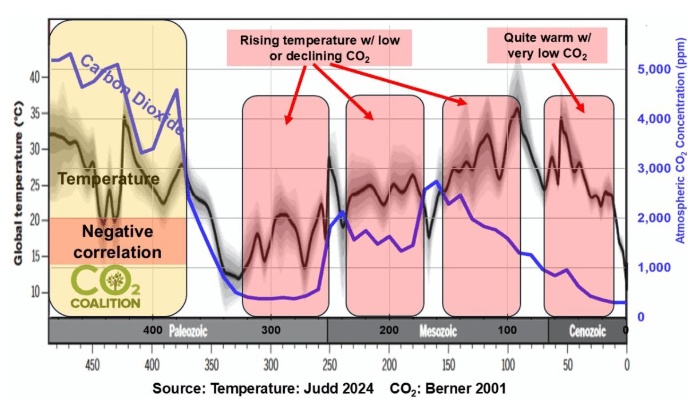
Latest research paper, news letter from the CO2 Coalition: How in the world did this new temperature reconstruction get past the Climate Industrial Complex’s censor machine?
The recent publication by Judd et al looked at nearly half-a-billion years of global surface temperatures and found that, rather living in a time of extraordinarily high temperature, we are in a period of near-historic lows. In fact, the global temperature peaked 100 million years ago at about 96.8oF (36oC) which was 37.8oF (21oC) higher than the temperature for 2023 (59oF and (15oC)! The inconvenient fact for the climate alarmists is that Earth’s temperature has been in a 50-million-year decline.
We then compared this data to long-term CO2 data (see below) and found that CO2 and temperature don’t correlate very well at all.
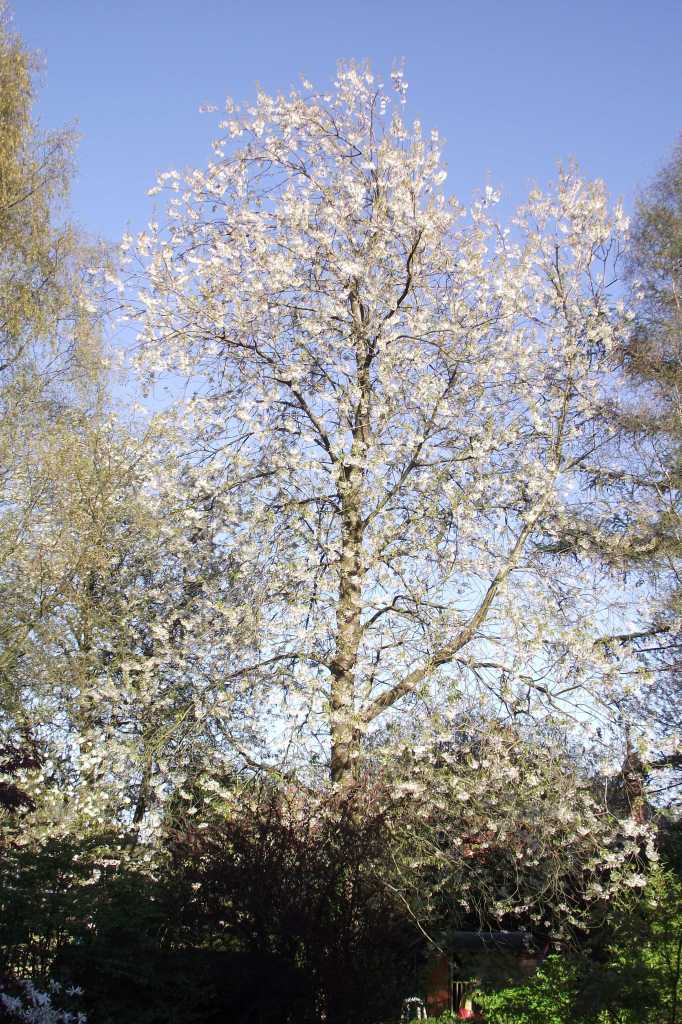
The wild cherry, just slipped this one in because I had one at the bottom of the garden. Unsurprisingly the avium comes from the fact it is generally propagated from seed deposited by our feathered friends.
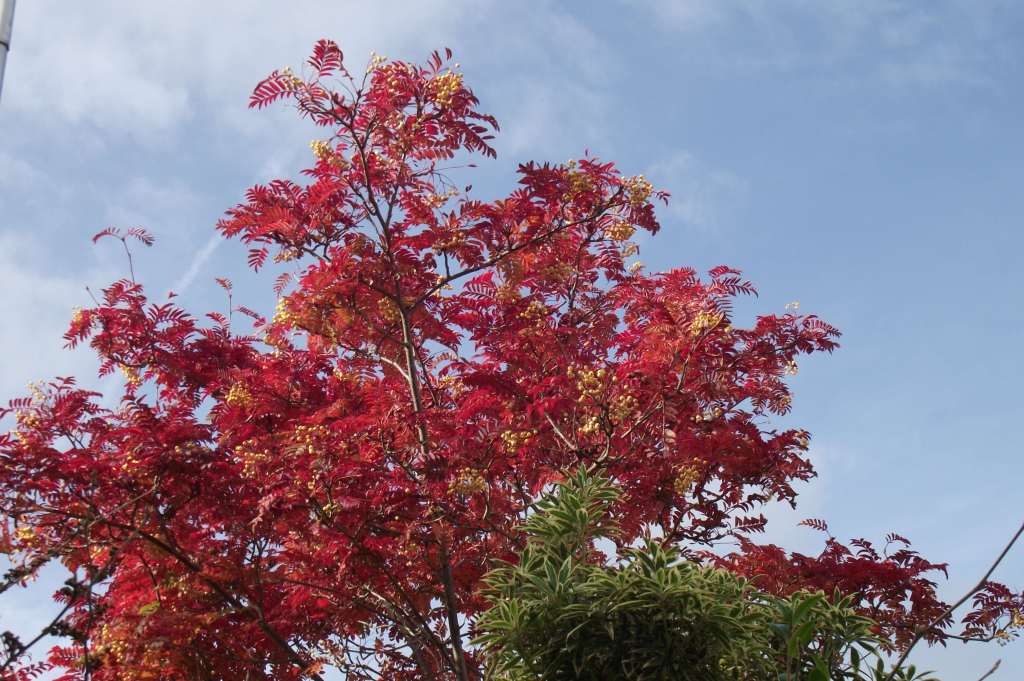
Rhus
Rhus typhinaRhus typhina autumn colour
The stag’s horn sumach, is a bit of a curiosity, it only fruits on female plants although the male carries the flowers. It gets its name from the way the branches resemble a stag’s antlers also the stems carry a sort of brown velvety russet which is also reminiscent. A fairly undemanding, strong grower, it is easy to propagate as it produces plentiful suckers and can quickly turn into a thicket if allowed. The pictures could possibly be of Rhus typhina laciniata.
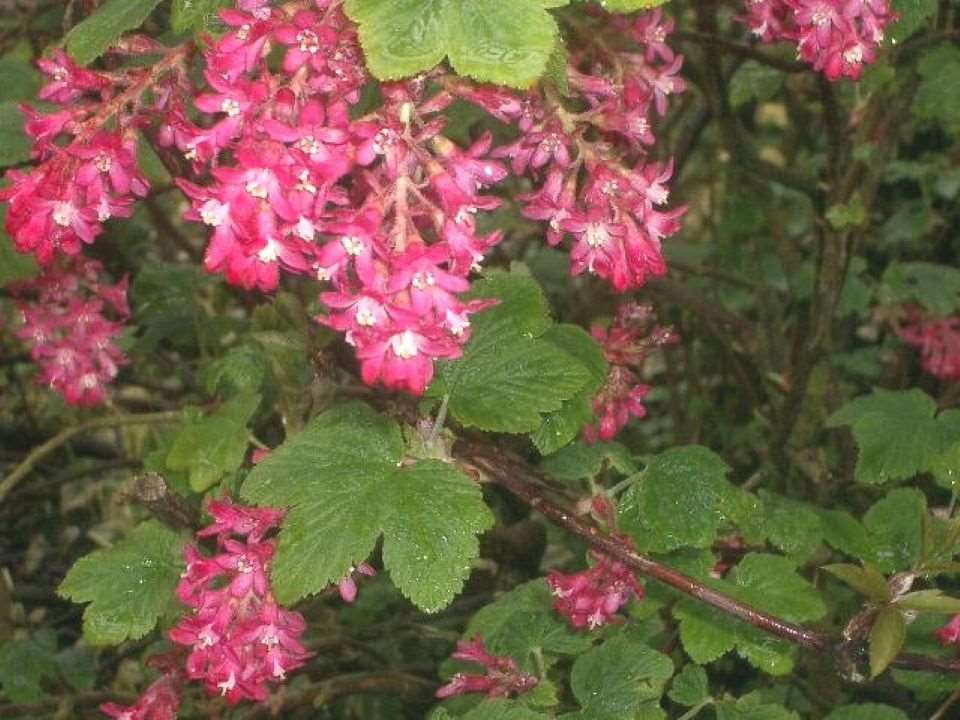
Ribes
Ribes sanguineumRibes sanguineum
Flowering currants are one of those plants which belong to the era of when forsythia, philadelphus and ribes was just about all that was on offer. The flowers offered early nectar for bees and other insects but once flowered the actual shrub itself was hardly engaging for the rest of the year. Still has a place in the larger garden with some cultivars available, in particular an old favourite R.sanguineum ‘Kind Edward VII’. As you would expect the prevailing impression from the plant is the smell of currants.
Robinia
Robinia pseudoacacia
Known in the UK usually as the false acacia this tree is actually a legume even to the extent that the roots fixate nitrogen. I never really liked it, although the fresh leaves were attractive, it frequently carried areas of die back and a rather untidy form as can be seen in the photo’. In this case it did die completely one day so I had to tolerate it no further.
Rosa sericea subsp. omiensis f. pteracantha
Rosa sericea subsp. omiensis f. pteracantha
This is real one-off, it was impossible to grow roses in my damp shaded garden without massive fungal problems but when I heard about this rose from parts of China and read an account of it growing in Nepal I had to have it! Grown for its spectacular thorned stems it had small nondescript white flowers followed by red hips of which unfortunately, I don’t have a picture, however the spectacular red stems and thorns make up for it.
Fallopia
Fallopia baldschuanica
The Russian vine or one time Russian glory vine, (syn. Polygonum baldschuanicum) was very popular for covering up unsightly structures until it was realised it could also cause untold damage to the structures and any shrubs and even trees in the vicinity. Superb when in flower but rather uninspiring for the rest of the year, definitely needs handling with care!
This is what happened to a rather nice specimen of Cedrus atlantica Glauca, the blue Atlas cedar I had by the front gate. I think the mistake was to try and restrict its growth but there was really no alternative as the tree was already pushing the telephone wires. I used to prune it myself but had left it to a professional arborist who I think just topped it instead of also thinning the growth out at the top causing it to become congested. The general consensus of opinion was that the tree had been pruned too heavily which eventually traumatised it, no evidence of any disease was found.
How a healthy tree should look.Die back!Almost bare!Gone!
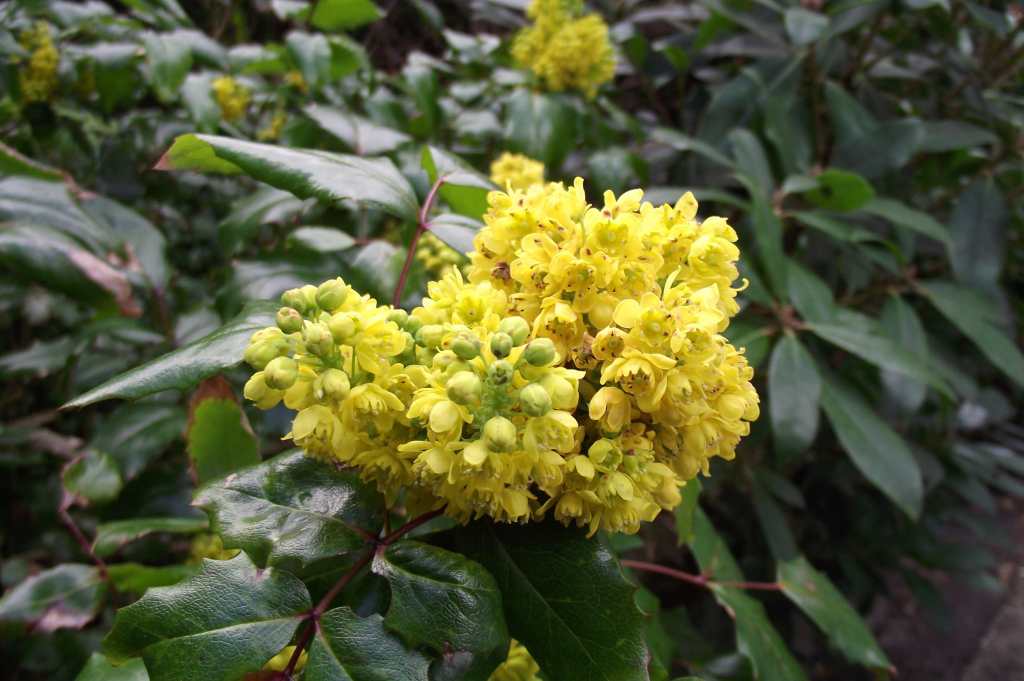
The mahonias are closely allied to berberis and as such the nomenclature can get a little confused with the generic name getting interchanged. Mahonia aquifolium, the Oregon grape, incidently the state flower, is generally a low growing (one metre) high spreading bush which is ideal for under-planting larger trees and shrubs, although stand-alone specimens in the wild grow to several metres. The flowers are followed by dark berries which are attractive to birds. I find the biggest problem is the evergreen foliage can become scrappy which detracts from the appearance so a heavy prune once in a while regenerates the growth. Mahonia japonica originates from Taiwan and it and its cultivars are now widely grown. These are very strong growing shrubs and like M.aquifolium benefit from a heavy prune from time to time. Although M.japonica is often classed as winter flowering I have known it in flower anytime from September to April depending on the prevailing weather conditions. Mainly in the spring, the yellow flowers attract blue-tits who just love to strip them. Do not go hand-weeding within a country mile of a large mahonia without wearing heavy gloves, the spines on the dead leaves in the leaf litter really hurt.
Parthenocissus
Parthenocissus quinquefolia
The Virginia creeper, as its name would imply, is an American native which is a useful deciduous climber for covering unsightly walls, out-buildings etc. because it attaches to the masonry by sucker pads and does not penetrate the fabric. The roots however, are a different matter, and can prove detrimental to such as old foundations but probably only on a par with others of a similar ilk. The flowers are insignificant, the foliage being the principal attraction, the berries that appear later are a good food source for the birds but are deadly poisonous to humans.
Passiflora
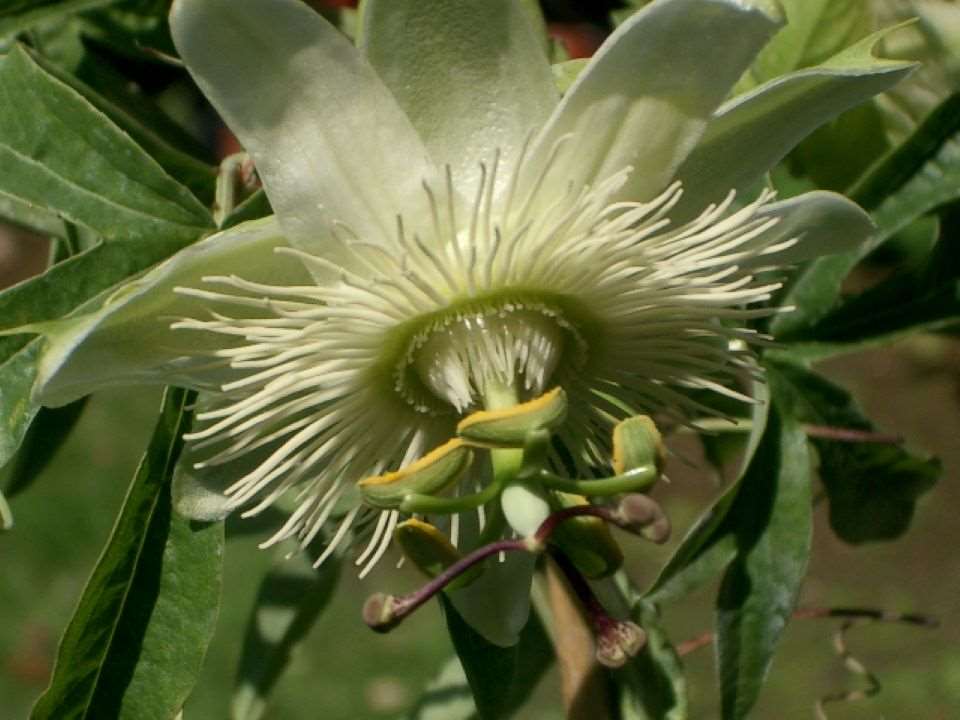
Passiflora Caerulea ‘Constance Elliot’
Sixty plus years ago the Passion Flower was a rarity but I was told about it as a child because of the Christian symbolism attached to the flower, it was also regarded as a subject for a cool greenhouse at best. Today there are only a few cultivars and ‘Constance Elliot’ AGM is probably the best known. What was once a talking point is now to be commonly found rampaging over fences and walls in in many urban gardens. The fruit is edible but by all reports rather insipid, I’ll leave it that.
Anemanthele lessoniana (Pheasant Grass)
This one appears under the all-inclusive banner of “other random plants” and because I forgot to include it earlier. I really like this grass, although I am not a big fan of grasses overall. Grown from seed, planted in containers, maybe it’s because I have not grown many grasses, but to actually see a group of these with the sun behind them is indeed impressive. Easy to grow but will seed around. (syn. Stipa arundinacea apparently.)
Philadelphus
Philadelphus
Philadelphus, the mock orange, is another shrub, along with the likes of forsythia, which was among the limited choice we had back in the 1960’s and 70’s. The fact that it was deciduous and did not make a particularly attractive bush was offset by its pure white flowers and powerful scent over its short flowering period at the time. Today the plant breeders have developed many cultivars ranging from patio-size bushes to double flowered specimens, nevertheless it remains a tough hardy plant.
Pieris
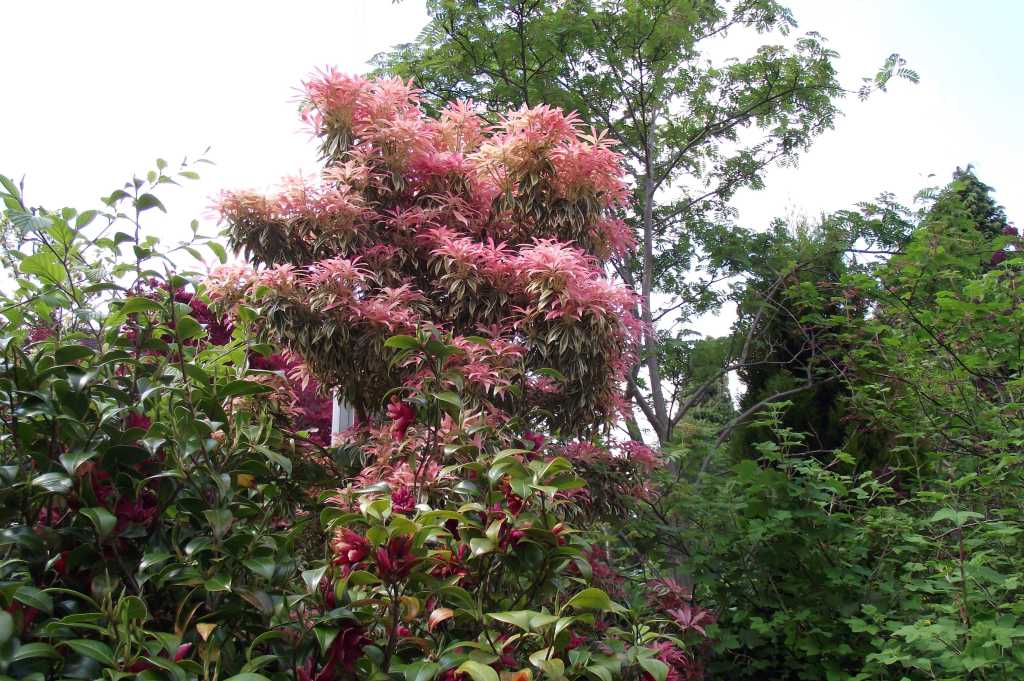
Pieris ‘Forest Flame’
There are generally two species and their cultivars grown as ornamental shrubs in the UK. P. ‘Forest Flame’ is a typical cultivar of P.floribunda from the US and the other is P. japonica from Japan and Taiwan. P.floribunda types are the ones which have the red/pink new growth which frequently is hit by frost in exposed areas, whereas P.japonica has striking and often variegated leaves. Both have bunches of lily of the valley-like flowers in white or sometimes pink. They are both toxic to animals and humans although I believe P.japonica to be extremely so.
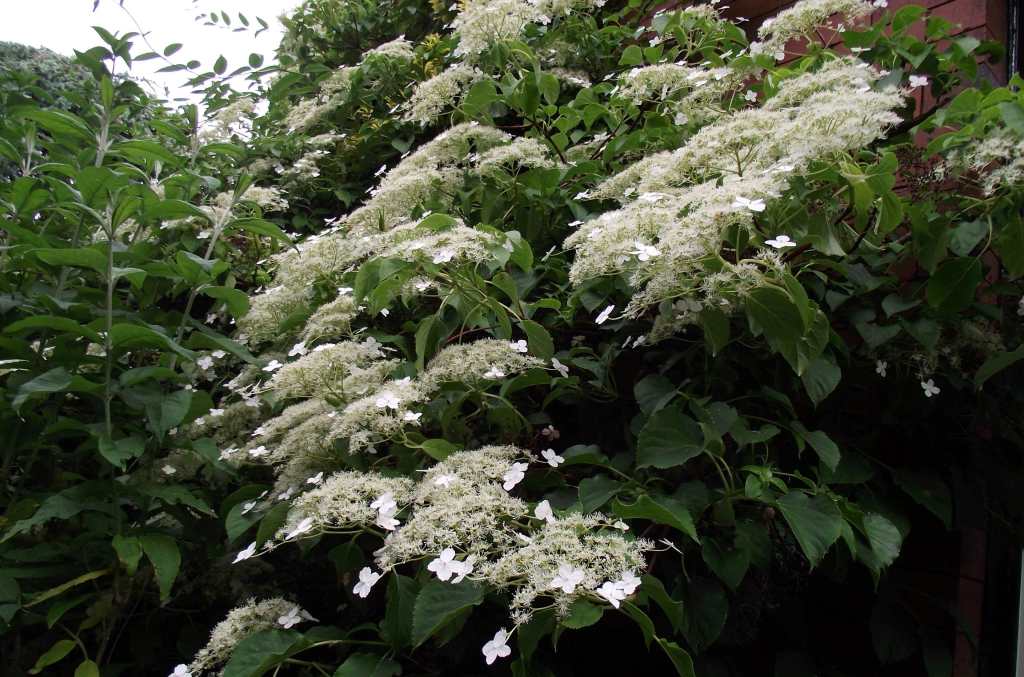
Hydrangeas are a familiar sight in gardens across the country, the most common are, what I refer to, as florist’s hydrangeas or the mopheads (Hydrangea macrophylla cultivars). These are generally named cultivars, some of which may have been passed from gardener to gardener over the years as well as those that have been recently purchased. In recent years the cultivars of H.paniculata have been in the ascendancy with the introduction of showy cultivars such as H.pan ‘Vanilla Fraise’ although these are not quite as easy to grow as they may seem when bought from the garden centre, pruning is all important to get strong enough stems to support the heavy flower panicles in young plants. The lace-caps (Hydrangea aspera for example) make wonderful specimens for under-planting tall trees or shrubs as well standing alone. Finally the climbing hydrangea now Hydrangea anomala subsp. petiolaris is one of the few climbers that do well on a north facing wall. Photo of ‘Vanilla Fraise’ not in my garden.
Hypericum
Hypericum calycinumHypericum calycinum berries
Hypericum calycinum, also known as Rose of Sharon or St John’s Wort, is a tough addition to the garden. Grown for its long season of flowers and berries and its ability to handle dry shade it can be particularly useful. The fact that hypericums are adaptable, and the genus contains around 500 species, has given them a world wide distribution and some species are even classified as noxious weeds in certain countries. A particularly good form is Hypericum x hidcoteense ‘Hidcote’, another particularly good form for the alpine garden or trough that I used to grow is Hypericum. olympicum. f. uniflorum.AGM.
Leycesteria
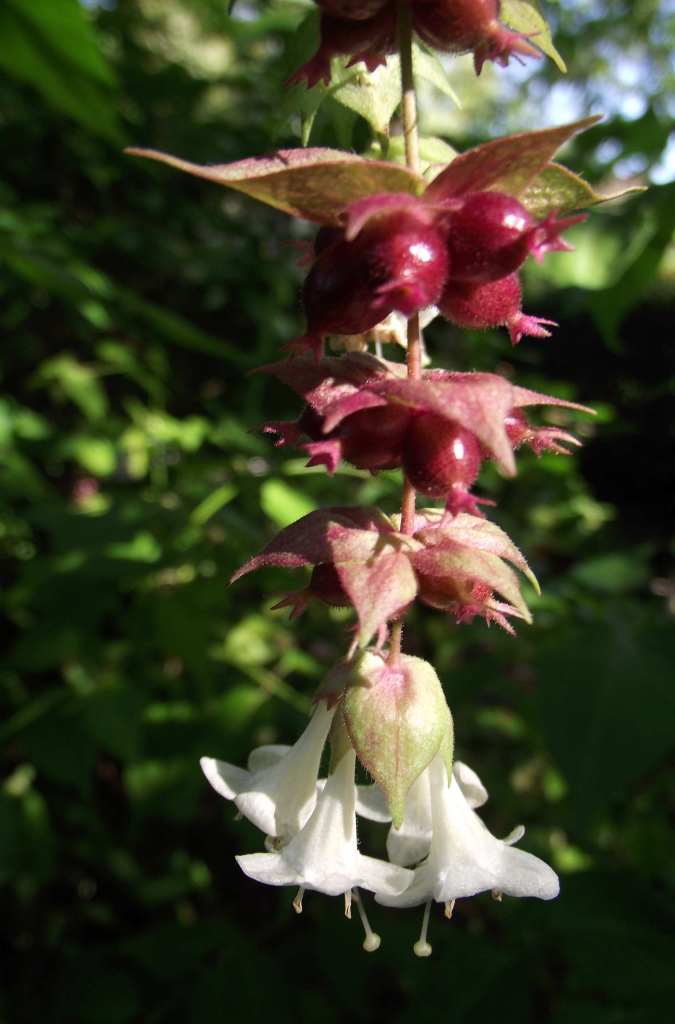
Leycesteria formosa
The Himalayan honeysuckle is a vigorous upright shrub, the hollow stems, from which hang the colourful scented flowers and berries, are almost what you would expect from an herbaceous plant. Easy to grow even to the extent it is regarded as an invasive species in Australia and New Zealand.
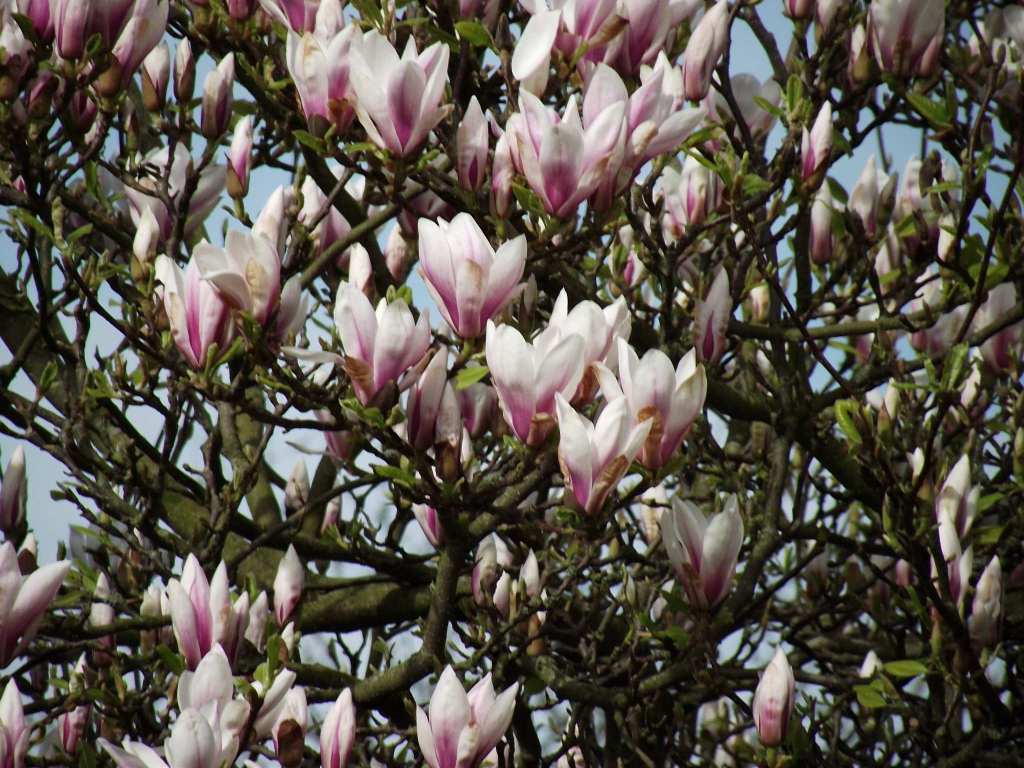
Magnolia
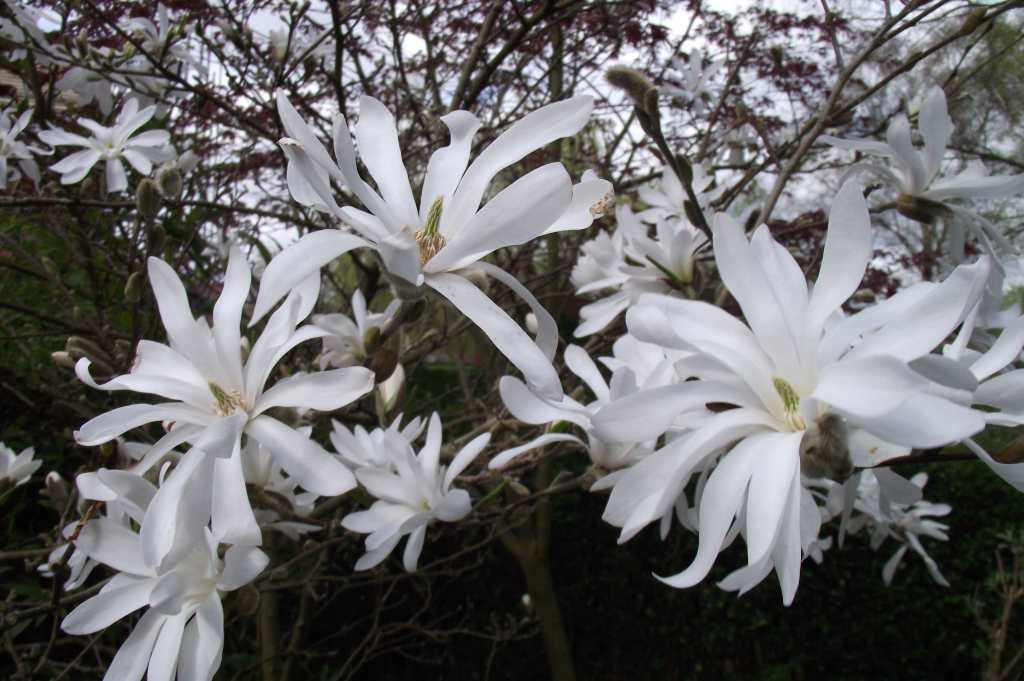
Magnolia stellataMagnolia grandiflora Magnolia x loebneri ‘Leonard Messell’Magnolia soulangeana nigra
Magnolias are an ancient genus but really came to the attention of the UK gardener with the introduction of M.soulangeana and its cultivars to the buying public back in the 1960’s and 70’s. Everybody wanted one as there were enough mature specimens to be seen and marvelled at from earlier years, they were also very expensive and usually took several years to result in a worthwhile flowering specimen but we persevered. The much anticipated flowering time came along and as the buds opened very often they were hit by a frost and still we clung on to the hope that next year we would see the perfect display, such was the allure. The plants we see today generally have their origins in South East Asia, but it is worth noting that there are a secondary group which originate from America such as Magnolia grandiflora which are actually forest trees, their wood being used to make furniture. The photos of M.grandiflora and M.soulangeana nigra are not from my garden.
We have had a “proper” frost on Thursday night, as opposed to a couple of air frosts about three weeks ago, which is only about 10 days earlier than last year. It caused little damage even on the north side of the house but tells me that I have probably run out of options for a while for Six on Saturday.
Clematis
I found a clump of clematis flowers hiding in amongst the honeysuckle and rambling rose that cover a boundary fence.
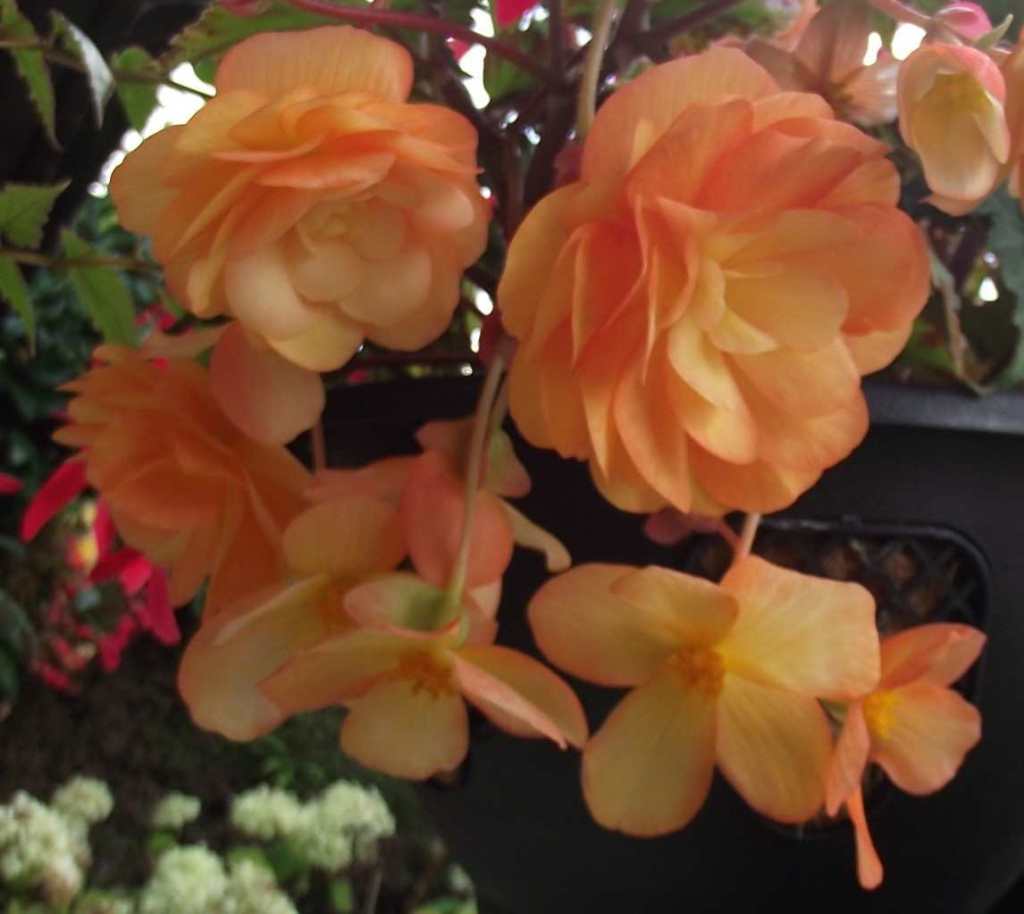
Begonia ‘Illumination’ Strain
I have a few baskets on the north facing front of my house where at one time I would have used impatiens but find begonias an excellent substitute. Mia culpa, I no longer have the facilities to raise bedding so have to buy in plugs. The one I have always used is Begonia ‘Illumination’ Strain, Apricot Shades although I must admit they haven’t done as well this year which I put down to a very slow start.
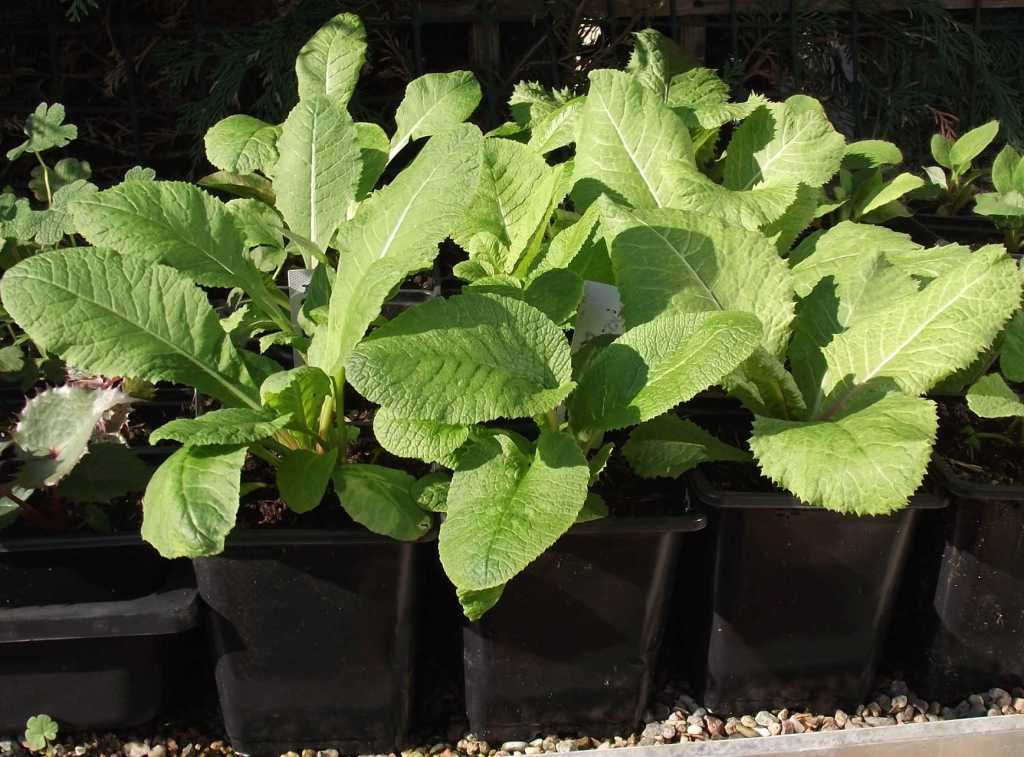
Young primula plants which should be planted out by now but I have nowhere to put them. I always have this problem, even when I had a much bigger plot, I always over-produced. I get the most satisfaction from raising plants from seed, particularly the more difficult ones. Every year I would be inundated with seedlings as a consequence of taking advantage of various plant society’s surplus seed offers such as those from the Scottish Rock Garden Club. I will be ordering again this year, but no lucky dips!
Always had a place for a few hydrangeas but I inherited this one. Two out of three I brought with me were decimated by frost in their first winter and didn’t flower the following year so rather than risk a repeat I discarded them. It sounds a bit harsh but space is at a premium.
Mahonia buds waiting to come into flower. I like mahonias but can never tell when they will flower, I have had the same plant come into flower in October and even March in the past, this one came into flower last year whilst the bedding was still going strong but I doubt it will happen this time.
Salvia officinalis
Despite the popularity of many salvia cultivars, I grow them myself but only have one that comes through the winter every year, the common or garden sage still looks good with its grey young leaves at this time of the year. This one is growing through a crack in the paving and I get the scent when I deliberately knock it in passing.
This meme is hosted by Jim Stevens who is to be found with all the details and links to plenty of other blogs to enjoy at Garden Ruminations.
First and foremost Glyphosate is not a selective weedkiller, it kills all the plants and grasses you may have in your garden regardless, it may take several applications over several years for particularly persistent weeds but it will get there eventually. Glyphosate works by being absorbed by the leaves and being transmitted to the roots killing the whole plant unlike most herbicides which only kill the top growth allowing the roots to regrow, which is the case with many perennial weeds.
Availability
Although many UK garden centres and supermarkets have removed glyphosate containing products from the shelves it is still freely available online. Unless you are very rich, or have a very small garden, “ready to use” products are definitely not the way to go, far better economically to buy the concentrate. When sold for garden use the product normally contains 300g/l of glyphosate in a soluble concentrate which also includes a wetting agent to help apply the solution to the leaves. These wetting agents have become subjects of controversy themselves as manufacturers do not have to list them in the product’s ingredients.
Application
Without doubt the best tool for application is a knapsack sprayer particularly if you intend to use a “no dig” approach, watering cans are out of the question although some products do give dilution rates for this. It is essential to be in control of the direction and volume of the spray principally to make sure that you only spray the unwanted plants and avoid those that you want to keep. It has been pointed out to me that the most necessary skill when spraying is to actually know the difference between a weed and a keeper, unfortunately many, what I call “mow and blow” garden maintenance people, don’t, best do it yourself. If you have a large garden it’s worth spending a bob or two on a decent sprayer with a metal nozzle, however I manage quite well today in my small garden with a cheap plastic one. If you intend to spray close to plants that you want to avoid, a good idea is to practice with just water first, and of course always point the nozzle away from them, I very often virtually dribble onto the offending weeds to avoid overspray, control is everything.
When and what to spray
As the herbicide is absorbed through the leaves it is essential that no attempt is made to cut back the weeds before spraying however tempting that can be in an overgrown patch, the more leaf surface area there is, the more spray can be absorbed. Old foliage does not take up the chemical as efficiently as new growth, an exception to the rule, in ideal conditions, is to cut back the old growth and then spray the re-growth at a later date to get better absorption. Weeds can be sprayed at any time of the year (it won’t say this on the label) as long as there is growth, however the results will take longer in the cold weather. Patience is a virtue when using glyphosate anyway, I always allow at least a week for it to show signs of acting even in summer.
When it comes to rain, the likelihood is that in ideal conditions for absorption on annual weeds a shower of light rain a couple of hours after spraying may not be too detrimental. If however one is spraying established perennial weeds at least 24 hours without rain is essential. An example of cold weather use is to spray emerging weed seedlings in early spring when the plants in your borders are mainly dormant, this is not necessarily “good practice” as you will get some overspray but it can save a lot of problems later. This particularly applies to the pernicious rock cress which seems to grow all year round.
Speaking of good practice, herbicides containing glyphosate are perfectly safe for the amateur gardener as long as the manufacturer’s instructions are adhered to. Maybe I don’t follow them quite as I should, particularly with regards to PPE, other than washing my hands. I am in my late 70’s and if I think back to the late 60’s and early 70’s when I used to spray God knows what on fruit trees from a cabless tractor without any form of PPE I think I am lucky to have made it this far! The most important thing is to stick to the manufacturers dilution rates. When using that which is available to the amateur gardener the recommended dilution is 24ml/litre. Commercial strength product at 360g/litre glyphosate is usually diluted at 20ml/litre for safe and effective use. There is actually nothing to gain from exceeding the manufacturers recommendations although some gardeners I have known in the past managed to get through remarkable amounts of product in a season!
No Dig
I use glyphosate as a tool in the garden. Although I was already familiar with its use in no-till agriculture in the US, I followed one man who was a great exponent of the use of herbicide to minimise cultivation of the soil in the UK. Roger Brook, a lecturer in Soil Science was a great advocate of controlling weeds by spraying therefore avoiding disturbing the ecosystem which he felt was detrimental to the soil’s health. His version of “no dig” was very different from today’s version which relies principally on mulching. A sign of the times occurred several years ago when a graveyard that he maintained and planted featured in a glossy magazine as a thing of beauty, strangely there was a distinct lack of further interest when it was realised that he had achieved this solely by judicious spraying of a herbicide. Even in my small garden, I still use spraying as my principle form of weed control.
No Dig may not be for you, it is very much a personal choice, but I hope that, in general, my experience is of interest, if in doubt engage the services of a qualified professional.
Book reviewer and garden enthusiast. Updates from my Hampshire garden. Usually talking about books and plants. People do not forget books or flowers that touch them or excite them—they recommend them.













































 A Plantsman's World