Popular bulbs, corms, rhizomes etc……… the non-fibrous rooted plants. Part 1.

With the early spring flowers coming mainly from plants which aren’t fibrous rooted I thought a description of some of the genera would be topical. I don’t claim this to be a comprehensive list as the variety of plants and their preferences is too wide a subject to cover and many books have been written about them. In the case of where to plant, this in itself is impossible to generalise as even a single genus can have originated from diverse locations and climatic conditions. This is then an overview of those plants that I have grown and my own experience. Many plants which are actually, though not obviously, rhizomatous are included in the Hardy Perennial posts.

Alliums

Allium karataviense ‘Ivory Queen’
Allium neapolitanum
Allium ‘Purple Splendour’
Allium sphaerocephalon
Allium crystalis

Alliums are no longer thought of as glorified onions but as a useful addition to any border. They have benefited from being marketed well by the bulb companies and are relatively easy to produce. Beware of advertisements offering allium collections at cheap prices as they very often include such as A.sphaerocephalon which in itself is attractive but the bulbs are tiny and the flowers are very small so check the varieties before you buy. The received advice is to plant the bulbs in a sunny border at least 6″ deep, although this doesn’t apply to the smaller bulbs and should be treated as a guide only. Personally I have successfully grown them in a quite shaded mixed border in proximity to deciduous shrubs, they benefit by being left alone where they will quite happily multiply forming attractive clumps. Many of the early ones poke through the ground with, or just after, the spring flowering bulbs but it is best to be aware that the large strapped shaped leaves can become very unsightly after flowering so planting amongst herbaceous perennials that will hide them is a good idea.

Nectaroscordum siculum syn. Allium siculum, Allium nectaracsardium.

Nectaroscordum siculum or the Sicilian Honey Garlic is an unusual relative with beautiful pendant flowers, this one definitely needs a sunny spot, in shade it will contort its stems trying to reach the sun which I found out to my cost.

Anemone species.

Several species of anemone are grown from rhizomatous rootstocks, the best known of these are A.blanda and A.nemorosa the best known species to be grown from corms is Anemone coronaria often known as the Florists Anemone being used widely as cut flowers, the ‘De Caen Group’ are particularly noteworthy.

Anemone blanda
Anemone nemerosa. Wood anemone

I have always treated A.nemerosa as it’s name suggests as a woodlander, cool dappled shade suiting it best. Remember as a forest dweller it flowers early before the forest canopy develops and does need sun for the flowers to open. Anemone blanda is quite versatile but again needs the sun to open fully. Anemone coronaria I have never had any success with and to be frank I don’t particularly like, I always visualise it growing in orderly rows as part of a commercial enterprise in the Channel Islands where I think it is best suited and should remain.

Chionodoxa luciliae

Chionodoxa luciliae and Chionodoxa luciliae alba. Glory of the Snow.

Chionodoxas or Glory of the Snow, as their common name implies, are early spring flowering bulbs from such places as Greece and Turkey and now classified as Scilla. Easy to grow and if left to their own devices will multiply by bulblets and seed. Looks well naturalizing in grassland where they are quite at home.

Colchicum

Known as the Autumn Crocus (Colchicum autumnale) and not to be confused with Crocus sativus which also goes by the same name but is actually the Saffron Crocus. The flowers emerge at the end of summer on naked stems, hence another common name of Naked Ladies, the leaves developing after flowering.

Colchicum autumnale.

Easy to grow in any decent deep soil the main problem being remembering where they are during the summer dormancy so it is another bulb (strictly a corm) that lends itself to being naturalized in grass. Used in medicine to produce a strong anti-inflammatory best known as Colchicine which is used in the treatment of gout. Colchicum autumnale is one of several species that come from Europe and the Mediterranean so will grow in the UK, there are others that are native to Africa. Unlike crocuses they belong to the lily family. This photograph was not taken in my garden.

Crocus

Crocus is a very large and diverse genus and one which I have little experience with, easy to grow from corms, plants range from the much hybridized larger late flowering “Dutch” types (Crocus vernus), like those pictured above, to the smaller early hybrids raised from such as C. chrysanthus like those below.

Crocus chrysanthus ‘Zwanenburg Bronze’
Crocus ‘Snow Bunting’

Crocuses are members of the Iris family and can be found from hot arid areas to arctic tundra although many come from the Eastern Mediterranean, probably best grown under some ground cover or in grass to make sure they are not disturbed when dormant.

The next post will feature erythroniums amongst others.

Lilies Part 3

Included here is the giant of them all Cardiocrinum giganteum (Syn. Lilium giganteum), a few Asiatics and pest and disease.

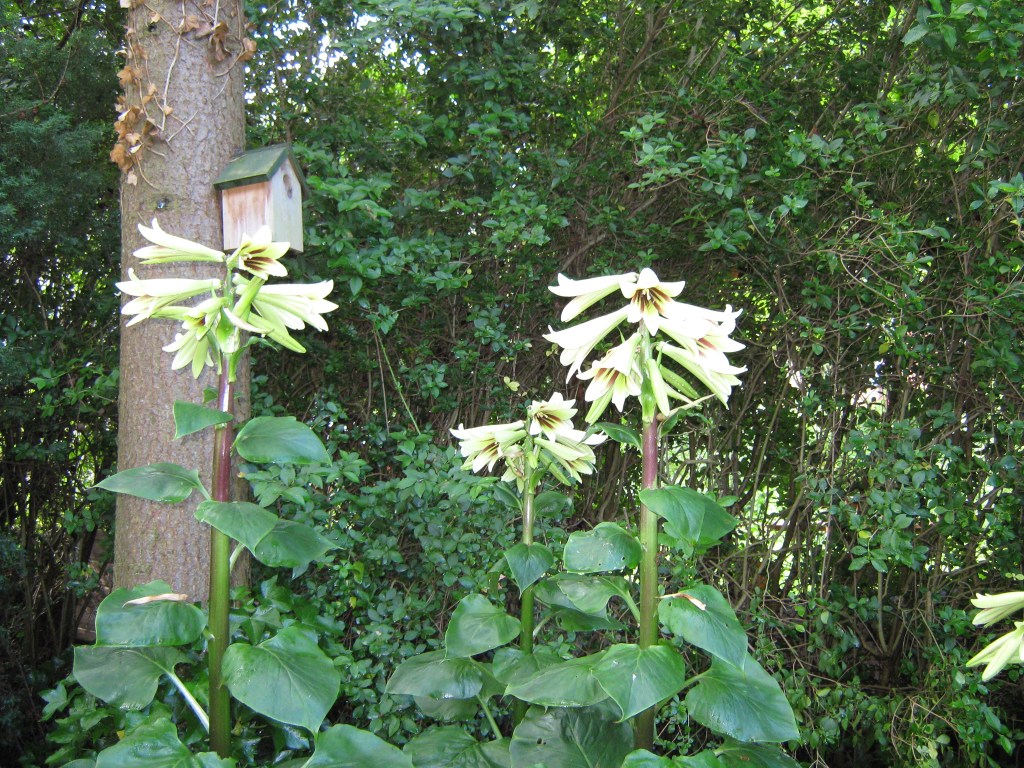
Cardiocrinum giganteum
Cardiocrinum giganteum emerging.
Cardiocrinum ready to open.
Cardiocrinum flower close up.
Cardiocrinum seed-head.

Cardiocrinums or Giant Himalayan Lilies grow up to 10 feet tall and are monocarpic (die after flowering) it takes around 5 years to flower from bulbs which develop as offshoots from the original before it dies. If you are extra patient it takes around 7 years from seed. They prefer a rich acid soil with some shade and unlike other lilies are planted with the nose of the bulb at the surface of the soil. The large glossy rosettes of leaves can be 12″ across, so plenty of space needs to be given. The flowers are born very high up on the stem, are 6″ or more long and highly scented, to stand near a group on a warm humid day is an exceptional experience.

Although I much prefer Oriental Lilies I have a grown a few Asiatics, ‘Night Flyer’ is a favourite.

Lilium ‘Night Flyer’
Lilium ‘Night Flyer’ Close up.
Pure white Asiatic Lily ‘Amazing’

The above are a few “Patio Hybrids” I had as a bonus offer, only 12″ high, very attractive flowers but unfortunately no scent.

The number one pest experienced by lily growers is the Lily Beetle, appearing first on fritillaries and later on lilies they are capable of great damage in a comparatively short time. The grubs only develop on these genera and are easily recognised by the fact they wrap themselves in their own excrement so if you see any nasty looking dark blobs on your leaves, usually at the axil, you know what they are. The easiest method of control is to be vigilant and pick the adults off as they appear and crush them but be careful they are tricky devils and if allowed to drop on the ground they land on their backs and are virtually invisible.

Host plant Fritillaria meleagris
Lily Beetle

I have come across a virus disease once and it can be devastating, although not fatal, the plant is severely weakened and never performs to the same degree. Spread by aphids, although aphid control and good garden hygiene helps, once the plant is infected the only way to deal with Mosaic Virus realistically is to uproot and burn it entirely.

Mosaic Virus

As I finish the post I have taken delivery of some more lily bulbs. Looking forward to a summer full of scent!

Warning: Lily pollen is fatal to felines.

Lilies Part2

Lilies generally prefer a slightly acid soil, originally I planted them in pots preferring to have the scent close to the house, later as their numbers grew, I started to remove them from the pot intact and planted the whole thing in the border after the first year, this worked quite well as many of the “transplanted groups” gave a good display for years. If planting direct into the garden it is recommended that a layer of grit is placed beneath the bulb to aid drainage however the thing to avoid is creating pockets in heavy soils which will fill with water during the winter. If planting in heavy ground a thorough cultivation of the planting area adding grit and additional grit under and around the bulb would seem prudent. I usually plant at 100mm which also helps to stabilise the stems as many lilies do actually throw roots out from the stem. Remember using odd numbers in a group always looks better and less artificial.

Oriental lily ‘Nippon’
Lilium ‘Pink Perfection’ Scented Trumpet Lily
Lilium ‘Robert Swanson’ Giant – Tree Lily.
Lilium ‘Salinas’ Highly scented Oriental.
Lilium ‘Salmon Star’
Shorter than most this scented Oriental (sometimes Dwarf Oriental) lends itself to container culture.
Dwarf Oriental Lily ‘Souvenir’
Oriental Lily ‘Starfighter’ Very large upturned flowers.
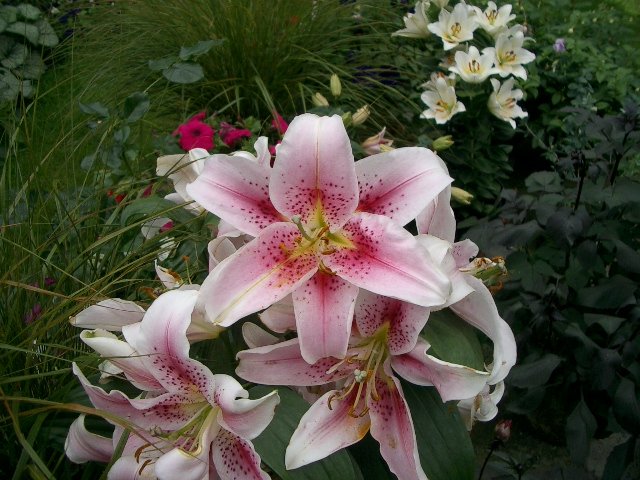
Lilium ‘Stargazer’ Oriental Lily. A deliberate cross between two species to produce an upturned flower. Traditional lily which has been around for some time.
Lilium ‘Time Out’ Oriental lily.
Oriental Lily ‘Tom Pouce’ Extremely large trumpets.
Lilium ‘Venezuela’ Oriental.
Fragrant Tree Lily ‘Honeymoon’

Watch out for the lily beetle! Next post miscellaneous, plus pest and disease and the giant of them all Cardiocrinum giganteum.

Lilies Part 1

I love of lilies, there is something about their stature and the majestic blooms that appeals to me although I have to admit, when younger, I shunned them as too artificial looking.There are none in my new garden but I have taken a delivery of some bulbs today which has inspired this post.

Lilies slot into various groups and have distinct characteristics but I am afraid that I only go for the scented ones, principally the Orientals, and ignore the others, mainly Asiatics, as a lily without scent just doesn’t do it for me. The post is probably more pictorial than informative but, this is the nature of the beast, they are reasonably easy to grow and will grow well in plenty of sun or dappled shade, many of the original species coming from the margins of woodland.

Trumpet lily ‘African Queen’ Lilium longiflorum hybrid.
Lilium ‘Arena’ Very fragrant Oriental.
Lilium Anastasia ‘Oriental Trumpet, Tree Lily or Orienpet Lily growing up to 2.5 mtrs.
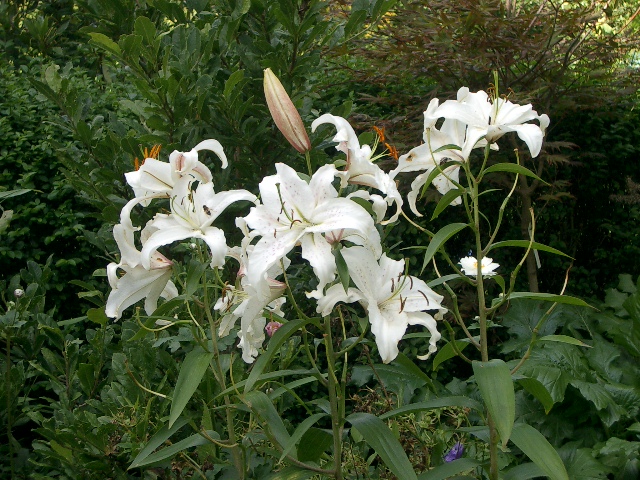
Oriental Lily ‘Casa Blanca’
Oriental Lily ‘Dizzy’
Another highly scented Oriental Lily ‘Everest’
Oriental Lily ‘Excelsior’
Lilium ‘Golden Splendour’ Trumpet Lily.
Sweet scented Lilium ‘Josephine’ Oriental Lily
Oriental Lily ‘Kiss Proof’
Tree Lily Lilium ‘Lavon’ These large lilies can take up to three years to attain their final height of approx. 2 Mtrs.
Lilium ‘Mona Lisa’ – Oriental Hybrid
Lilium ‘Muscadet’ – Oriental stunner.
Planting and my preferences coming up in Part 2.

The Lost Year

Having had websites or a blog for many years and deciding to start again from scratch my first decision was to remove all previous material as I felt that the temptation to recycle material would be too great and consequently defeat the object of the exercise. I live alone and I am in my 70’s so one would have thought that under the circumstances 2020 would have been a perfect time to start my new project however my enthusiasm literally evaporated, my get up and go went, so I find myself almost a year later finding the resolve to get down to business.

I am now operating in a very limited space so my plan last year was to have a series of trips out to local gardens and events to find new material but, as we all know, this was doomed to failure. The back-up plan was to write a series of blogs on my favourite genera, this also did not come to fruition but nevertheless that is the way I intend to go for the immediate future.

I have already written a post on one of my favourites, epimediums, but my real love lies with the likes of Asiatic primulas and meconopsis which, living in the North of England, I have been able to grow with some success. I hope to be able to show and describe some less familiar plants as one of the things I have retained is my photograph library so I have a reminder of some beautiful plants I have grown in the past which I can share.

Epimediums

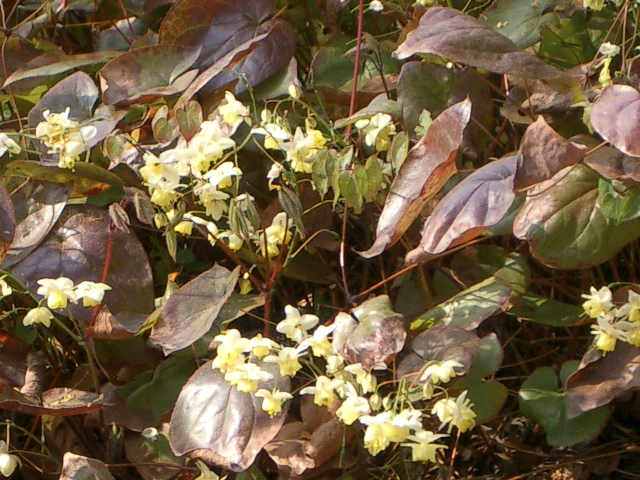
For the last ten years or so I have been increasingly in love with this genus of beautiful flowering plants. They are so adaptable, some more than others, to what are best described as “difficult” conditions some members of the genus have actually seemed to thrive for me rather than just tolerate dry shade which is one of the most difficult areas to cater for. There are both evergreen and deciduous species many with colourful leaves particularly when just emerging in the early spring and sometimes again in the autumn. Many variations are now available sporting different flower combinations giving a wide range of “mini-orchids” to choose from.

Epimedium grandiflorum ‘Queen Esta’

Deciduous cultivar Queen Esta prefers a moisture retentive soil although I have grown it within a few feet of the base of a birch tree as shown in the picture without any trouble however during very dry spells the area received some watering.

Epimedium x rubrum

Much as I like the flowers of Epimedium x rubrum I have never grown a robust specimen and I normally don’t have a problem with epimediums, in fact the new plant I have now is not doing well compared with its companions. This plant is evergreen in that the leaves last the winter and although preferring moist soils should withstand drier conditions.

Epimedium x warleyense ‘Orangekonigin’
Epimedium x warleyense ‘Orangekonigin

Epimedium x warleyense from the legendary Miss Willmott’s garden was the result of a cross between two western species, the cultivar ‘Orangekonigin’ is a fairly recent introduction. Seems to thrive in either moist or dryish soils. Unfortunately the new foliage pictured had been visited by Mr. Slug!

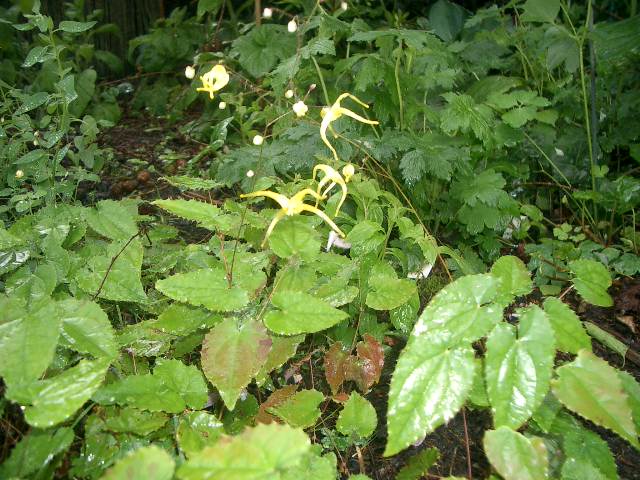
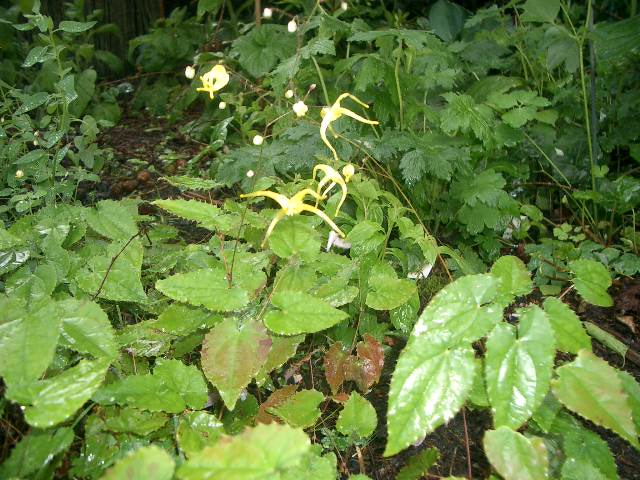
Epimedium davidii?

I am not sure if this actually is E.davidii but the combination of the yellow spider-like flowers and the glossy toothed leaves makes for a really useful plant. I had this in my mind as E.rossii but it could have been a case of word association as I knew someone called David Ross, who knows? E.davidii is from China and therefore prefers moist conditions although, again, the plant pictured, which thrived, was growing in fairly dry shade.

Epimedium grandiflorum ‘Lilafee’

E. grandiflorum ‘Lilafee’ is a cultivar from the same stable as ‘Orangekonigin’. The lilac coloured flowers are suspended over glossy leaves with toothed edges, seems to grow best in moist conditions.

Epimedium x versicolor ‘Sulphureum’

Delicate flower spikes over copper foliage which tends to green up during the summer only to revert to copper again as winter approaches. Although evergreen the foliage does tend to look rather tatty by the spring.

Epimedium x youngianum Niveum AGM

Neat little plant growing to about 8″, delicate pure white flowers hang off wiry stems which are reddish in colour. prefers a moist spot to thrive. The new leaves can give some good colour.

It is a matter of preference when or if one decides to remove the old foliage, personally I prefer to leave it on until the spring and then remove it just as the new foliage and flower stems are appearing being careful not to cause any damage to the new growth. This allows a good view of the flowers and the colours of the new leaves, leaving the foliage intact can detract from the display in some types which carry their flowers closer to the base of the plant.

Some New Additions

In my new front garden I added quite a few plants last year as plugs and a few bulbs. Unfortunately we did get some frost damage a couple of weeks ago on some of the plants I brought with me.

Tetrapanax papyrifer

Every Acer I have was damaged but none of them too severely, where I lived before late frost damage was not a feature although I suspect the unexpected warm spring bringing the plants on was the culprit this year. Some of last year’s plugs, bulbs and young plants have come on well from last year, here a few examples.

Geum ‘Cosmopolitan
Geum ‘Cosmopolitan’ (Cocktails Series)

Since the plant breeders have really concentrated on geums some marvellous colour combinations have been produced.

Geranium Johnson’s Blue

Geraniums are one of my favourite plants, the majority are as tough as old boots and I have grown many varieties in the past and have already quite a few among my new purchases and have actually sown seed of some of my favourites this year.

Helianthemums

Grown from plugs last year along with Phlox subulata for some quick bright colour.

Papaver Orientale Royal Wedding

Grown from plugs, the plants themselves need another year to properly settle down and are a bit tatty nevertheless they have produced some nice flowers.

Lupinus Tequila Flame

Again grown from plugs this lupin strain, bred in this country has been a revelation in terms of both growth and colour.

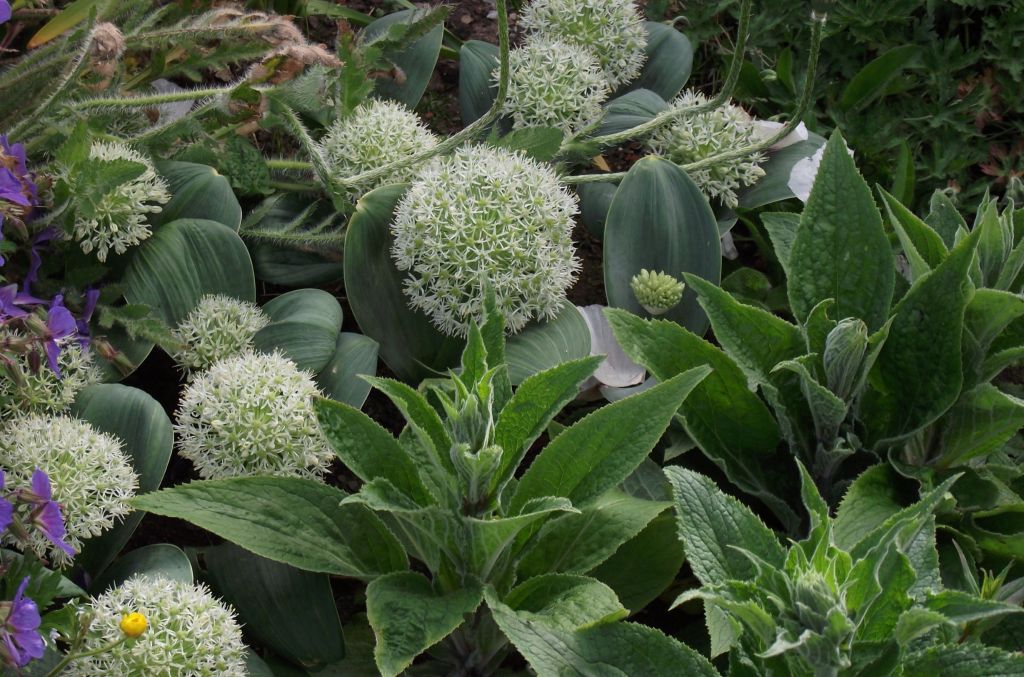
Allium karataviense Ivory Queen

Very pleased with this bulb as it gives a really nice combination between the white flowers and the gunmetal leaves, I hope it comes strongly again next year.

More spring colour

After a change in the weather has brought grey skies and some rain and drizzle as if things weren’t depressing enough! I took a walk, just before the weather broke, round my local park which is actually a piece of land, including woodland, which was purchased by the village to honour the fallen of the First World War. most of the trees are only just beginning to break leaf but there were a few patches of lovely blossom.

The weather has now become more settled and despite some very cold east winds, has remained mainly dry with the promise of some higher temperatures to come. I am lucky in that these pictures were taken a ten minute walk from where I live.

Wild Garlic

A patch of wild garlic amongst the trees with its distinctive onion scent that can be picked out a good distance away. Back to the plants on my next post.

My spring flowers

I have already had some crocus and iris in flower this year but for the purpose of my new blog here are some plants which are in flower this week.

Narcissus Jetfire

I love daffodils and narcissus, there something about them that really heralds spring, although there are quite a few plants that are in flower earlier they still steal the show for me. This year with the cold spring they seem to have lasted longer than usual.

Narcissus Lemon Beauty
Narcissus Pink Wonder

Personally I always deadhead, let the foliage die down naturally and, if I remember, feed with a high potash liquid feed such as Tomorite.

Amongst the springtime greens and yellows the plugs I planted last year add a splash of bright colour. Heucheras are fairly forgiving given sun and a reasonable soil but will not tolerate overcrowding.

Heuchera var.
Heuchera var.

Reliable easy to grow alpine phlox, almost garish colours provide a real splash. Best grown in a sunny spot on fairly poor but well drained soil. The thing to remember about most “rock dwellers” is that they don’t need a rich medium to grow well and will grow “soft” and not flower well if overfed.

Geum is one of my favourite genera other than the weed Geum urbanum which had become a real pest in my last garden. There are plenty of cultivars available now as the genus has become a popular subject for plant breeders. Although many are very showy the one pictured below is quite muted. They are tolerant of shade and will grow in even fairly poor soils, not only that many have a very long flowering period.

Geum Tequila Sunrise

Here’s to the next time!

Return to the Web

After an absence of over a year in which time I have moved to a much smaller property at a slightly higher elevation I have decided to return to the world of blogging.

The garden I have now consists of two small plots at the back and front of my little bungalow respectively which is quite sufficient for my needs today. My intention is to fill the new areas, which are minuscule compared with my last garden, with as many plants as possible and to this end I am first going to plant a number of “basic” genera to give points of interest and some kind of framework followed by bringing in my more specialised plants next year.

The front garden I inherited had a few nice plants and a patch of grass in the middle which I covered with several tons of topsoil and planted out, mainly using plugs, to form a country garden effect incorporating roses, which did not grow well in my last garden because of the damp conditions, and a few climbers and shrubs. This year it should come to fruition and is showing signs of being quite successful.

The back garden however is a totally different proposition, the garden has been stripped right back to the original soil level which in turn has been covered in limestone chippings and flags. Most of the flags have been removed, a basic layout has been achieved and quite a few plants have been introduced however planting with a pick and my favourite trenching spade was not easy!

Because of the limited scope of the new garden it is now my intention to use this blog to describe many of the plants that I have grown and my experience with them rather than a formulaic list. To keep things moving along I also expect to give interim reports on the new garden as it develops plus some diversification into the area of pubs and steam trains when we are allowed to live again.