Temperatures are remaining around 20°C which rather suits me. I am writing this on Friday and we are expecting heavy rain later which is much needed. The garden has really filled out now and I can hardly move for plants. Which is making it difficult to get to any weeds without treading on things I’d rather not. A mixed bag this week of plants I can name, and those I can’t.
Update 6.00am Saturday. As always, it seems, the promised heavy rain went north of us. When I looked out this morning everywhere was dry! More heavy rain forecast for early morning tomorrow. Fingers crossed.
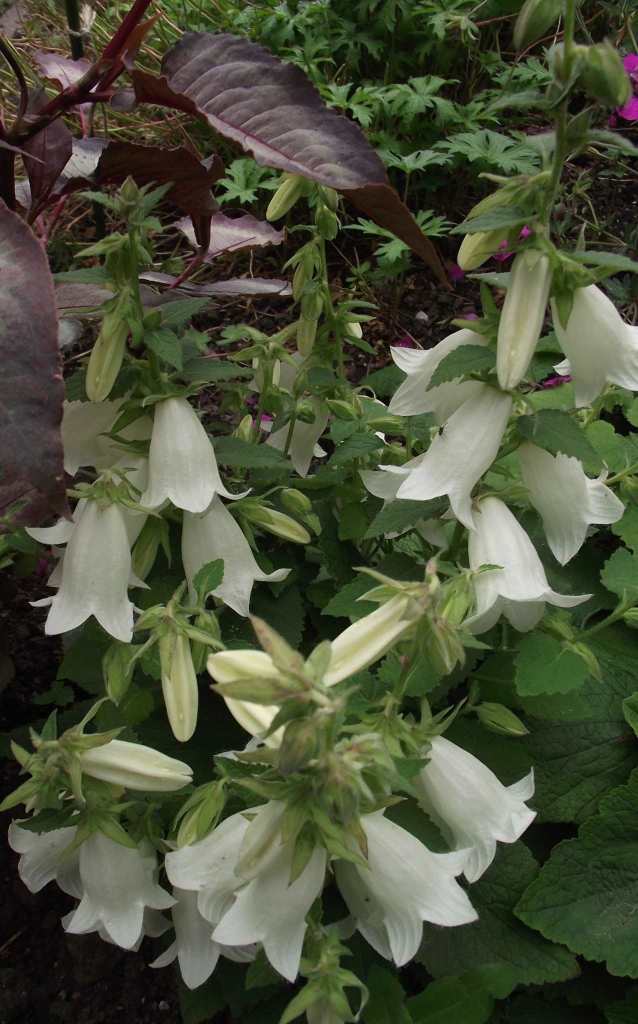
This little campanula is from a packet of seed labeled large white flowered. The flowers are white and also large for the plant, which is typical of campanulas. The plant itself however, is less than a foot tall. It reminds me very much of Symphyandra hoffmannii which I used to grow.
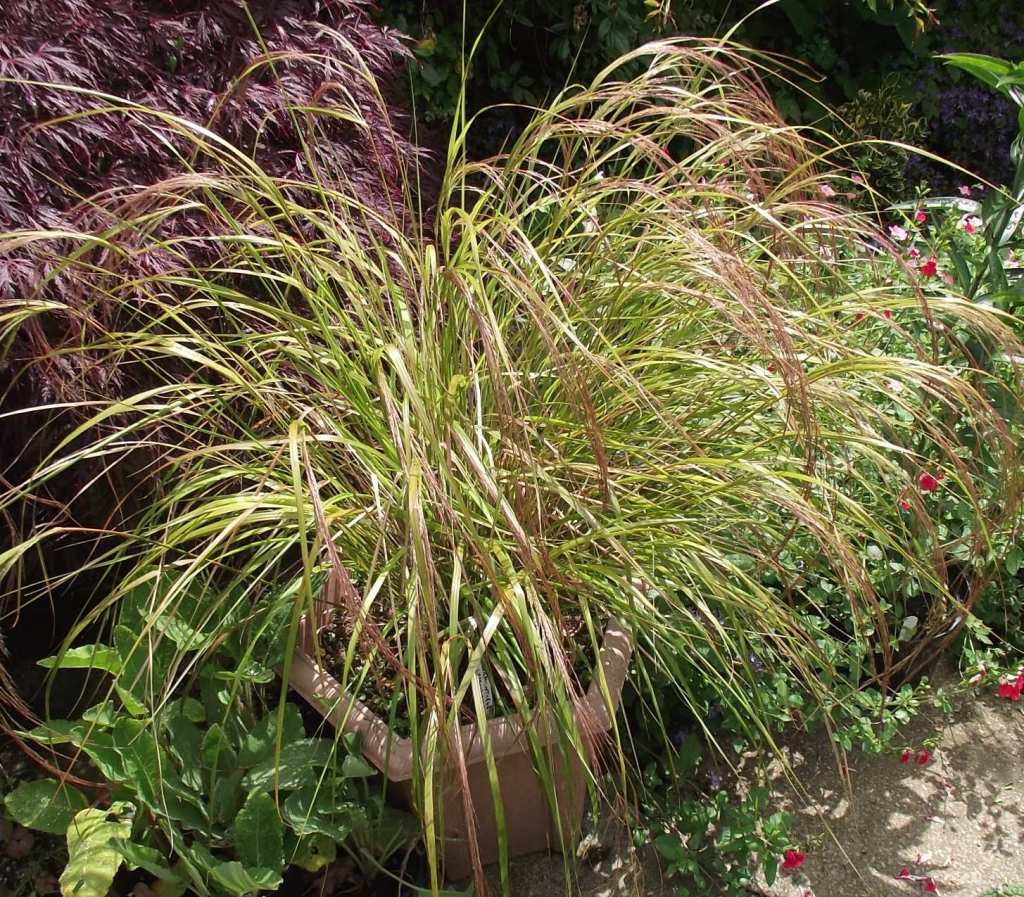
I am not a great fan of grasses but I find Anemanthele lessoniana, the pheasant tail grass outstanding. Unfortunately the picture doesn’t capture the effect of it glinting in the sunlight as it does. It will carry on throughout the year with the leaves taking on yellow, orange and red streaks towards winter.
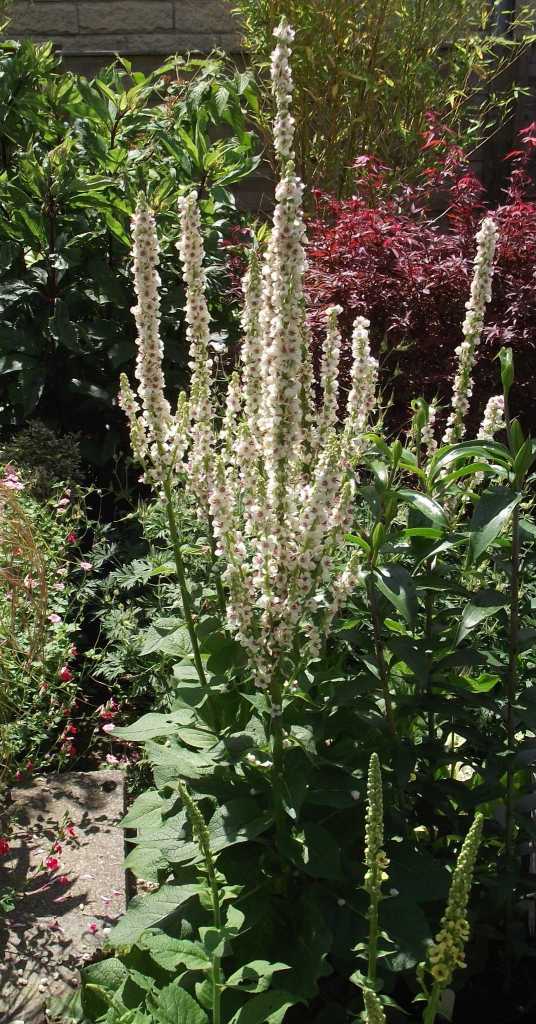
This white, self-seeded verbascum has improved year on year. I know the wild plant is somewhat looked down on as a weed but I find them rather attractive. A big plus is that they are constantly visited by numerous bees. Both the white one, and the smaller yellow one, in the foreground, originated from a packet of mixed verbascum seed, but these plants have seeded themselves, into the paving, from elsewhere in the garden.
Primula x bulleesiana showing fasciation. This is one of the few botanical “coveralls” that I can relate to. x bulleesiana is obviously the combination of bulleyana and beesiana. Fasciation is quite common in primulas, particularly the candelabra types. There seems to be a myriad of things that can cause it from genetic mutation to viral or insect damage, which means, I think, that nobody is really certain.
Another plant that has seeded itself into the garden. This rather neat astrantia has been with me for several years now, and I have just left it alone to do its thing.
The first lily flower this year from a pot I have had for years, so, naturally I have lost the label! At a guess, I think it could be Lilium ‘African Queen’ a Lilium longiflorum hybrid. But please don’t take my word for it!
This meme is hosted by Jim Stevens who is to be found with all the details and links to plenty of other blogs to enjoy at Garden Ruminations.
Sisymbrium luteum is a member of a small genus of plants in the brassica family and is basically a mustard. Grown from a “lucky-dip” batch of seeds out of curiosity, I think it is an American species and grew well in standard border soil and conditions, probably more of a field plant in the wild.
Stachys
Stachys recta?
Stachys is a large genus probably the most familiar members being S.byzantina and S.lanata known as Lamb’s Ears which are evergreen carpet forming plants with woolly leaves. The plant illustrated was grown from seed labelled S.recta however the problem is that S.recta is the Yellow Woundwort! Other members of the genus include various Hedge-nettles and Betony. When it comes to cultivation most seem able to grow in fairly poor dry conditions.
Strobilanthes
Strobilanthes wallichiiStrobilanthes wallichii
A member of a genus that is widespread throughout Asia, Strobilanthes wallichii or the Hardy Persian Shield is a Himalayan plant which thrived in my “woodland garden”. One of the few plants producing such intense blue flowers it is a welcome late-flowering addition to any garden.
Stylophorum
Stylophorum lasiocarpumStylophorum lasiocarpum
Stylophorum lasiocarpum, the Chinese Celandine Poppy is a biennial or short lived perennial from Central China. The flowers don’t last but I find the tapering seed pods fascinating, when they eventually ripen the seeds are ejected explosively. Best grown in moist soil in sun or partial shade.
Symphyandra
Symphyandra hoffmannii
Symphyandra hoffmannii is a rather beautiful member of the campanula family from the Balkans. This biennial or short-lived perennial is rarely seen but is easy to grow and sets copious amounts of seed to the extent, if left to its own devices, it is capable of producing great drifts of flowers which are both long-lasting and go on to late in the season. A real gem.
Sysrinichium
Sysrinichium striatum
Sysrinichium striatum is an American member of the Iris family which has a variety of common names such as pale yellow-eyed grass because of its narrow leaves giving it a grass-like appearance. It is actually rhizomatous and as one would expect prefers a well-drained soil in a sunny spot to thrive.
Telekia
Telekia speciosa
Telekia speciosa sometimes known as the yellow ox eye is a superb plant for the back of the herbaceous border. A rhizome forming plant it is easy to grow in any good border soil and reasonable aspect. The subject above looked particularly striking with the background cotinus for contrast.
Tradescantia
Tradescantia x andersoniana
Tradescantia is probably a genus more associated with house plants known as spiderworts such as T.zebrina and T.pallida however one species makes an attractive border plant. Tradescantia x andersoniana is the group classification for a range of cultivars that have been developed by the plant breeders. They are all easy to grow in well drained soil in sun or partial shade. Note the generic characteristic of three petals.
The toad lilies originate from Japan and Taiwan (T.formosana) they are best suited to shady areas in a rich moist acidic soil and will in fact tolerate quite heavy shade. They thrived in my “woodland garden” their rhizomes spreading well. One can’t help but be fascinated by the exotic orchid-like flowers being produced on such a tough little plant.
Trilliums are beautiful spring-flowering plants from Asia and the United States. The name is self-evident three petals being born above three leaves makes them very distinctive. They are another woodland subject and thrive in the same conditions as tricyrtis, once planted best left alone as they are not fond of being disturbed. In the wild T.grandiflorum, in particular, forms huge drifts in deciduous woodland.
The mulleins are a large genus of mainly biennial and perennial plants which are both easy to grow in any good to poor soil in a reasonably sunny position. Although they are native to Europe and Asia V.thapsus is now in fact a familiar field weed in some states in America. They are all easy to raise from seed and some of the big ones such as the biennial Verbascum ‘Arctic Summer’ are definitely a talking point with their large woolly leaves and 6′ flower spikes. To be honest a favourite of mine.
Verbena
Verbena bonariensis
We are all familiar with the summer bedding and trailing verbenas but Verbena bonariensis is now listed in most of the main online catalogues as a wonderful go-to plant which I don’t think is entirely accurate. I admit it is quite exceptional in many ways but illustrates everything I hate in the horticultural industry of which it is not the only example. I have grown this in my shaded garden with little success which is what I would expect as in reality it will only do well in light soils in a sunny position along with many other plants particularly those included in the prairie planting trend. It is easy to grow from seed but although it is perennial I would expect it to be short-lived in other than ideal conditions.
Vinca
Vinca major variegata
There are basically two forms of the periwinkle grown V.major and V.minor both make excellent if somewhat rampant ground-cover plants. Tolerant of most conditions they are a stalwart for weed suppression under shrubs or even roses. There are white flowered forms available a particularly good one being Vinca minor f. alba ‘Gertrude Jekyll’.
I have only photographed pansies in views of bedding or baskets but here are a few violas I have grown. It is impossible to cover the subject here as it is so far wide ranging including some delightfully scented specimens. Basically easy to grow, versatile and rightfully popular.
Book reviewer and garden enthusiast. Updates from my Hampshire garden. Usually talking about books and plants. People do not forget books or flowers that touch them or excite them—they recommend them.



 A Plantsman's World