
First, let me identify just where I stand on matters of climate change and the response to it. The reason I am stating this is because the whole issue of banning peat is now inexorably linked to the so called “climate crisis”. The climate is changing, it always has, but I have the advantage of being lucky enough to be of an age to have had an education that taught me to think for myself, not what to think, which seems to have been the case for the last forty years and even more apparent since the turn of the century. The way I see it is that the whole question has become politicised, and some people are making a lot of money out of a narrative which is now completely divorced from the science.
For anyone reading this outside the UK it must be difficult to comprehend that the sale of peat is related to the actions taken by UK governments in the name of the “climate crisis”. Other than Germany mulling over proposals to limit the extraction of peat, the UK’s response is unique in the western world. For some reason, probably because we are now world leaders in very little, the UK governments have decided they must lead the world in tackling climate change, the fact that we contribute less than 2% of the world’s CO2 emissions doesn’t seem to have occurred to them.
Originally it was planned for the sale to the general public of bagged peat products to be banned from 2024, a typical response from an NGO by Ailis Watt, peat policy officer at The Wildlife Trusts is:
“Today’s announcement is bitterly disappointing. Last year we welcomed the news that the UK Government would ban the sale of bagged peat compost in England by the end of 2024. The Wildlife Trusts hoped that a ban on all peat products would follow shortly after this date.”
UK Government confirms ban on all peat-based gardening products will not be implemented until 2030
Today, Defra (Department for Environment Food and Rural Affairs) has confirmed that while some peat-containing products will be banned from shelves in 2027, others will be exempt from a ban until 2030.
Ailis Watt continues:
“The decision to allow the sale of peat-containing products to continue until 2030 does not reflect the value of peatlands – here and abroad – and is at odds with this Government’s manifesto commitment to ‘deliver the most ambitious environmental programme of any country on earth’.
“It contradicts the notion that gardening is an activity which is beneficial to nature and places a burden of responsibility on the consumer to ensure they are not inadvertently buying environmentally destructive peat-based products.”
The Wildlife Trusts estimate that policy failure to stop peat extraction has caused up to 31 million tonnes of CO2 to be released since 1990.
80% of the UK’s peatlands are now degraded as a direct result of damaging practices such as drainage for agriculture, burning and peat extraction for horticulture. Peatlands are important for biodiversity, home to a host of highly specialised and rare species – from the carnivorous plant, sundew, to Red-listed birds as well as reptiles, amphibians, insects and mammals. It is the lack of protections afforded to habitats like peatlands which has propelled the loss of almost 50% of the UK’s biodiversity.
Peatlands are also crucial carbon stores, locking away over three billion tonnes of carbon in the UK alone. However, when peatlands are damaged, this carbon is released. Today, emissions from peatlands make up 4% of all UK annual greenhouse gas emissions, and the UK is a world leader in emissions from degraded peatlands. To put this into context, every year emissions from degraded peatlands are equivalent to the carbon footprints of over 1.9 million British citizens.*
*Thursday 23 March 2023. The Wildlife Trusts’ website.
I could dissect much of this statement and show it, at best, to be misinformation, but that is not the point I am making. The Wildlife Trusts’ focus should be on wildlife but the card isn’t strong enough, so like many others of their ilk the focus is switched to climate change which is definitely not their core doctrine. I wholeheartedly agree with Kenneth Cox director of Glendoick Gardens when he says:
“The RHS, National Trust RBG, Kew & Edinburgh and other influential organisations, as well as TV presenters such as Monty Don should have a little more courage than simply to jump on this bandwagon. Instead they should appraise themselves of the facts and have the courage to portray both sides of the argument. Rather than condemn peat they should explain the facts and defend the sustainable and sensible of peat. At the moment the only reduction in peat seems to be in sales of bags marked ‘peat’. If the bag says ‘multi-purpose compost’ or ‘ericaceous compost’ it sells as well as ever. Such bags usually contain 40-90% peat.
Many well informed gardeners and writers such as Peter Seabrook and the best selling author Dr Hessayon (author of the ‘Expert’ series) take a pragmatic view. Dr Hessayon writes: ‘don’t use peat as for overall soil improvement- it is not efficient and garden compost and manure will do a much better job. However moss peat has a role to play in planting and seed composts where there are no substitutes of equal merit’ (The Bedside Book of the Garden)” *
*Peat Policy at Glendoick Gardens
The demonization of CO2
There seems to be a train of thought which has developed over the last 20 to 40 years that has been etched into the psyche of western society, aided by our controlled media and education system. It looks something like this: Climate crisis >global warming> greenhouse gases >CO2. The question is: Why is having a greater concentrations of Co2 in the atmosphere a bad thing, as gardeners we all know Co2 is the proverbial staff of all life.
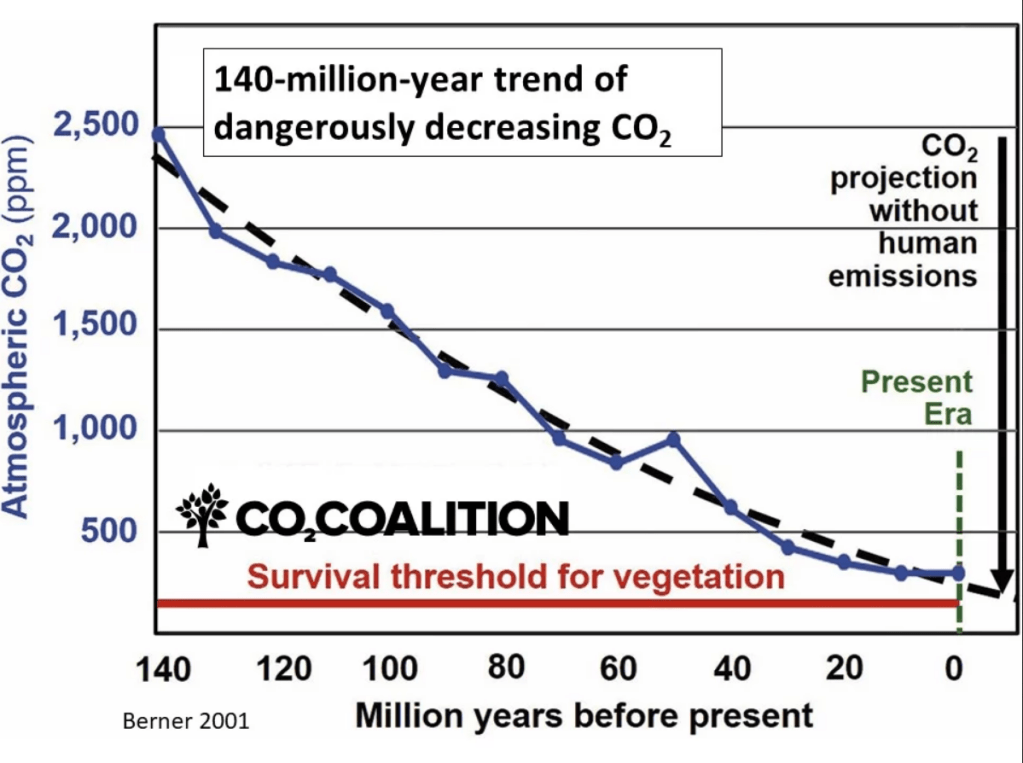


Before climate science became politicized, warm periods were referred to by scientists as “climate optima” because, for almost all species on Earth, warmer is better than colder. The most dramatic advances in civilization took place during the last four warm periods—including our own. The advancement of science, technology and the arts have been directly linked to warmer weather. The warming, which made possible an abundance of food, freed the population from its preoccupation with daily survival to do other things. It led to cultural development, something impossible during the cold periods. These prosperous warm periods were followed by declining temperatures with names like the Greek Dark Ages, the Dark Ages and the Little Ice Age. These were times of great despair as the Earth plunged into global cooling that featured crop failure, famine and mass depopulation. Make no mistake; bad things happen during cold periods, very bad things.
This data is from Greenland ice cores where temperatures are extremely cold.
*CO2 Coalition.
The conclusion that I draw from the available science is that CO2 levels do not pose any immediate or even long term threat to the planet particularly as:
“Climate scientists have determined, and both sides agree, that the warming effect of each molecule of CO2 decreases significantly (logarithmically) as its concentration increases. This is one reason why there was no runaway greenhouse warming when the concentration of CO2 was approaching 20 times that of today. This inconvenient fact, important though it is, is kept very well hidden and is rarely mentioned, for it undermines the theory of future catastrophic climate change. Diminishing returns apply.”*
*CO2 Coalition.
Leaving aside the arguments about the CO2 effect, and coming back to the actual amount of peatlands that are affected by commercial extraction here is a breakdown of the areas of peatlands in the UK and their current status expressed as percentages.
Peatland covers around 3 million hectares in this country:
- 22% of the total peatland area remains in a near-natural condition, comprising undrained bogs and fens
- 41% of the UK peat area remains under semi-natural peatland vegetation, but has been affected by
human activities including drainage, burn-management, livestock grazing and the cutting of peat for fuel - 16% is covered by woodland, the majority of which is drained conifer plantation
- 15% is occupied by agricultural cropland and grassland, mainly in lowland regions of England such as the Fens, Norfolk Broads, Manchester Mosses and Somerset Levels
- Industrial peat extraction for horticultural use occupies 0.15% of UK peatland, mostly on lowland raised bogs.*
*UK Centre for Ecology & Hydrology.
Yes, that’s right, 0.15%, so out of 3,000,000 hectares of peatlands only around 4,500 hectares are used for industrial extraction. All that government effort, not to mention money, going into penalising the horticultural industry and primarily you, the gardener. What about those bogs that are in need of protection? In fact the majority already are protected, that’s how the movement started before it got out of hand. To balance things out, there are now several government schemes to aid the restoration of those bogs which have been degraded, however, to be honest, the sums dedicated to these schemes are not very impressive.
Having read the actual figures again, I can no longer resist commenting on how this information has been misrepresented, for example, in the statement from The Wildlife Trusts. “80% of the UK’s peatlands are now degraded as a direct result of damaging practices such as drainage for agriculture, burning and peat extraction for horticulture.” peat extraction for horticulture right up there with the worst of them yet only 0.15%! Another interesting quote from the same source is the allusion to other countries: “The decision to allow the sale of peat-containing products to continue until 2030 does not reflect the value of peatlands – here and abroad.” yet countries like Sweden have a sound peat harvesting policy and the UN Intergovernmental Panel on Climate Change has changed the classification of peat from a ‘fossil fuel’ to a ‘renewable biomass resource’ in recognition that peat can indeed be harvested and cultivated sustainably. In November 2000 the European Parliament amended Article 21 of the Council Directive on the promotion of electricity from renewable energy sources in the international electricity market, adding peat to the list of renewable energy sources. From the same source, I am not sure what “the UK is a world leader in emissions from degraded peatlands.” even means. In Southeast Asia, in particularly Indonesia, the draining of peat bogs for agricultural use has led to many catching fire and releasing massive amounts of CO2 into the atmosphere, the UK’s peatlands contribution is minimal in comparison. It is also worth noting here that the very high release of CO2 only comes with draining and burning.
In conclusion what has happened to lead to the vilification of peat is similar to that of Co2, a minority opinion, not even good science, has been politicised and the establishment have run with it for whatever reason until it has achieved cult status. I sometimes wonder if this is the result of a society which suffers from an indolent aimlessness until it is given something that it can easily focus on with little or no effort and feel good about itself, or, maybe, it’s just a good business opportunity?
References and Reading
Co2 Coalition for all things CO2 (here)
Peatlands factsheet (here)
The go to webpage for a balanced approach: Peat Policy at Glendoick Gardens (here)
Bunny Guinness – For Peat’s Sake – Don’t Deprive UK Gardeners. (here)
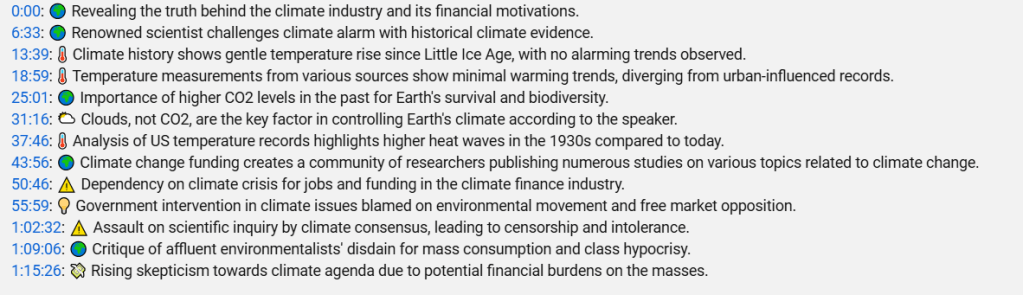
YouTube video, explaining the multi-trillion dollar climate crisis scam, how it evolved and how it is maintained. The scientists who appear in this film are at the top of their game, including a Nobel Prize winner. They, quite simply, have no longer anything to fear from the establishment so can speak out.
Some of you may well disagree with what I have set out here, and you are welcome to make any constructive comments, however, please read and watch all the material listed before doing so. Thank you.

Latest research paper, news letter from the CO2 Coalition: How in the world did this new temperature reconstruction get past the Climate Industrial Complex’s censor machine?

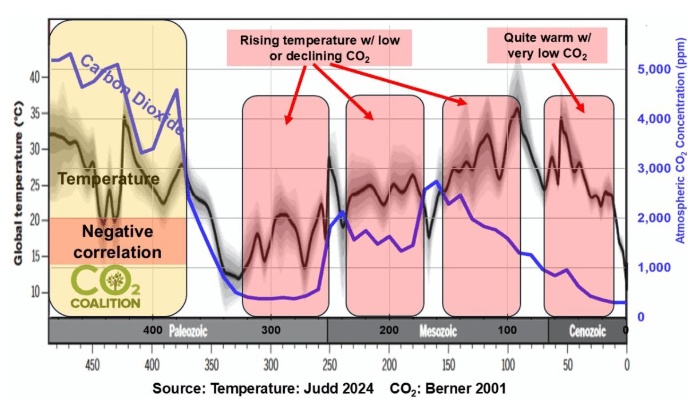
The recent publication by Judd et al looked at nearly half-a-billion years of global surface temperatures and found that, rather living in a time of extraordinarily high temperature, we are in a period of near-historic lows. In fact, the global temperature peaked 100 million years ago at about 96.8oF (36oC) which was 37.8oF (21oC) higher than the temperature for 2023 (59oF and (15oC)! The inconvenient fact for the climate alarmists is that Earth’s temperature has been in a 50-million-year decline.
We then compared this data to long-term CO2 data (see below) and found that CO2 and temperature don’t correlate very well at all.


Thanks for sharing this, I’ll read the info!
LikeLike
Thanks Tracy, I would be extremely interested in any comments you may like to make. There is some correspondence on my previous post regarding this.
LikeLike